


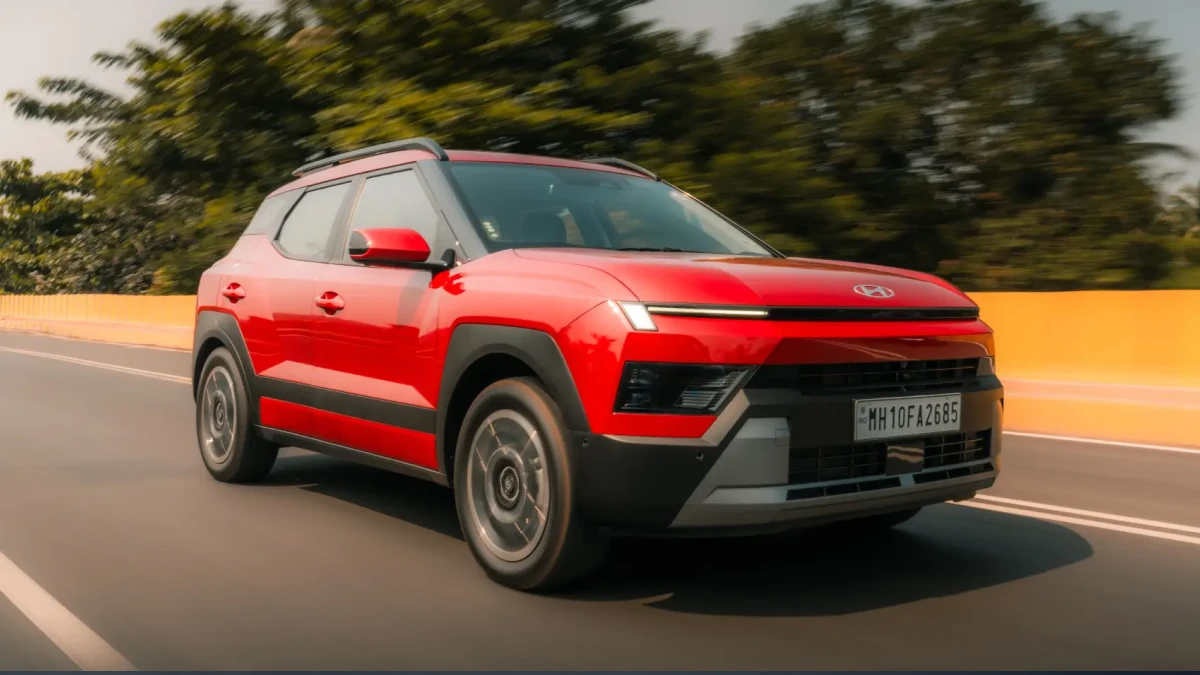
Hyundai has added another interesting option to its Indian SUV portfolio with the Bayon. Positioned between the Venue and Creta, the new SUV targets buyers who want something more spacious and feature-rich than a conventional compact SUV without moving into a higher price bracket.
Starting at ₹9.99 lakh, the Hyundai Bayon brings a distinctive exterior design, a digital cabin with dual 12.3-inch displays, ventilated front seats, a 360-degree camera and an extensive driver-assistance package. It also introduces generative AI-powered voice assistance, connected technology and over-the-air software updates.
Under the bonnet, the Bayon uses Hyundai’s familiar 1.5-litre naturally aspirated petrol engine, offered with a manual gearbox and an IVT automatic. While its equipment list looks impressive, the driving experience has received mixed impressions from the first-drive reviews.
So, does the Hyundai Bayon have enough to stand out against the Venue and Maruti Suzuki Victoris? Here is a closer look at its design, interior, technology, safety, performance and practicality.
Hyundai Bayon: Key Details at a Glance
| Specification | Hyundai Bayon |
|---|---|
| Starting Price | ₹9.99 lakh (ex-showroom) |
| Segment Positioning | Between Venue and Creta |
| Engine | 1.5-litre naturally aspirated petrol |
| Maximum Power | 115 PS |
| Peak Torque | 143.8 Nm |
| Transmission | 6-speed Manual / IVT |
| Driving Modes | Eco, Normal and Sport |
| Length | 4,245 mm |
| Wheelbase | 2,600 mm |
| Ground Clearance | 205 mm |
| Boot Space | Up to 505 litres |
| Infotainment | 12.3-inch touchscreen |
| Driver Display | 12.3-inch digital display |
| ADAS | Level 2+ Pro ADAS, up to 23 functions |
| Connected Technology | 70+ Bluelink features |
| Voice Assistant | Generative AI-powered assistant |
Specifications and features are based on the reviewed vehicle and published first-drive reports. Equipment may vary by variant.
Hyundai Bayon Design: A Different Approach to SUV Styling
The Hyundai Bayon takes a noticeably different design direction compared with the familiar Venue and Creta. Rather than following the conventional tall and upright compact SUV shape, it gets a wider, lower stance with sharp body lines and prominent black cladding.
Hyundai’s Art of Steel design language gives the Bayon a distinctive appearance. At the front, the H-Edge LED daytime running lights are among the most recognisable elements. They are accompanied by dual LED projector headlamps, a sculpted bonnet and sharp detailing around the front fascia.
The side profile features prominent character lines, flared wheel arches and machined 17-inch alloy wheels on the top-spec version. Black body cladding runs around the vehicle, giving it a more rugged appearance.
At the rear, the wide haunches and roof spoiler contribute to its road presence. The high-mounted stop lamp is integrated into the spoiler, while the design avoids the connected tail-lamp treatment seen on several recent SUVs.
The Bayon is available in six monotone colours, two dual-tone options and two matte finishes, according to the review coverage. The exterior colour selection also influences the interior colour theme.
Overall, the Bayon’s styling is likely to appeal to buyers who want something visually different from the more familiar compact SUV designs.
Hyundai Bayon Interior: Dual 12.3-Inch Screens and a Premium Cabin
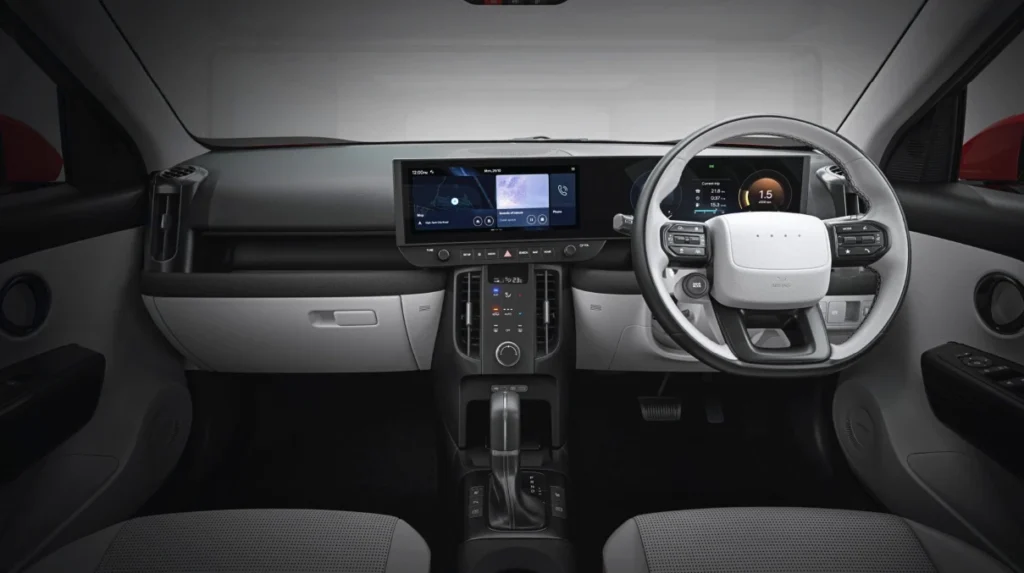
The cabin is one of the Bayon’s strongest areas. Hyundai has equipped it with a dual-screen arrangement consisting of a 12.3-inch infotainment touchscreen and a 12.3-inch digital instrument display, housed together in a curved panoramic-style dashboard layout.
The dashboard uses a combination of soft-touch elements, fabric inserts and leatherette upholstery to create a more premium atmosphere. Ambient lighting and a panoramic sunroof further improve the cabin experience.
Importantly, Hyundai has retained physical controls for frequently used functions such as volume and climate control. This makes everyday operation easier without requiring the driver to navigate touchscreen menus for basic adjustments.
Hyundai Bayon interior features
| Feature | Availability / Details |
|---|---|
| Infotainment Screen | 12.3-inch touchscreen |
| Digital Instrument Cluster | 12.3-inch display |
| Android Auto | Wireless |
| Apple CarPlay | Wireless |
| Audio System | Bose premium audio with subwoofer |
| Front Seats | Ventilated |
| Driver Seat | Powered |
| Wireless Charging | Available |
| Climate Control | Automatic |
| Parking Assistance | 360-degree camera |
| Interior Lighting | Ambient lighting |
| Sunroof | Single-pane electric or panoramic option |
| Connected Technology | Bluelink with OTA updates |
| Dashcam | Inbuilt dashcam |
The Bayon also gets built-in navigation, an auto-dimming inside rear-view mirror, electronic parking brake and rear AC vents.
However, it misses out on some features such as a head-up display and powered tailgate, according to the TopGear India review. Buyers should check the equipment list of their preferred variant before making a booking.
Rear Seat Comfort and 505-Litre Boot Space
Space and practicality are important parts of the Bayon’s appeal. Despite being shorter than the Maruti Suzuki Victoris, the SUV has a 2,600mm wheelbase, which helps provide a spacious passenger cabin.
The rear seats offer good legroom and headroom, while the reclining function adds comfort on longer journeys. Rear passengers also get adjustable headrests, a centre armrest and a Type-C charging port.
The Bayon’s boot capacity is rated at up to 505 litres, making it one of the notable practical features highlighted in the first-drive reviews.
| Practicality Detail | Hyundai Bayon |
|---|---|
| Overall Length | 4,245 mm |
| Wheelbase | 2,600 mm |
| Boot Capacity | Up to 505 litres |
| Rear Seat Recline | Yes |
| Rear AC Vents | Yes |
| Rear Centre Armrest | Yes |
| Rear Type-C Charging Port | Yes |
The boot’s squared-off shape makes it useful for carrying luggage. In the TopGear India review, the boot accommodated three cabin-sized suitcases and three smaller backpacks.
This combination of rear-seat comfort and luggage capacity could make the Bayon an interesting option for families who regularly travel together.
Hyundai Bayon Technology: Generative AI Voice Assistant and OTA Updates
Technology is one of the most significant talking points of the Hyundai Bayon.
The SUV introduces a generative AI-powered voice assistant using technology from Perplexity and SoundHound AI. The system is designed to support more natural conversations and provide responses using real-time information and situational context.
The vehicle also supports more than 500 embedded voice commands across multiple regional languages.
Hyundai Bayon technology highlights
| Technology | Details |
|---|---|
| Generative AI Voice Assistant | Powered by Perplexity and SoundHound AI |
| Embedded Voice Commands | 500+ |
| Regional Language Support | Multiple languages |
| Bluelink Connected Features | 70+ |
| Over-the-Air Updates | Updates for up to 19 controllers |
| Navigation | Built-in navigation |
| Smartphone Connectivity | Wireless Android Auto and Apple CarPlay |
| Audio | Bose system with subwoofer |
The OTA update capability is particularly relevant because it allows supported vehicle systems to receive software updates without requiring every update to be carried out at a dealership.
The combination of connected features, voice commands and a modern digital cabin gives the Bayon a technology-focused identity in its segment.
Hyundai Bayon Safety: Level 2+ ADAS With Up to 23 Functions
Safety technology is another major part of the Bayon’s equipment package.
Hyundai offers its Level 2+ Pro ADAS suite with up to 23 autonomous assistance functions. These include features such as navigation-based adaptive cruise control, designed to assist the driver in different traffic and road situations.
The SUV also gets a 360-degree camera, blind-spot alerts and blind-spot monitoring.
Hyundai Bayon safety and assistance features
| Safety Feature | Details |
|---|---|
| ADAS | Level 2+ Pro ADAS |
| ADAS Functions | Up to 23 |
| Adaptive Cruise Control | Navigation-based assistance |
| Parking Camera | 360-degree camera |
| Blind-Spot Assistance | Blind-spot alerts and monitoring |
| Vehicle Platform | Global K enhanced platform |
The Global K enhanced platform is described as being engineered for a five-star safety rating. However, this should not be confused with an independently awarded crash-test rating. Buyers should look for an official Bharat NCAP or Global NCAP result before treating the vehicle as having a confirmed five-star rating.
The extensive assistance package should make the Bayon attractive to buyers who prioritise driver support and parking convenience.
Hyundai Bayon Engine and Performance: Is the 1.5-Litre Petrol Enough?
The Hyundai Bayon is powered by a 1.5-litre, four-cylinder naturally aspirated petrol engine. It produces 115 PS and 143.8 Nm of torque.
Buyers can choose between a six-speed manual transmission and an IVT automatic. The SUV also gets Eco, Normal and Sport driving modes.
One additional feature highlighted in the RushLane review is Dash Boost mode, which is designed to improve acceleration response when the driver needs an extra burst of performance.
Hyundai Bayon engine specifications
| Engine Specification | Details |
|---|---|
| Engine Type | 1.5-litre naturally aspirated petrol |
| Cylinders | 4 |
| Maximum Power | 115 PS |
| Peak Torque | 143.8 Nm |
| Manual Gearbox | 6-speed |
| Automatic Gearbox | IVT |
| Driving Modes | Eco, Normal, Sport |
| Additional Feature | Dash Boost mode |
The driving impressions, however, are not entirely consistent across the reviews.
RushLane found the IVT-equipped Bayon responsive and enjoyable to drive, highlighting its light feel, composed handling and useful acceleration response. The review also noted that the suspension remained composed on Indian roads.
TopGear India’s first-drive assessment was more critical of the engine’s performance. It found the naturally aspirated motor less enthusiastic during acceleration and overtaking, with the driver needing to use lower gears and higher engine speeds to get the required response. It also noted that engine noise became more noticeable at higher revs.
These are subjective driving impressions from different reviews and potentially different driving conditions. The takeaway is that the Bayon appears better suited to buyers who value comfortable everyday driving than those looking for an especially sporty petrol SUV.
Ride Quality and Handling: Built for Everyday Comfort
The Bayon’s suspension is tuned to provide a comfortable driving experience. According to RushLane’s review, the SUV maintained a composed feel on Indian roads, with its suspension handling uneven surfaces without excessive body movement.
The 205mm ground clearance is another useful specification for Indian road conditions. It should provide a reasonable amount of clearance over speed breakers and uneven stretches, although drivers should still exercise caution on rough terrain.
TopGear India’s review also highlighted the comfort-oriented suspension setup but noted that some road noise could enter the cabin over rough surfaces. It also felt the rear of the vehicle could become light when driven more quickly through corners.
The overall impression is of an SUV designed primarily for comfortable city use and relaxed highway journeys rather than aggressive driving.
Hyundai Bayon vs Hyundai Venue: Which One Makes More Sense?
The Bayon sits between the Venue and Creta in Hyundai’s SUV portfolio, making a comparison with the Venue particularly relevant.
The Venue has an established reputation for combining compact dimensions, everyday usability and multiple powertrain options. The Bayon, on the other hand, focuses more heavily on cabin space, a distinctive design and a technology-rich feature package.
| Comparison Area | Hyundai Bayon | Hyundai Venue |
|---|---|---|
| Positioning | Between Venue and Creta | Compact SUV |
| Design | Wider, lower and more distinctive | More conventional compact SUV proportions |
| Engine in Reviewed Bayon | 1.5L NA petrol | Multiple powertrain options |
| Bayon Power Output | 115 PS | Depends on engine |
| Infotainment | 12.3-inch touchscreen | Variant-dependent |
| Digital Driver Display | 12.3-inch | Variant-dependent |
| Boot Space | Up to 505 litres | Variant/specification dependent |
| Key Strength | Space, technology and distinctive design | Familiar package and broader powertrain appeal |
The Venue may be the better choice for buyers who prioritise a more responsive driving experience and want a wider choice of powertrains. The Bayon makes a stronger case for those who value its cabin, luggage capacity and technology package.
Hyundai Bayon vs Maruti Suzuki Victoris: A New Competition
The Maruti Suzuki Victoris is another important comparison for the Bayon.
The two SUVs target buyers looking for a feature-rich family vehicle, but they approach the segment differently. The Bayon focuses on its digital cabin, ADAS technology, rear-seat comfort and distinctive styling.
The Victoris has a taller and longer-looking exterior profile, while the Bayon adopts a lower and wider stance. The TopGear India review notes that both have a similar wheelbase, making the Bayon’s interior packaging particularly interesting.
For buyers comparing the two, the decision will likely depend on the preferred design, powertrain requirements, feature priorities and final on-road price.
Should You Buy the Hyundai Bayon?
The Hyundai Bayon makes a strong case for itself through its equipment and practicality. Its dual 12.3-inch screens, AI-powered voice assistant, Level 2+ ADAS, ventilated seats and 505-litre boot give it a substantial list of talking points.
It also offers a different design direction from the Venue, which could appeal to buyers looking for something less conventional.
However, the naturally aspirated petrol engine may not satisfy everyone. The mixed first-drive impressions suggest that buyers who frequently overtake on highways or enjoy enthusiastic driving should take a proper test drive before choosing the Bayon.
The IVT automatic is likely to be the more convenient option for city commuters, while the manual may appeal to buyers who prefer greater control over gear selection.
Ultimately, the Bayon is worth considering if your priorities are space, comfort, technology and everyday usability rather than outright performance.
Frequently Asked Questions
1. What is the starting price of the Hyundai Bayon in India?
The Hyundai Bayon starts at ₹9.99 lakh (ex-showroom), according to the published first-drive reviews.
2. What engine does the Hyundai Bayon use?
The Bayon is powered by a 1.5-litre naturally aspirated four-cylinder petrol engine producing 115 PS and 143.8 Nm of torque.
3. Is the Hyundai Bayon available with an automatic gearbox?
Yes. The Bayon is offered with a six-speed manual gearbox and an IVT automatic transmission.
4. What is the boot space of the Hyundai Bayon?
The Hyundai Bayon offers up to 505 litres of boot capacity, making it a practical option for family use and luggage.
5. Does the Hyundai Bayon get ADAS?
Yes. It gets a Level 2+ Pro ADAS package with up to 23 assistance functions, including navigation-based adaptive cruise control.
6. Does the Hyundai Bayon get a generative AI voice assistant?
Yes. The Bayon features a generative AI-powered voice assistant using Perplexity and SoundHound AI technology. It also supports more than 500 embedded voice commands across multiple regional languages.
7. Is the Hyundai Bayon better than the Venue?
The Bayon offers a more spacious and technology-focused package, while the Venue may appeal more to buyers who prioritise driving performance and powertrain choices. The better option depends on individual requirements.
8. Does the Hyundai Bayon have a five-star safety rating?
The reviewed reports describe its Global K enhanced platform as engineered for a five-star rating. However, an independently awarded crash-test rating should be confirmed through an official NCAP assessment.
Final Verdict
The Hyundai Bayon is an interesting addition to the Indian SUV market. It combines distinctive styling with a spacious cabin, a large boot, modern connectivity and an extensive safety-assistance package.
Its 1.5-litre petrol engine is familiar, but the driving experience may not be equally appealing to every buyer. While one review found the IVT version responsive and comfortable, another felt that the engine lacked the urgency expected during overtaking.
For buyers who want a technology-loaded SUV with family-friendly space and a distinctive road presence, the Bayon deserves a place on the shortlist. Those who prioritise performance should compare it directly with the Venue and other alternatives before making a decision.
The Bayon’s biggest strength is not outright speed. It is the combination of space, comfort and technology it brings to the segment.

1 Comment
Pingback: Hyundai Bayon Launched at ₹9.99 Lakh: Variants, Features, Mileage & CNG Plans