


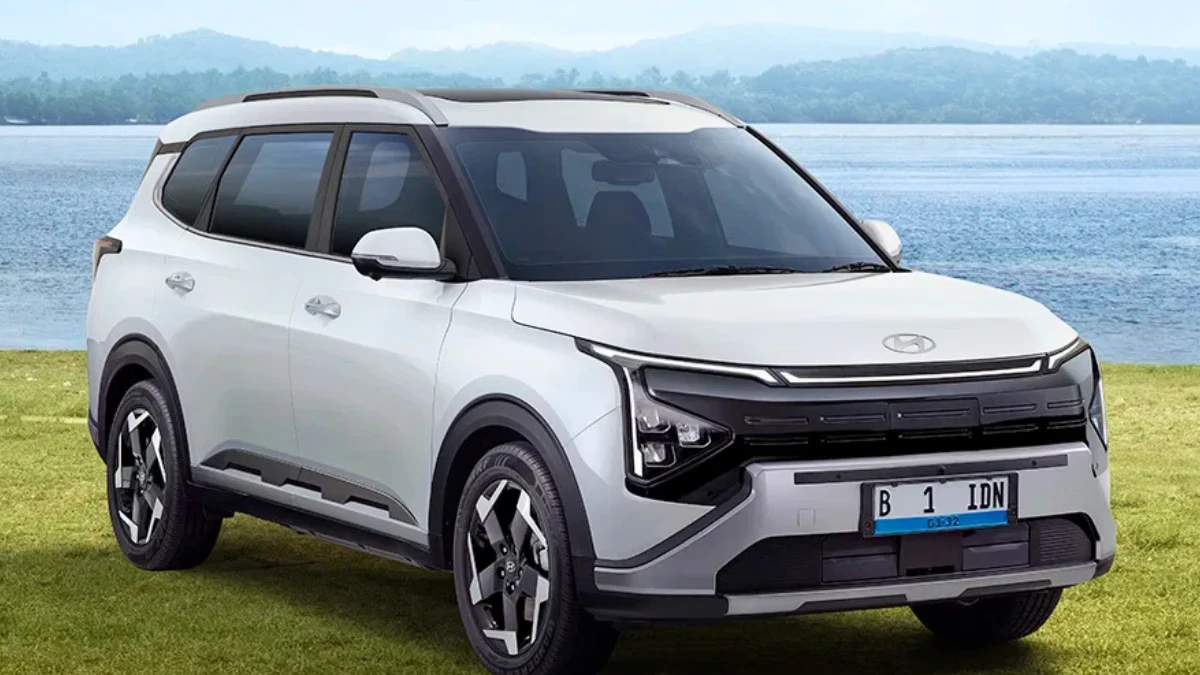
Platform sharing between Hyundai and Kia is nothing new—it is the backbone of how the South Korean automotive group moves faster than almost every rival in the business. Usually, though, the two sister brands go to great lengths to give their mechanical twins completely different sheet metal and distinct silhouettes. With the newly revealed Hyundai Neira, Hyundai has taken a much more direct route.
Unveiled in production-ready form ahead of its public appearance at the 2026 Gaikindo Auto Week in Indonesia starting November 20, the Hyundai Neira is an all-electric, three-row MPV built directly on the underpinnings of the Kia Carens Clavis EV. First previewed as a concept back in July at the 2026 Gaikindo Indonesia International Auto Show (GIIAS), the production model sticks remarkably close to its Kia sibling while wearing just enough Hyundai styling cues to claim its own showroom identity.
For now, the Neira is being manufactured in Indonesia, which will also serve as its first launch market. Naturally, the immediate question for Indian buyers is whether this seven-seat electric family hauler will eventually make its way to our roads. Before we get into that, let’s unpack everything Hyundai has shown so far, what it shares with the Carens Clavis EV, and where the two electric MPVs part ways.
Exterior Design: Familiar Proportions, Sharper Hyundai Details
Walk up to the Hyundai Neira from a distance, and you will immediately recognise its Kia roots. The overall body proportions, glasshouse, and lighting layout are closely tied to the Carens Clavis EV. Rather than re-engineering the entire body shell, Hyundai’s design team focused their energy on the nose, tail, and wheels—the exact areas that define a car’s road presence.
Up front, the Neira retains the connected LED daytime running lights and headlamp arrangement seen on its Kia counterpart. The real differentiation happens right below the light signature. Hyundai has fitted a redesigned front bumper paired with a black-finished closed-off grille featuring intricate patterned detailing. The lower section of the front bumper has also been reshaped, giving the MPV a slightly cleaner, more upright face that fits neatly alongside Hyundai’s global electric lineup.
Look at the Neira in profile, and the shared DNA becomes even more obvious. The side bodywork carries over largely untouched, complete with slim black cladding running around the wheel arches and lower doors, topped off by silver roof rails. To break the visual familiarity, Hyundai has introduced a fresh set of alloy wheels designed specifically for the Neira.
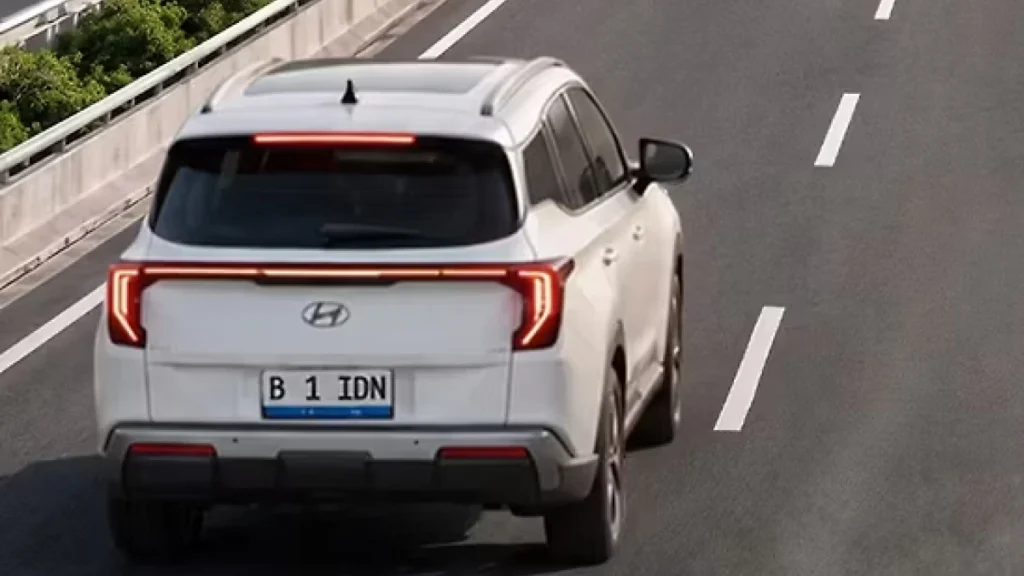
Around the back, Hyundai has kept the connected LED tail-lamps from the Carens Clavis EV, but swapped out the lower half for a new rear bumper highlighted by prominent silver trim. It is a smart, cost-effective redesign: it keeps tooling costs in check while ensuring nobody mistakes the Neira for a Kia from the rear-view mirror.
Inside the Cabin: High-Tech Layout and a Strict Seven-Seat Focus
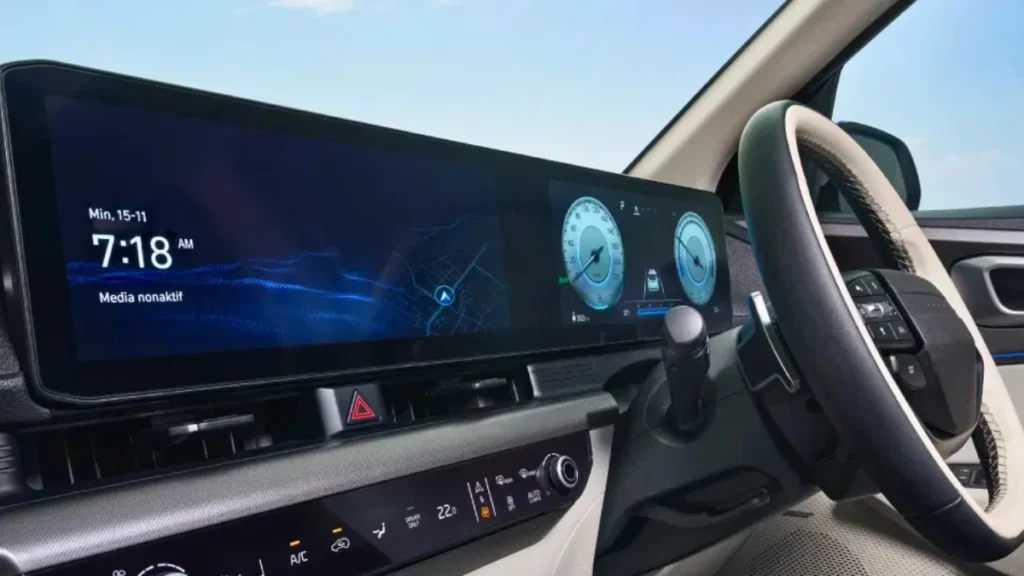
Hyundai has not yet published full images of the production-spec Neira’s interior, saving the complete cabin walkaround for its Gaikindo Auto Week showcase. That said, the prototype displayed earlier in July gave away almost the entire story—and unsurprisingly, it closely mirrors the cabin architecture of the Kia Carens Clavis EV.
If the production model carries over the prototype’s layout as expected, occupants will be greeted by a modern, screen-heavy dashboard anchored by dual 12.3-inch displays—one serving as the digital instrument cluster and the other handling infotainment duties. Below the central screen sits a sleek touch-based climate control panel flanked by tactile rotary control knobs, a welcome touch for drivers who prefer physical dials over digging through menus on the move.
Practicality is the whole point of an MPV, and the Neira leans into it with a floating centre console that frees up extra room for bags and daily clutter, alongside generous integrated cabin storage spaces throughout the three rows.
One neat Hyundai-specific touch spotted in the cabin is the steering wheel. Instead of a traditional chrome ‘H’ emblem in the centre, the Neira adopts Hyundai’s signature four-dot motif, which translates to the letter ‘H’ in Morse code—a design detail borrowed directly from its global Ioniq electric models.
There is, however, one major functional difference inside. While Kia sells the Carens Clavis EV in both six-seat (with second-row captain chairs) and seven-seat layouts, Hyundai is offering the Neira exclusively as a seven-seater. That points clearly to Hyundai positioning the Neira as a straightforward, maximum-capacity family mover for Indonesia, where three-row MPVs are the default everyday vehicle.
Battery, Range, and Performance: Reading the Kia Blueprint
As of now, Hyundai is keeping the Neira’s official battery capacities, motor outputs, and certified range figures under wraps until the November 20 public debut. Still, because the Neira is mechanically twinned with the Kia Carens Clavis EV, we have a very reliable blueprint of what is likely sitting beneath the floor.
In the Kia Carens Clavis EV, buyers get a choice of two battery packs—a 42kWh unit and a larger 51.4kWh pack—both powering a front-mounted electric motor. While these numbers belong to the Kia and should not be treated as officially confirmed Hyundai specs yet, they offer a clear look at the performance and charging capability the Neira is expected to deliver.
Expected Powertrain & Charging Reference (Based on Kia Carens Clavis EV)
| Technical Specification | Kia Carens Clavis EV Reference Figures |
| Battery Pack Options | 42kWh and 51.4kWh |
| Electric Motor Placement | Front-mounted (Front-Wheel Drive) |
| Maximum Power Output | 135hp (42kWh) / 171hp (51.4kWh) |
| Peak Torque | 255Nm |
| Claimed MIDC Driving Range | Up to 490km |
| DC Fast Charging Support | Up to 100kW |
| Fast Charging Time (0–80%) | Approximately 39 minutes |
If Hyundai carries these exact mechanicals over to the Neira, Indonesian buyers will be getting a genuinely usable family EV. A claimed range approaching 490km on the larger battery pack—paired with 100kW DC fast charging that tops the battery up to 80 percent in under 40 minutes—takes most of the stress out of intercity family trips. Even the smaller 42kWh pack, with 135hp and instant 255Nm of electric torque, is more than capable of hauling seven passengers through dense urban traffic without breaking a sweat.
Hyundai Neira vs. Kia Carens Clavis EV: How Do They Compare?
On paper, the two electric MPVs are cut from the same cloth, but their market roles and configurations set them apart. Here is a quick side-by-side look at how the Hyundai Neira stacks up against the Kia Carens Clavis EV.
| Comparison Parameter | Hyundai Neira | Kia Carens Clavis EV |
| Powertrain Type | All-Electric | All-Electric |
| Platform Relationship | Shared underpinnings with Kia | Original Kia-developed model |
| Exterior Styling | Hyundai-specific bumpers, patterned black grille, new alloys | Distinct Kia design language |
| Seating Configuration | 7-seater only | 6-seat and 7-seat options |
| Primary Launch Market | Indonesia (manufactured locally) | India and select international markets |
| India Availability | Not confirmed | Currently on sale |
Will the Hyundai Neira Launch in India?
For Indian car buyers watching the electric family-car space heat up, the Neira immediately sparks curiosity. Yet, as things stand today, Hyundai has not confirmed any plans to bring the Neira to India.
That does not mean the door is shut. Hyundai has previously stated its intention to introduce a new MPV for the Indian market by 2030. Internationally, the brand already has a couple of established people-movers in its garage—the mass-market Stargazer and the larger, futuristic Staria. Adding the all-electric Neira gives Hyundai a third distinct MPV option to evaluate for emerging markets.
Bringing the Neira to India, however, is a slightly tricky strategic puzzle. Because Kia already sells the Carens Clavis EV here, Hyundai would have to be very careful about pricing, variant distribution, and brand positioning so the two sister companies don’t simply end up cannibalising each other’s sales. On the flip side, Hyundai’s massive dealership and service network across Tier-2 and Tier-3 Indian cities is a huge advantage. A Hyundai-badged seven-seat electric MPV with proven underpinnings and local manufacturing scale could easily attract families who love the Carens Clavis EV’s formula but prefer a Hyundai showroom closer to home.
What Happens Next?
For now, the Neira stands as a smart, pragmatic expansion of Hyundai’s Southeast Asian EV lineup. By borrowing a proven electric MPV platform from Kia, wrapping it in sharper Hyundai styling, and building it locally in Indonesia, Hyundai gets a competitive seven-seat electric family car to market in record time. Whether Indian buyers will eventually get to see that four-dot steering wheel in a three-row electric MPV of their own remains a story worth watching closely.
