


When Tata Motors decided to revive the Sierra nameplate as an electric SUV, nostalgia was only ever going to take it so far. Modern Indian car buyers have moved well past buying a vehicle on heritage or styling alone. Today, before anyone even asks about touchscreen sizes or range figures, one question almost always comes up first: how safe is it?
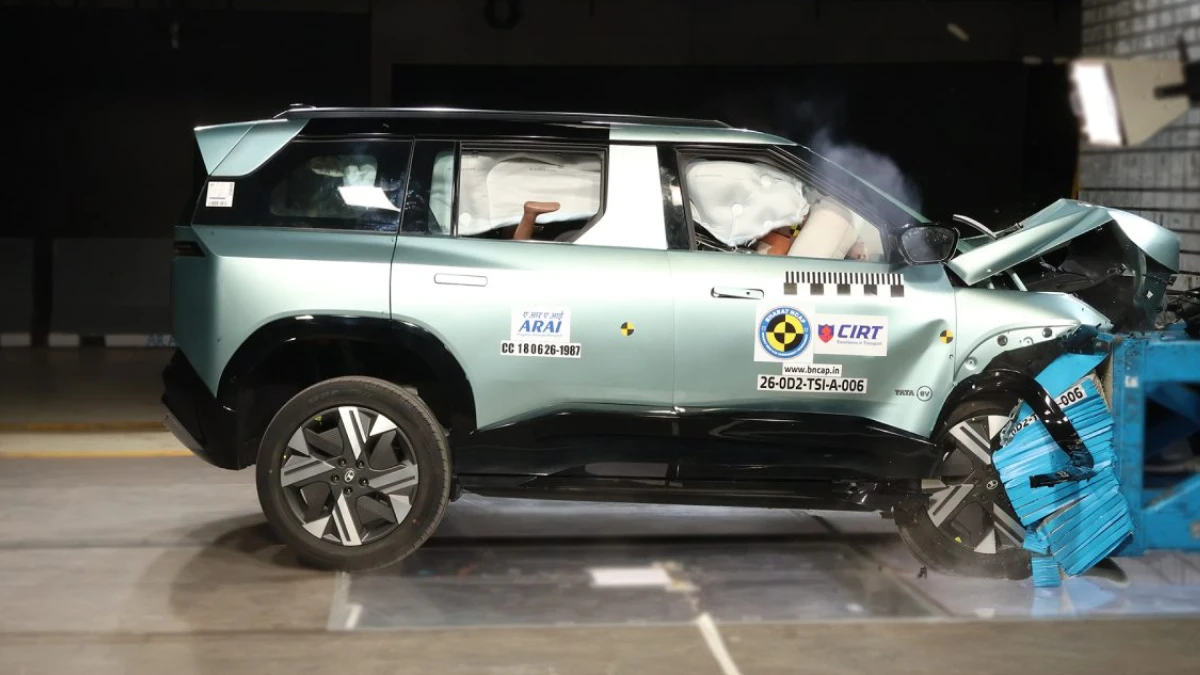
Tata Motors now has a definitive answer for anyone eyeing its latest electric flagship. The Tata Sierra EV has officially cleared Bharat NCAP crash testing with a full five-star rating in both Adult Occupant Protection (AOP) and Child Occupant Protection (COP).
For a brand that has spent the last several years building its reputation around five-star crash scores, this result feels like a continuation of a deliberate engineering philosophy rather than a lucky break. Still, a five-star badge on a showroom poster never tells the full story. To understand how well the Sierra EV actually holds up when things go wrong, you have to look closely at the individual test metrics, the weight of the vehicle involved, and how it stacks up against its petrol and diesel sibling.
Testing a 2.4-Tonne Electric SUV: Why This Score Matters
Crash-testing a large electric SUV is a fundamentally different engineering puzzle compared to testing a conventional petrol or diesel car. The specific variant sent into the Bharat NCAP test facility was the Sierra EV Empowered AWD A, fitted with the larger 75kWh battery pack and an all-wheel-drive layout.
On the scales, this tested model carries a kerb weight of roughly 2,412 kg.
Physics does not care about marketing brochures. When a 2.4-tonne vehicle hits a deformable barrier, the chassis has to manage and dissipate a tremendous amount of kinetic energy. At the same time, engineers have to build a rigid protective cage around the underfloor high-voltage battery pack so that it remains completely uncompromised during both frontal and side collisions. Getting that balance right—soft enough at the crumple zones to absorb impact without jarring the passengers, yet stiff enough around the cabin and battery bay to stop structural intrusion—is notoriously difficult.
The good news for prospective buyers is that this five-star certification is not locked behind the most expensive all-wheel-drive variant. According to the published Bharat NCAP findings, the rating extends across the listed Sierra EV lineup, covering models equipped with both the 63kWh and 75kWh battery packs.
Inside the Numbers: Tata Sierra EV Bharat NCAP Scorecard
In the Adult Occupant Protection category, the Sierra EV posted 30.62 points out of a possible 32. In Child Occupant Protection, it walked away with 45 points out of 49.
Those are commanding figures by any measure, and the sub-category breakdown shows exactly where the SUV excelled and where a few points were left on the table.
| Safety Assessment Parameter | Score Achieved | Maximum Possible Score | Result / Remarks |
| Adult Occupant Protection (AOP) | 30.62 | 32 | 5 Stars |
| Child Occupant Protection (COP) | 45.00 | 49 | 5 Stars |
| Frontal Offset Deformable Barrier | 14.62 | 16 | Strong frontal impact absorption |
| Side Movable Deformable Barrier | 16.00 | 16 | Perfect score; maximum lateral protection |
| Child Dynamic Assessment | 24.00 | 24 | Full marks across crash simulations |
| Child Restraint System (CRS) Installation | 12.00 | 12 | Full marks for seat fitment compatibility |
| Vehicle Assessment (Child Safety) | 9.00 | 13 | Minor points deducted on vehicle-side criteria |
Adult Protection: Flawless From the Side, Solid Up Front
The standout figure on the entire scorecard is the 16 out of 16 in the side movable deformable barrier test. Side collisions are often the most dangerous real-world accidents because there is no long bonnet or engine bay between the impacting object and the people sitting inside the cabin. Scoring full marks here means the side structure, door beams, and side/curtain airbags worked in complete harmony to shield occupants from lateral forces. For an electric vehicle carrying a massive battery pack along its floor, side-impact integrity is also critical for battery safety.
In the frontal offset deformable barrier test, the Sierra EV scored 14.62 out of 16. Losing just 1.38 points in a frontal impact test—especially while managing over 2.4 tonnes of mass—points to a well-engineered front crush structure and effective restraint calibration.
Child Protection: Built With Families in Mind
For years, child safety was an afterthought in the Indian car market, with many vehicles scoring poorly even when adult protection looked decent. The Sierra EV flips that script convincingly with 45 out of 49 points.
It earned a clean sweep in the child dynamic assessment (24/24), which measures how well child dummies are protected from head, neck, and chest injuries during frontal and side impacts. It also scored a perfect 12 out of 12 in the Child Restraint System (CRS) installation check, confirming that installing standard ISOFIX child seats is straightforward and secure without awkward seat-belt routing or compatibility headaches.
The only area where the SUV dropped points in child safety was the vehicle assessment segment, where it scored 9 out of 13. Even with those four points deducted, the overall tally comfortably cleared the threshold for a five-star COP rating.
Standard Safety Hardware on the Sierra EV
Structural steel and crumple zones do the heavy lifting in a crash, but they rely heavily on active and passive safety hardware to keep occupants in position and prevent accidents before they happen. The Sierra EV comes equipped with a thorough suite of reported standard safety features designed to protect everyone in the cabin.
- Comprehensive Airbag Coverage: Front airbags for the driver and front passenger, dedicated side chest and pelvis airbags for front occupants, and full-length side head curtain airbags.
- Electronic Stability Control (ESC): A vital active safety system that steps in when the SUV begins to skid or lose traction during sudden swerves on wet highways or loose gravel, applying individual brakes to keep the vehicle pointed where you steer.
- Seatbelt Pretensioners and Load Limiters: Pretensioners instantly cinch the seatbelt tight the millisecond a crash is detected, removing slack so occupants stay pinned safely in their seats. Load limiters then release a controlled amount of webbing if the chest pressure gets too high, preventing rib injuries from the belt itself.
- All-Seat Seatbelt Reminders: Alerts for every seating position in the cabin, encouraging rear-seat passengers to buckle up—a habit that is still catching on across Indian highways.
- ISOFIX Child-Seat Anchorages: Standardized metal anchor points built directly into the chassis for rock-solid child seat installation.
On a heavy electric SUV with instant torque, having Electronic Stability Control and proper restraint systems working together as standard equipment is not a luxury; it is essential for everyday drivability.
Sierra EV vs. Sierra ICE: Comparing the Siblings
Before the electric version went through the crash lab, Bharat NCAP had already evaluated the internal combustion engine (ICE) version of the Tata Sierra. Both versions came away with five-star ratings across the board, making the Sierra lineup one of the safest single-nameplate offerings in the country regardless of what powers the wheels.
However, putting their scorecards side by side reveals some interesting, subtle differences.
| Safety Category | Tata Sierra EV | Tata Sierra ICE | Key Difference |
| Adult Occupant Protection | 30.62 / 32 (5 Stars) | 31.14 / 32 (5 Stars) | ICE leads by 0.52 points |
| Child Occupant Protection | 45.00 / 49 (5 Stars) | 44.73 / 49 (5 Stars) | EV leads by 0.27 points |
| Overall Adult Rating | 5 Stars | 5 Stars | Identical top-tier rating |
| Overall Child Rating | 5 Stars | 5 Stars | Identical top-tier rating |
The petrol and diesel Sierra nudged ahead in Adult Occupant Protection by just over half a point (31.14 vs. 30.62). That slight variance is completely normal when comparing an ICE vehicle to its battery-powered counterpart. Because the EV carries hundreds of extra kilograms in battery mass, the energy management during a frontal impact behaves slightly differently, leading to minor variations in dummy sensor readings.
Flip over to Child Occupant Protection, and the Sierra EV actually edges ahead of the ICE model, scoring 45 points against the ICE version’s 44.73. In real-world terms, the margins between the two are razor-thin. Whether a buyer chooses the combustion engine or the battery pack, they are stepping into a cabin engineered to the exact same five-star safety standard.
What This Result Means for Prospective Buyers
India’s electric SUV market is getting crowded fast. Buyers looking at mid-size and large EVs now have more options than ever, and range anxiety is slowly taking a backseat to practical questions about long-term durability, comfort, and crash protection.
With this Bharat NCAP result, Tata Motors reinforces its strongest selling point. Knowing that the Sierra EV’s five-star rating covers the listed 63kWh and 75kWh variants removes a common worry—that you have to stretch your budget to the top-end all-wheel-drive trim just to get the safest version of the car. The core crash structure and fundamental occupant protection remain solid across the board.
That said, smart car shopping always requires checking the fine print. A five-star Bharat NCAP rating tells you that the vehicle’s body shell, airbags, and restraint systems perform admirably in standardized crash tests. It does not automatically mean every trim level shares the exact same list of convenience or active driver-assistance tech. Before signing the booking form, buyers should still walk through the variant-wise brochure to confirm the exact safety and driver-assist equipment included on the specific trim they plan to drive home.
Ultimately, the Tata Sierra EV has passed its most important test with flying colours. Bringing back a beloved icon is easy to get wrong if it relies purely on looks, but backing up that design with 30.62 points in adult safety, 45 points in child safety, and a clean sweep in side-impact protection proves that the modern Sierra is built to protect the families who buy it.
