


For years, the Indian automotive market has been dominated by the relentless rise of the sport utility vehicle. Crossovers and high-riding compact SUVs have flooded the streets, leaving traditional three-box sedans fighting for breathing room in a shrinking segment. But if there is one vehicle that has consistently proven that the low-slung, corner-carving sedan is far from dead, it is the Volkswagen Virtus.
Since its grand arrival in June 2022, the Virtus has been the definitive choice for driving enthusiasts who prioritize handling, turbocharged power, and timeless European aesthetics over raised ground clearance. It injected a massive dose of adrenaline into a category that was starting to feel stagnant. Now, as the competition intensifies and technological benchmarks shift, Volkswagen is preparing to raise the stakes once again.
Ahead of a highly anticipated launch expected in December 2026, Volkswagen India has officially pulled the covers off the exterior of the Virtus facelift. Draped in a stunning blue finish and adorned with aggressive GT styling cues, the updated sedan promises to be more than just a mid-lifecycle cosmetic touch-up. From heavily redesigned bumpers to rumors of a major transmission overhaul, the 2026 Virtus is shaping up to be a formidable machine. Let us meticulously break down every known detail, analyze the design philosophy, and explore exactly what this facelift means for the Indian sedan market.
Exterior Design: Aggression Meets Precision
Automotive mid-lifecycle facelifts are notoriously tricky to execute. Automakers walk a tightrope between updating the car enough to attract new buyers and altering it so much that it alienates the existing fanbase. With the 2026 Virtus, Volkswagen’s design team in Wolfsburg and Pune has struck a masterful balance. The underlying MQB A0 IN platform’s brilliant proportions—the long wheelbase, the sweeping roofline, and the sharp character lines—remain entirely intact. The magic, however, lies in the aggressive new details.
A Sharper, More Menacing Front Fascia
The most dramatic visual transformations are heavily concentrated at the front end of the vehicle. The Virtus has always possessed a wide, confident stance, but the 2026 model turns the aggression dial up to eleven.
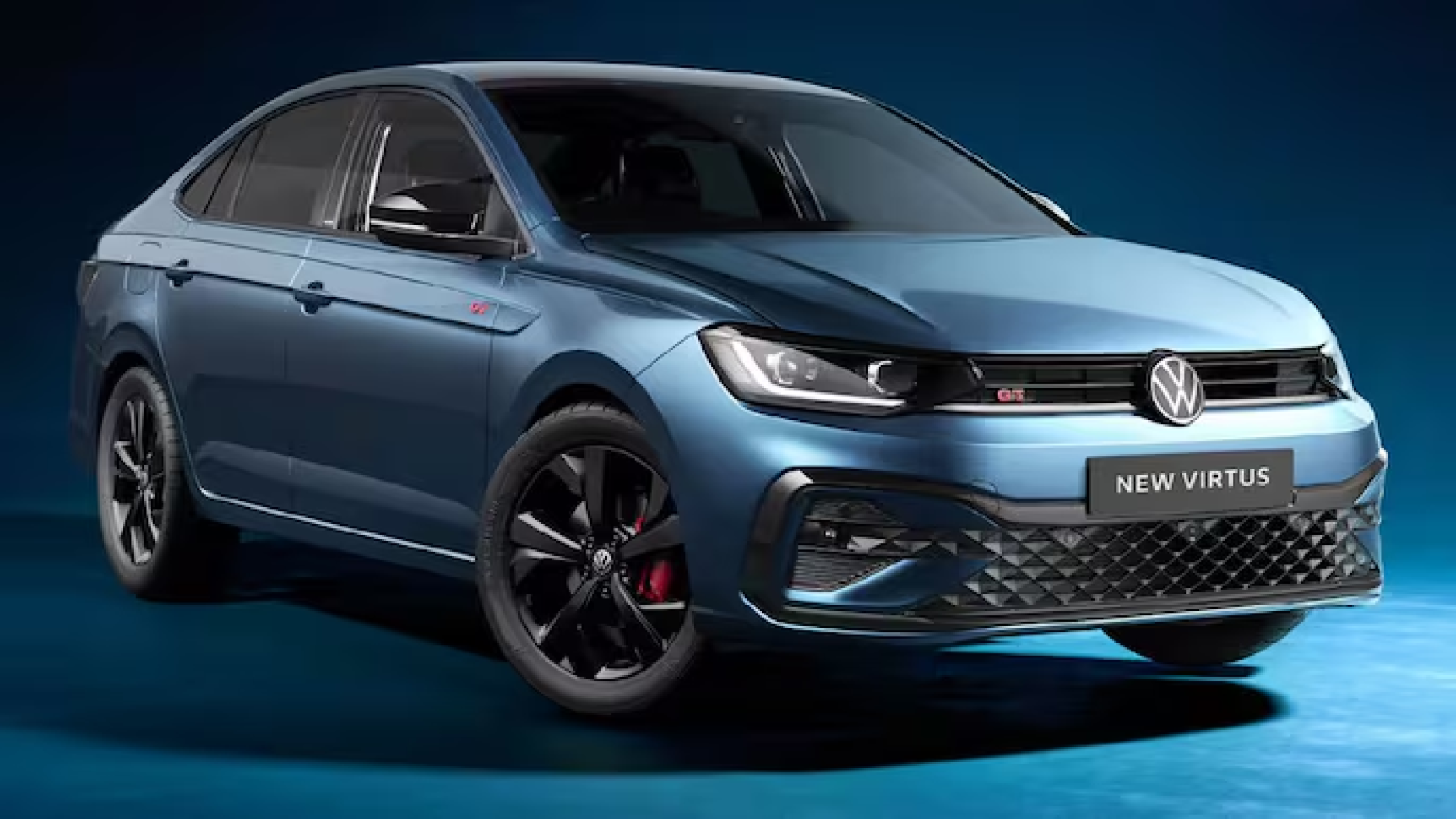
While the sleek, sharply contoured headlamp housings remain largely similar to the outgoing model, the front bumper has been completely redesigned from the ground up. The lower grille section has grown significantly wider, dominating the lower half of the fascia. Volkswagen has introduced intricate, geometric diamond-shaped and triangular detailing within this air dam, giving the car a highly complex and premium visual texture that catches the light beautifully.
In the GT trim shown in the official reveal, the outer sections of the bumper feature heavy black surrounds. These darkened elements serve to visually widen the car even further, grounding it to the tarmac and hinting at its performance capabilities. A slim, bright strip runs elegantly along the lower lip of the bumper, acting as a sophisticated contrast to the aggressive black mesh.
The upper grille, which seamlessly connects the two headlamp units, continues to house the prominent Volkswagen roundel at its dead center. Naturally, the coveted red ‘GT’ badge sits proudly on the grille, signaling that this is not your average family commuter.
The “No Lightbar” Rebellion
In contemporary automotive design, there is a massive, almost inescapable trend: the full-width LED light bar. From Hyundai’s striking new Verna to a slew of modern SUVs, manufacturers are connecting their headlights and taillights with continuous strips of illumination.
Interestingly, Volkswagen has chosen to actively rebel against this trend with the Virtus facelift. The German automaker has retained separate, distinct LED daytime running light (DRL) signatures within the individual headlamp units. The rear tells a similar story, with the split tail-lamp clusters remaining entirely separate rather than being bridged by a luminous bar. This design choice is a breath of fresh air. It allows the Virtus to maintain a classic, sophisticated European identity, avoiding the somewhat polarizing, futuristic styling that some of its rivals have adopted.
GT Styling Cues: The Devil is in the Details
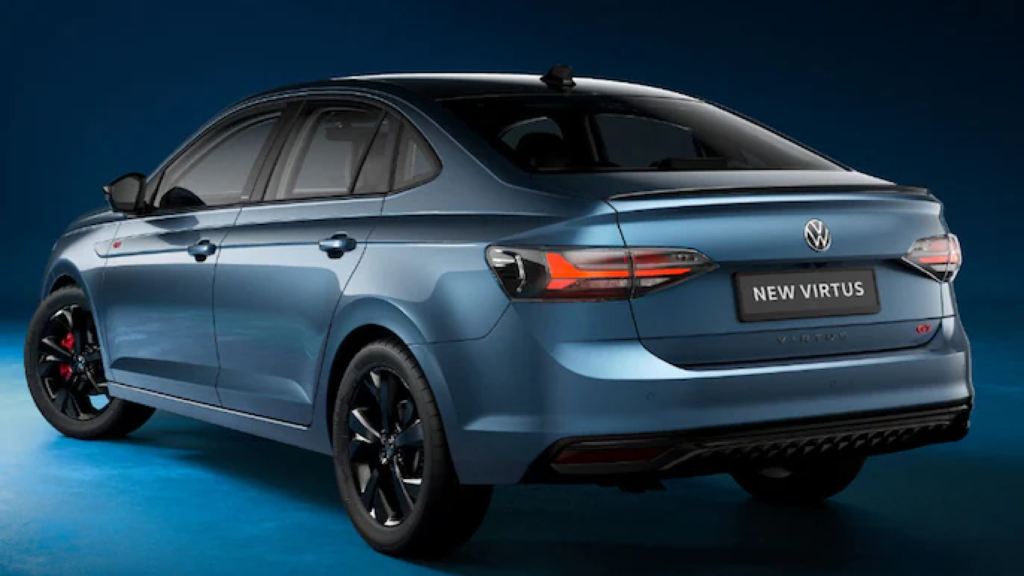
The official images highlight a breathtaking blue exterior paint finish that is exclusive to the GT line. While Volkswagen has kept the official marketing name of this specific shade under wraps, it provides a stunning canvas for the contrasting sporty elements.
The side profile is dominated by a brand-new set of blacked-out alloy wheels. These feature sharp, angular spokes that perfectly complement the geometric patterns found in the new front grille. Tucked behind these dark alloys are brilliantly painted red brake calipers—a traditional hallmark of Volkswagen’s performance-oriented models.
Further enhancing the athletic stance are gloss black outside rearview mirror (ORVM) housings and subtle red GT badges meticulously placed on the front fenders.
Moving to the rear, the facelifted Virtus receives a gloss black boot-lip spoiler that not only looks fantastic but helps manage aerodynamic wake at highway speeds. The lower rear bumper has been heavily revised with geometric detailing that mirrors the front fascia, creating a cohesive design language from nose to tail. The spaced-out ‘V I R T U S’ lettering remains proudly positioned below the number plate recess, accompanied by a final red GT badge on the right side of the boot lid.
The Cabin: Anticipating a Massive Technological Leap
While Volkswagen has been generous with exterior imagery, they have kept the doors firmly locked and the windows tinted, hiding the interior of the 2026 Virtus from public view. This secrecy has fueled intense speculation within the automotive community regarding the extent of the cabin upgrades.
If we look at industry trajectories and the recent updates given to sibling vehicles within the Volkswagen Skoda group, we can paint a highly accurate picture of what to expect when the doors finally open.
The outgoing Virtus already boasts a well-appointed cabin, featuring a crisp touchscreen infotainment system, a digital instrument cluster, ventilated front seats (a blessing in the Indian summer), wireless smartphone connectivity, and automatic climate control. However, the 2026 facelift is expected to push the envelope further.
Industry insiders suggest the introduction of a larger, higher-resolution digital driver’s display, potentially offering more customizable views and integrated navigation mapping directly in the driver’s line of sight. We also expect a massive overhaul in the upholstery department. The GT variants will likely feature new leatherette seating with aggressive red contrast stitching, heavily bolstered to hold the driver securely during spirited cornering.
The biggest question mark surrounds Advanced Driver Assistance Systems (ADAS). With rivals like the Hyundai Verna and Honda City heavily marketing their Level 2 ADAS suites, it is highly probable that Volkswagen will introduce a similar safety net in the facelifted Virtus. Features such as adaptive cruise control, lane-keeping assist, autonomous emergency braking, and a high-definition 360-degree surround-view camera system would elevate the Virtus to the absolute top of the segment in terms of active safety.
Under the Hood: The Powertrain Arsenal and a Rumored Gearbox Swap
Volkswagen built the reputation of the Virtus on the back of its phenomenal TSI (Turbocharged Stratified Injection) engines. For the 2026 facelift, the core engine blocks are expected to remain the same, which is excellent news for driving purists. However, a massive mechanical update is heavily rumored for the transmission department.
Expected Powertrain Specifications
| Specification | 1.0L TSI Turbo-Petrol | 1.5L TSI EVO Turbo-Petrol |
| Engine Configuration | 3-Cylinder, Direct Injection | 4-Cylinder, Direct Injection with ACT |
| Maximum Power | 115 PS | 150 PS |
| Maximum Torque | 178 Nm | 250 Nm |
| Manual Transmission | 6-Speed Manual | 6-Speed Manual |
| Expected Automatic | 8-Speed Torque Converter | 7-Speed DSG (Dual-Clutch) |
| Target Audience | Urban commuters, mileage-conscious buyers | Driving enthusiasts, highway cruisers |
The standard workhorse of the lineup will continue to be the brilliant 1.0-litre, three-cylinder turbo-petrol engine. Pumping out 115 PS of power and 178 Nm of torque, it provides punchy, eager performance that belies its small displacement.
The headline news, however, is the expected transmission swap for this 1.0L engine. Currently, the automatic variants utilize a highly reliable 6-speed torque converter. Reports strongly suggest that Volkswagen is preparing to replace this with an advanced 8-speed torque converter automatic gearbox.
Why is this a big deal? Adding two extra forward gears allows the transmission to keep the turbocharged engine in its absolute optimal powerband at all times. It means shorter, punchier lower gears for rapid city acceleration, and incredibly tall top gears for silent, highly efficient highway cruising at lower RPMs. This upgrade alone could drastically improve both the real-world fuel economy and the overall refinement of the 1.0 TSI variants.
For the power-hungry buyer, the revered 1.5-litre, four-cylinder TSI EVO engine will continue to dominate the GT lineup. Delivering a blistering 150 PS and 250 Nm of torque, this engine turns the Virtus into a bona fide sports sedan. It features Active Cylinder Technology (ACT), which seamlessly shuts down two cylinders under light engine loads to maximize fuel efficiency without sacrificing on-demand performance. This powerhouse will continue to be mated to Volkswagen’s lightning-fast 7-speed DSG (Direct-Shift Gearbox), offering instantaneous, paddle-shifted gear changes that no traditional automatic can match.
The Sedan Segment Battleground
When the 2026 Volkswagen Virtus facelift finally hits showroom floors this December, it will re-enter a fiercely competitive arena. The midsize sedan segment in India is no longer about budget family haulers; it is a battleground of technology, premium materials, and performance.
Its primary mechanical sibling and fierce rival, the Skoda Slavia, will also be vying for the attention of the European car enthusiast. While they share the same MQB A0 IN platform and powertrains, the Virtus relies on its sharper, more aggressive styling to woo buyers who prefer a slightly more youthful, sporty aesthetic compared to the Slavia’s understated elegance.
The Hyundai Verna represents the most radical threat. With its futuristic, polarizing design language, endless list of tech features, and its own potent 1.5L turbo engine, the Verna targets the gadget-obsessed buyer. The Virtus counters this by offering superior driving dynamics, a stiffer, more communicative chassis, and a timeless design that will likely age far more gracefully than the trendy lightbars of its Korean rival.
Finally, the legacy champion, the Honda City, remains a formidable presence. While it cannot match the sheer turbocharged torque of the Virtus GT, the City offers bulletproof reliability, an incredibly spacious rear seat, and a highly efficient strong-hybrid option. The Virtus facelift will look to lure City buyers away with its superior high-speed stability, premium build quality, and sheer fun-to-drive factor.
The Road Ahead
The December 2026 launch of the Volkswagen Virtus facelift cannot come soon enough. By aggressively refining the exterior styling with sharp geometric details and stunning GT-specific accents, Volkswagen has ensured that their flagship sedan remains the most visually striking option in its class.
If the rumors regarding the 8-speed automatic transmission and a heavily upgraded, ADAS-equipped interior hold true, the Virtus will not just be a pretty face; it will be a technological tour de force. Volkswagen has built a machine that actively rewards the driver, proving once and for all that you do not need to buy an SUV to rule the Indian roads. The sedan is fighting back, and it is wearing a red GT badge.
