


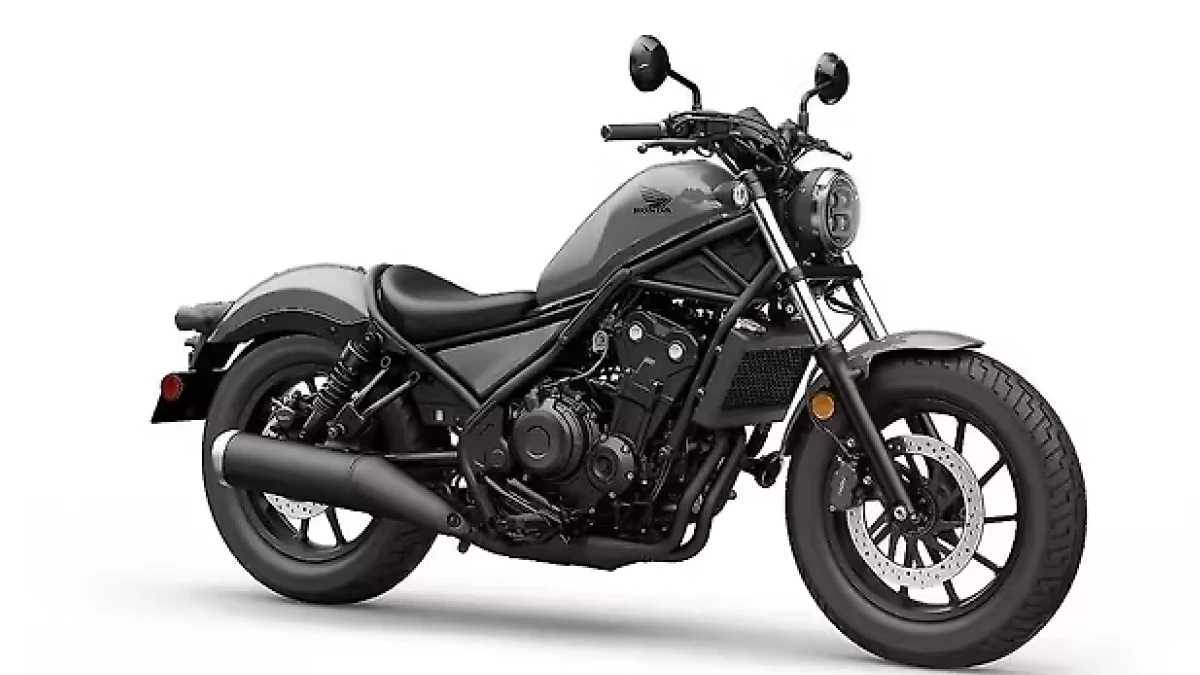
For years, Indian riders who wanted a refined, Japanese twin-cylinder cruiser had a frustratingly short list of options—and almost all of them came with the steep price tags attached to imported motorcycles. Honda Motorcycle and Scooter India (HMSI) has just changed that conversation. The company has officially launched the internationally popular Honda Rebel 500 in India, with prices starting at ₹4.50 lakh (ex-showroom, Bengaluru) for the Standard trim and ₹4.90 lakh for the tech-forward E-Clutch variant.
The biggest reason Honda managed to keep the sticker price grounded is right in the manufacturing plan: the Rebel 500 is being manufactured in India. Localisation has allowed Honda to position its middleweight cruiser far more competitively than a full import could ever manage, opening the door for riders upgrading from 300cc and 350cc singles who have been waiting for a smooth, approachable twin-cylinder step up.
Bookings are already open nationwide for a token amount of ₹5,000, both through Honda’s official website and at authorised BigWing dealerships. As expected for Honda’s premium lineup, the Rebel 500 will be sold exclusively through the BigWing retail network.
Pricing and Variants: Keeping the Lineup Simple
Honda has resisted the urge to overcomplicate the brochure. Instead of splitting features across four or five confusing trims, the Rebel 500 arrives in just two clear variants. Both motorcycles share the exact same chassis, styling, features, and 471cc parallel-twin engine. The sole separating factor is the addition of Honda’s E-Clutch system, which adds a ₹40,000 premium to the ex-showroom price.
| Variant | Price (Ex-Showroom, Bengaluru) | Key Differentiator | Booking Amount |
| Honda Rebel 500 Standard | ₹4,49,900 | Conventional manual clutch operation | ₹5,000 |
| Honda Rebel 500 E-Clutch | ₹4,89,900 | Electronic clutch management with manual override | ₹5,000 |
Looking at the numbers, ₹4.49 lakh ex-showroom puts the Standard Rebel 500 in a very interesting sweet spot. Manufacturing the bike locally does more than just trim the upfront purchase price; over the long term, local production typically translates into better spare parts availability and more predictable service costs—two things middleweight motorcycle buyers in India care deeply about once the showroom honeymoon wears off.
The 471cc Parallel-Twin Heart
At the centre of the Rebel 500 sits Honda’s well-proven 471cc, liquid-cooled, parallel-twin engine. It produces 46hp at 8,500rpm and 43.3Nm of torque at 6,000rpm, paired with a six-speed gearbox.
On paper, those figures aren’t trying to win a drag race against high-strung supersports, and that is entirely the point. This motor has earned a global following precisely because of how friendly and linear it feels. Rather than forcing you to wring the throttle to the redline to find usable pace, it focuses on smooth, accessible power delivery across the rev range.
In everyday riding, that translates into a motorcycle that doesn’t feel intimidating when you are threading through tight urban lanes, yet has more than enough composure and passing punch to hold comfortable highway speeds all day long. Paired with the Rebel’s low-slung cruiser stance and relaxed riding character, the 471cc twin gives the bike a completely different personality compared to aggressive street-naked motorcycles sharing the same displacement bracket.
Honda Rebel 500 Key Specifications
| Specification | Details |
| Engine Type | 471cc, liquid-cooled, parallel-twin |
| Maximum Power | 46hp @ 8,500rpm |
| Peak Torque | 43.3Nm @ 6,000rpm |
| Transmission | 6-speed gearbox |
| Clutch System | Manual (Standard) / Honda E-Clutch (E-Clutch variant) |
| Braking Hardware | Front and rear disc brakes with dual-channel ABS |
| Traction Aid | Honda Selectable Torque Control (HSTC) |
| Retail Network | Honda BigWing dealerships |
What Exactly Is Honda E-Clutch—and Why Does It Matter?
If you have been following Honda’s recent global engineering announcements, the E-Clutch variant is the headline act here. It is easy to mistake it for a regular automatic gearbox or a dual-clutch transmission (DCT), but the way it works in practice is quite different.
With Honda’s E-Clutch system, you do not have to touch the left-hand clutch lever to pull away from a standstill, come to a complete stop, or shift up and down through the six-speed gearbox. The electronics handle clutch engagement automatically and smoothly behind the scenes. You simply twist the throttle and click through the gears with your left foot using the regular gear lever.
Here is the clever part that purists will appreciate: the manual clutch lever stays right where it belongs. If you ever want to feather the clutch yourself while executing a tight U-turn, or if you simply feel like riding the old-fashioned way on a twisty stretch of road, you can pull the lever and take full manual control at any moment.
Anyone who has ridden a 500cc motorcycle through peak-hour traffic in Bengaluru, Mumbai, or Delhi knows how quickly a heavy clutch can leave your left wrist aching. By taking the repetitive stop-and-go grind off your left hand while keeping the engagement of shifting gears intact, the E-Clutch bridges the gap between everyday practicality and classic motorcycling feel.
Minimalist Cruiser Styling Meets Modern Equipment
Visually, the Rebel 500 sticks to the stripped-back, blacked-out cruiser formula that made it a hit overseas. It avoids heavy chrome panels and bulky bodywork, opting instead for clean proportions, a low seat height, and a compact, muscular silhouette that feels approachable even for riders who aren’t particularly tall.
Honda is offering the motorcycle in two understated matte paint finishes: Mat Axis Grey Metallic and Mat Dune Brown. Both shades lean heavily into the bike’s dark, minimalist aesthetic rather than chasing flashy graphics.
Beneath that pared-back exterior, however, Honda has made sure the Rebel 500 doesn’t feel dated on the equipment front. Key highlights include:
- 3.5-Inch Circular TFT Instrument Display: Keeps the classic round-dial look intact while replacing basic LCD readouts with a crisp, modern colour screen.
- Honda RoadSync Connectivity: Pairs with your smartphone to unlock connected features directly on the dash.
- Turn-by-Turn Navigation: Keeps route guidance right in your line of sight so you don’t have to strap an expensive phone onto the handlebars on bumpy roads.
- LED Projector Headlamp: Gives the front end a sharp modern signature while offering stronger nighttime illumination.
- Honda Selectable Torque Control (HSTC): Acts as a traction-control safety net when road surfaces get wet, dusty, or unpredictable.
- Dual-Channel ABS with Disc Brakes: Front and rear disc brakes backed by dual-channel ABS come as standard across both trims.
Where the Rebel 500 Sits Against Its Rivals
Entering India’s premium middleweight cruiser space means stepping into a niche that has started heating up noticeably. The Rebel 500’s most obvious direct rival is the Kawasaki Eliminator, another Japanese parallel-twin cruiser that targets riders who want low-seat accessibility, highway refinement, and modern reliability without moving up to heavyweight 650cc+ cruisers. Beyond the Eliminator, the Rebel 500 will also cross-shop against other premium retro and cruiser motorcycles depending on how much a buyer values twin-cylinder smoothness versus classic thumper charm.
Where Honda immediately creates separation is twofold. First, local manufacturing gives the Rebel 500 a sharp pricing foothold in the sub-₹5 lakh ex-showroom bracket. Second, the availability of the E-Clutch system gives it a unique technological hook that no direct middleweight cruiser rival currently matches in India.
Standard vs. E-Clutch: Which One Should You Buy?
With both variants sharing the exact same 471cc engine, TFT display, lighting, and safety suite, the buying decision boils down to a single question: is the E-Clutch worth an extra ₹40,000?
| Buying Factor | Rebel 500 Standard (₹4.50 Lakh) | Rebel 500 E-Clutch (₹4.90 Lakh) |
| Upfront Value | Lower purchase price; ₹40,000 saved for gear or accessories | Higher initial outlay |
| City Traffic Comfort | Requires regular manual clutch work in bumper-to-bumper jams | Effortless stop-and-go riding with zero clutch fatigue |
| Rider Engagement | Traditional manual riding experience at all times | Manual gear shifting with optional manual clutch override |
| Best Suited For | Weekend highway riders and traditionalists on a tighter budget | Daily commuters, city-plus-highway riders, and tech enthusiasts |
If your Rebel 500 is destined primarily for early-morning weekend rides and open highway runs—where you spend most of your time cruising in fifth or sixth gear—the Standard variant makes a lot of financial sense. You get the exact same smooth parallel-twin motor, the same RoadSync TFT dash, and the same cruiser stance while keeping ₹40,000 in your pocket (more than enough for a quality helmet, riding jacket, and gloves).
On the other hand, if you plan to use the motorcycle regularly inside the city, commute through crawling traffic, or simply want the newest piece of rider-friendly engineering Honda offers, the E-Clutch variant is easy to justify. Because it never forces you to give up the gear lever or the manual clutch when you want them, there is virtually no downside to having the system on board—only added convenience whenever traffic grinds to a halt.
Final Thoughts
With the made-in-India Rebel 500, Honda BigWing has delivered exactly what Indian cruiser fans have been asking for: a genuine, refined Japanese parallel-twin cruiser priced sensibly enough to feel within reach. Between its accessible 46hp motor, clean styling, modern TFT connectivity, and the clever addition of E-Clutch technology, the Rebel 500 doesn’t just expand Honda’s premium lineup—it raises the bar for what riders can expect from a sub-₹5 lakh middleweight cruiser in India.

1 Comment
Pingback: BMW R 12 G/S Launched at Rs 25.40 Lakh