


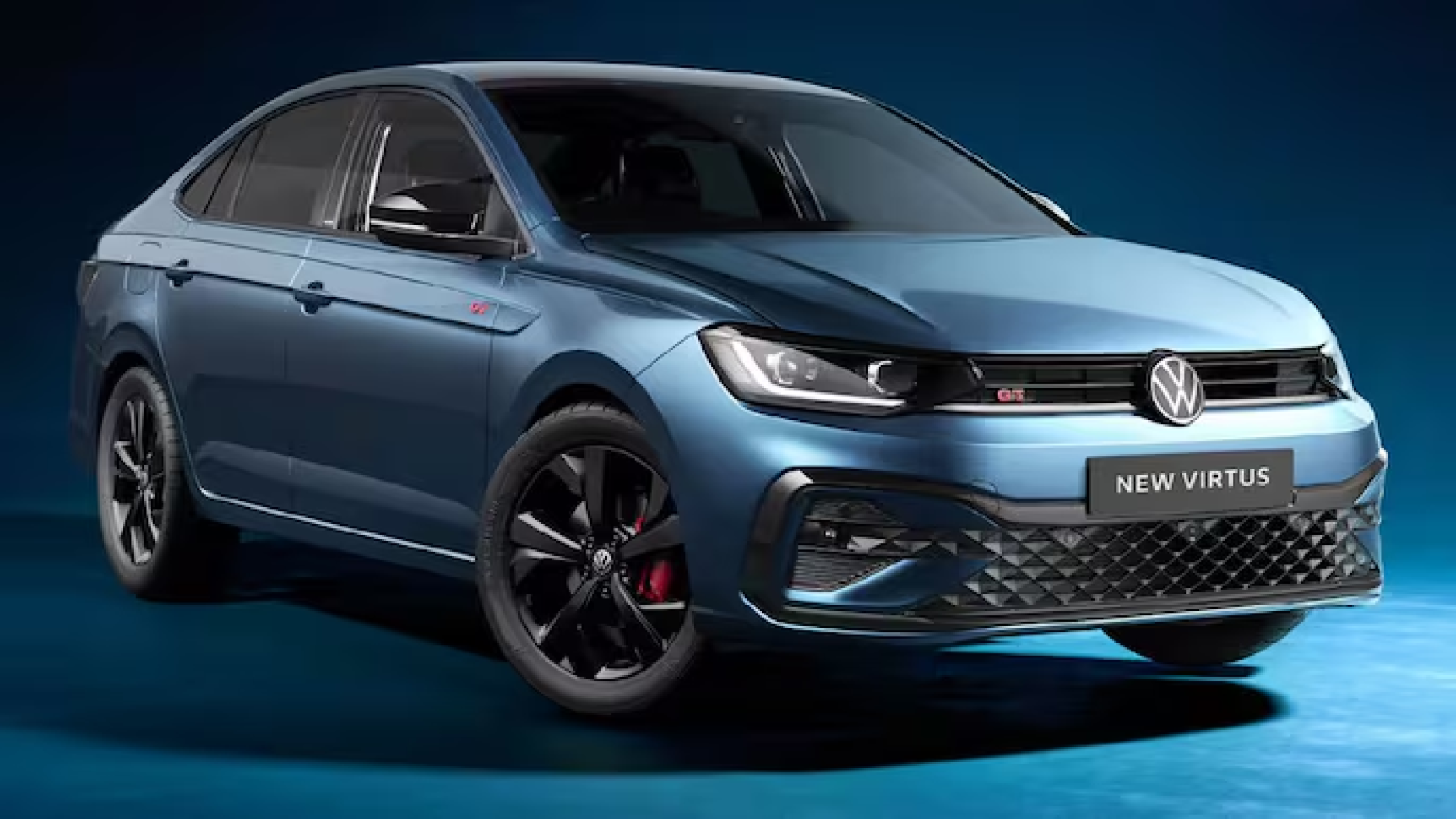
Sedans have had a tough few years in India, pushed to the margins by an endless wave of compact and midsize SUVs. Yet the Volkswagen Virtus has quietly refused to play along with that script. Since arriving in 2022, it has managed to keep enthusiasts interested and showroom footfall steady, proving there is still a healthy audience for a clean three-box silhouette and proper highway manners.
After four years on the road, though, even the sharpest designs start showing their age. Volkswagen India has now officially locked in December 11, 2026, as the launch date for the Virtus facelift. This marks the sedan’s first proper mid-life refresh since its debut, and from what we have seen so far, Volkswagen is not trying to reinvent the car. Instead, it is addressing the exact pain points buyers have been talking about—cabin tech, parking aids, cooling performance, and potentially a much smarter automatic transmission for the smaller engine.
With the exterior already out in the open and the launch just weeks away, here is a clear look at everything changing on the updated Virtus and what buyers can realistically expect when prices drop.
Exterior Updates: Sharper Details Without Ruining the Proportions
One of the biggest compliments you can pay the current Virtus is that it looks timeless. Unlike a few newer rivals that went chasing futuristic light bars and polarising creases, the Virtus stuck to clean European lines. Thankfully, Volkswagen’s designers resisted the urge to overcomplicate things for the facelift. The overall silhouette, stance, and basic proportions carry over untouched.
Most of the visual work has happened up front. The sedan gets a redesigned front bumper that gives it a slightly wider, more planted look on the road. The lower air intake now wears a diamond-patterned mesh, flanked by proper LED fog lamps. Just above that, the main grille has received subtle tweaks—nothing drastic, just enough to signal to other drivers that this is the newer model.
Move around to the sides, and you will spot a fresh set of 16-inch gloss-black alloy wheels. Dark wheels tend to suit the Virtus well, especially on brighter paint shades, and they pair neatly with the sportier trims. Volkswagen has also relocated the front-fender badges, while smartly keeping the signature red GT badges intact. Those little red badges have built up real street credibility over the last four years, so leaving them alone was the right call.
More interesting than the cosmetic flourishes, however, are two functional details spotted right on the front bumper: a small camera pod and flush-mounted front parking sensors. Those are dead giveaways. A front camera pod almost certainly points to a 360-degree surround-view camera system joining the feature list, while front sensors will be a huge relief for anyone trying to squeeze a long midsize sedan into tight apartment basements or crowded market lanes.
Inside the Cabin: Catching Up With Modern Expectations
Volkswagen has kept the updated Virtus interior under wraps for now, saving the full reveal for December 11. Even so, it is not hard to connect the dots. Volkswagen’s India 2.0 cars—the Virtus and the Taigun—have always shared their cabin architecture and tech stack closely. Following the updates recently introduced on the refreshed Taigun, the Virtus is widely expected to follow the exact same playbook.
The biggest upgrade for the driver should be a 10.25-inch fully digital instrument cluster. While the outgoing car’s 8-inch digital display did its job well enough, it always felt slightly small next to the sprawling twin-screen setups offered by newer competitors. Stepping up to a 10.25-inch unit will immediately make the cockpit feel more current and give the driver cleaner layouts for navigation and trip data.
Over in the centre of the dashboard, the existing 10.1-inch touchscreen infotainment unit is expected to remain, but with a noticeably updated software interface. Along with fresher graphics and smoother menus, the system is tipped to gain an AI-based voice assistant to handle routine commands more naturally.
Volkswagen is also expected to refresh the cabin trim pieces and introduce updated seat upholstery to lift the overall ambience. For years, the Virtus interior has been praised for its solid ergonomics and logical button placement, even if a few lower-cabin plastics felt built to a price. Better trim finishes and fresh seat fabrics should help the cabin feel more aligned with its near-₹20 lakh top-end price tag.
The Underrated Upgrade: A Better AC Compressor
If you spend any time on Indian owner forums, you will know that the 1.0-litre TSI cars from Volkswagen and Skoda had one recurring complaint: air-conditioning performance in peak summer traffic. While the company did issue software tweaks earlier in the car’s life, hardware always beats code when outside temperatures cross 45 degrees Celsius.
With this facelift, the Virtus is expected to receive a variable-geometry compressor for its air-conditioning system. Unlike a conventional compressor that simply cycles on and off, a variable-geometry unit adjusts its output continuously based on cooling demand and engine load. In real-world Indian summers, that should translate to faster cabin cooling, steadier temperatures when stuck in bumper-to-bumper traffic, and less noticeable power drain on the engine. It might not sound as flashy on a brochure as a voice assistant, but for daily owners, it could easily be the single best upgrade in this entire facelift.
Expected Feature Additions: Outgoing vs. Facelift
| Feature Area | Outgoing Virtus | Expected on Virtus Facelift |
| Front Bumper & Grille | Standard bumper with halogen/LED elements | Redesigned bumper, diamond-pattern intake, LED fog lamps |
| Alloy Wheels | 16-inch alloys (design varies by trim) | New 16-inch gloss-black alloy wheels |
| Instrument Cluster | 8-inch digital cockpit (higher trims) | Larger 10.25-inch fully digital instrument cluster |
| Infotainment Software | 10.1-inch touchscreen | 10.1-inch screen with updated UI and AI voice assistant |
| Parking Assistance | Rear camera and rear parking sensors | Front parking sensors and potential 360-degree camera |
| Climate Control Hardware | Standard AC compressor | Variable-geometry AC compressor for stronger cooling |
| Interior Finish | Existing upholstery and trim inserts | Updated upholstery and revised cabin trim |
Engines and Gearboxes: The Rumoured 8-Speed Automatic
Under the bonnet, Volkswagen is sticking to what works. The Virtus facelift is expected to carry forward both of its established turbo-petrol engines—the 1.0-litre TSI and the 1.5-litre TSI. In a segment where naturally aspirated engines still do most of the volume, having turbocharged units across the board remains one of the Virtus’s strongest selling points.
The real mechanical headline, however, sits behind the smaller engine. While the 1.0-litre TSI is expected to continue with its familiar 6-speed manual gearbox, reports point to Volkswagen replacing the outgoing 6-speed automatic with a new 8-speed torque-converter automatic.
Why does adding two extra gears matter? Small-capacity turbo engines rely heavily on staying in the right rev band to feel responsive without guzzling fuel. An 8-speed torque converter allows engineers to pack the lower gears closer together for smoother, punchier progress through city traffic, while leaving the top gears tall enough to let the engine loaf quietly at highway speeds. That usually brings two immediate benefits: better real-world fuel efficiency on long expressway runs and noticeably calmer cabin refinement.
For buyers stepping up to the larger 1.5-litre TSI, the fast-shifting 7-speed DSG dual-clutch automatic is expected to continue as the primary automatic pairing. Volkswagen has not officially signed off on the complete engine-gearbox matrix yet, so we will have to wait until December 11 to see the final variant-wise combinations and whether any manual options change on the 1.5-litre trim.
Expected Powertrain Matrix
| Engine Option | Expected Transmission Choices | Target Buyer |
| 1.0-Litre TSI Turbo-Petrol | 6-Speed Manual | Budget-conscious enthusiasts who prefer rowing their own gears |
| 1.0-Litre TSI Turbo-Petrol | Expected 8-Speed Torque Converter Automatic | Daily urban commuters wanting smooth shifts and improved highway efficiency |
| 1.5-Litre TSI Turbo-Petrol | 7-Speed DSG Automatic | Drivers prioritising outright performance and quick paddle-shift responses |
Expected Pricing and Segment Rivals
Currently, the outgoing Volkswagen Virtus retails between roughly ₹10.71 lakh and ₹19.20 lakh (ex-showroom), depending on the engine, gearbox, and trim level.
Adding a larger digital cluster, front sensors, a potential 360-degree camera, upgraded AC hardware, and a more sophisticated 8-speed automatic gearbox does not come cheap. Buyers should realistically brace for a modest price hike across the board, particularly on the higher trims where most of the new technology will be concentrated. Still, Volkswagen knows how sensitive this segment is; pricing the car too aggressively would push fence-sitters straight into midsize SUV showrooms.
Once launched, the updated Virtus will pick up right where it left off against its three established rivals.
Midsize Sedan Rivals at a Glance
| Model | Segment | Key Strength Against the Virtus |
| Volkswagen Virtus | Midsize Sedan | European styling, solid highway stability, turbo-petrol focus, GT appeal |
| Skoda Slavia | Midsize Sedan | Mechanical twin with slightly softer, more understated styling and similar driving dynamics |
| Hyundai Verna | Midsize Sedan | Feature-packed cabin, ADAS availability, and a very punchy turbo-petrol engine |
| Honda City | Midsize Sedan | Rear-seat comfort, bulletproof reliability reputation, and a strong-hybrid option |
Each of these cars appeals to a slightly different mindset. The Honda City remains the safe, sensible family pick—especially if you want hybrid fuel economy. The Hyundai Verna wins over gadget lovers who want every possible screen and driver-assist feature on the spec sheet. The Skoda Slavia is the Virtus’s closest shadow, sharing the same core hardware under a more restrained design.
By tightening up its tech deficit and sorting out practical details like front parking sensors and cabin cooling, the Virtus facelift makes its case as the driver’s pick much harder to argue against.
Should You Wait for December 11?
If you are currently shopping for a midsize sedan and considering the Virtus, waiting until December 11 is an easy recommendation. Unless a dealership is offering a massive year-end clearance discount on the outgoing 2026 stock that makes the math impossible to ignore, the facelift looks set to fix almost every minor gripe owners have had with the car over the past four years.
The exterior changes keep the car looking fresh without losing its understated charm, the cabin is finally getting the digital polish it needed, and the potential switch to an 8-speed automatic on the 1.0-litre TSI could transform the most popular version of the sedan. All eyes are now on December 11 to see the final feature split and how sharply Volkswagen prices its refreshed flagship sedan.

1 Comment
Pingback: Kia Sorento Crosses 4,500 Wholesale Units in India