


For nearly three decades, the Honda CR-V has been the ultimate default choice for families, daily commuters, and road-trip enthusiasts. It built an unshakeable reputation by being relentlessly reliable, highly practical, and comfortably predictable. But in the fast-paced, highly volatile modern automotive industry, playing it safe is no longer a viable long-term strategy. The rules of the game are shifting rapidly toward electrification, and automakers must either adapt or be left in the dust.
Taking a massive leap of faith, Honda has just dropped a bombshell announcement that completely rewrites the DNA of its most popular vehicle. On November 12, 2026, the Japanese automotive giant officially released tantalizing teasers of the upcoming seventh-generation CR-V. Slated to hit the North American market in 2027 as a 2028 model, this completely redesigned SUV is bringing a seismic shift to the lineup: it will completely abandon the traditional standalone petrol engine.
That’s right. The upcoming 2028 Honda CR-V is going exclusively hybrid.
Coupled with an entirely new modular platform, a revolutionary electric all-wheel-drive system, and a strikingly bold design language, this upcoming iteration promises to be the most dramatic overhaul in the vehicle’s thirty-year history. Let’s pop the hood, analyze the strategic pivot, and break down exactly what we can expect from the next-generation Honda CR-V.
The End of the Pure Combustion Era: Why Go Hybrid-Only?
For decades, the standard internal combustion engine (ICE) has been the bread and butter of the CR-V’s massive sales volume. Discontinuing the pure-petrol variant in a market as vast as North America might sound like a massive gamble, but a closer look at the shifting consumer trends reveals that Honda’s decision is actually a calculated masterstroke.
Over the last few years, the automotive industry has realized that while fully battery-electric vehicles (BEVs) are the ultimate long-term goal, a massive segment of buyers isn’t quite ready to deal with range anxiety and charging infrastructure hurdles just yet. Hybrids have emerged as the perfect bridge technology, offering the instant torque and fuel efficiency of an EV with the quick-refueling convenience of a traditional gas car.
Honda’s internal sales data clearly reflects this changing tide. The company recently reported that hybrid variants now account for more than 50 percent of the current CR-V’s total sales mix in the United States. To put that explosive growth into perspective, annual sales of the CR-V hybrid have multiplied nearly tenfold since the option was first introduced to the market in 2020. Buyers are actively voting with their wallets, choosing the electrified option over the traditional gas-guzzler for its superior fuel economy and smoother power delivery.
By transitioning to a hybrid-only lineup for the 2028 model year, Honda is streamlining its manufacturing processes, massively reducing its corporate carbon footprint, and directly catering to the overwhelming consumer demand for smarter, greener mobility.
Unpacking the Fifth-Generation Two-Motor Hybrid System
So, what exactly will be powering this new generation of the CR-V? Honda engineers haven’t just carried over the existing powertrain; they have completely reworked the mechanical and software architecture to debut their highly advanced, fifth-generation two-motor hybrid system.
While the brand is keeping the exact horsepower and torque numbers tightly under wraps until a full reveal, they have shared their aggressive performance targets. The primary goal of this new setup is to drastically improve both the raw driving performance and the overall fuel efficiency of the heavy SUV.
Engineers have reportedly expanded the operating window where the petrol engine runs at its absolute peak thermal efficiency. Simultaneously, the electrical driving unit has been optimized to reduce energy loss during power transfers. What does this mean for the person behind the wheel? Honda is confidently targeting a fuel-efficiency improvement of more than 10 percent compared to the outgoing generation. In an era of unpredictable fuel prices, an extra 10 percent at the pump translates to massive savings over the lifespan of the vehicle.
To understand the baseline of where this new technology is starting from, let’s take a quick look at the current hybrid setup compared to what we anticipate for the 2028 model.
| Feature / Specification | Current Generation CR-V Hybrid (North America) | Expected 2028 CR-V Hybrid (Next-Gen) |
| Powertrain Philosophy | Optional Hybrid Trim | Exclusively Hybrid Across All Trims |
| Engine Architecture | 2.0-Litre Petrol + Two Electric Motors | Upgraded 4-Cylinder Atkinson-Cycle + Advanced Motors |
| Combined Power Output | 204 Horsepower | TBA (Expected to exceed current output) |
| Targeted Efficiency | Baseline | Targeting >10% Improvement |
| AWD System | Mechanical Driveshaft AWD | New Fully Electric AWD System |
| Underlying Platform | Legacy Architecture | All-New Modular, Lightweight Platform |
Conquering the Elements: The Shift to Electric All-Wheel Drive
One of the most fascinating mechanical upgrades teased for the 2028 CR-V is the introduction of a newly developed electric all-wheel-drive (AWD) system.
Historically, providing power to all four wheels in a traditional vehicle required a heavy, space-consuming mechanical driveshaft running straight down the middle of the car, connecting the front engine to the rear axle. It added significant weight, reduced fuel efficiency, and compromised interior cabin space.
Electric AWD systems fundamentally change the physics of the car. Instead of relying on a mechanical connection, the new CR-V will likely utilize an independently controlled electric motor mounted directly on the rear axle. This setup allows the vehicle’s computer brains to distribute torque instantly and precisely to the wheels that need it most, reacting to wheel-slip in milliseconds.
Whether you are navigating a treacherous snow-covered mountain pass, driving through torrential monsoon rains, or simply taking a corner aggressively on dry tarmac, this electric AWD system promises to offer vastly superior traction, enhanced vehicle stability, and a much sharper, more responsive driving dynamic. It is a technological leap that transitions the CR-V from a simple family hauler to a highly capable all-weather machine.
A Brand New Skeleton: Platform Architecture and Bold Aesthetics
You cannot completely revolutionize a vehicle’s powertrain without addressing the bones of the car itself. To accommodate this advanced hybrid technology and the new electric rear axle, Honda has developed an all-new platform architecture for the seventh-generation SUV.
The engineering focus here has been a relentless pursuit of contradictory goals: increasing structural rigidity while simultaneously shedding unnecessary weight. A stiffer body structure translates directly to a quieter cabin, less vibration over rough roads, and significantly better handling characteristics. By utilizing a highly modular approach, Honda can also share critical structural components across different models in their future lineup, maximizing production efficiency and keeping overall development costs in check.
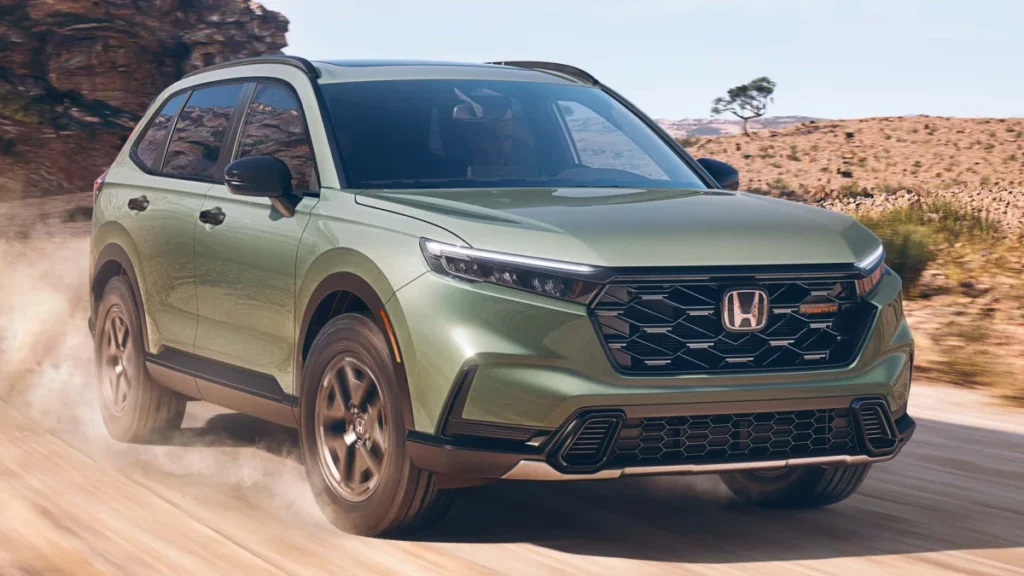
Visually, the teaser images suggest that the 2028 CR-V is ditching its historically conservative styling in favor of a much bolder, more aggressive exterior design. We expect to see sharper character lines, a more imposing front grille, and a stance that heavily emphasizes its new, sportier driving dynamics. While the full reveal is still pending, it is clear that Honda wants this new SUV to command attention on the road.
Celebrating Three Decades of Dominance
The arrival of the 2028 model year is perfectly timed to coincide with a massive milestone. In 2027, the Honda CR-V will officially celebrate its 30th anniversary.
When the first-generation model rolled onto the streets back in 1997, it helped invent and popularize the compact crossover segment. It proved to the world that you didn’t need a heavy, truck-based, gas-guzzling 4×4 to enjoy the benefits of a high driving position and practical cargo space.
Over the last three decades, it has morphed into one of Honda’s most critical global pillars. In the United States alone, cumulative sales of the CR-V have crossed an astronomical 7.5 million units. As of 2026, the vehicle is on track to surpass 400,000 annual sales in the US for the third consecutive year, defending its title as Honda’s best-selling vehicle in the country every single year since 2017.
The North American Manufacturing Push
Building this next-generation hybrid empire requires serious manufacturing muscle. The 2028 CR-V represents a critical piece of Honda’s broader, highly aggressive strategy to expand its electrified portfolio across North America.
The company is currently overhauling its US manufacturing footprint to prepare for an absolute explosion in hybrid production. In fact, Honda has publicly stated that its production capacity for hybrid systems will increase by a staggering 250 percent over the next few years.
The brand’s manufacturing facilities across Ohio, Indiana, and Canada will serve as the beating heart of this operation. Specifically, the highly advanced new four-cylinder Atkinson-cycle engine that will serve as the combustion component of the new CR-V’s powertrain will be proudly manufactured in Ohio. This localized production strategy not only secures thousands of jobs but also insulates the automaker from the fragile, unpredictable nature of global supply chains.
Will the Hybrid-Only CR-V Make Its Way to India?
While the North American market is buzzing with excitement over this radical new direction, automotive enthusiasts on the other side of the globe are left with a burning question: Will this highly advanced, hybrid-only CR-V ever hit Indian shores?
As of right now, Honda India has remained tight-lipped, announcing no official plans regarding the launch of the seventh-generation SUV in the subcontinent. The November 2026 announcement was laser-focused on the North American strategy and the corresponding manufacturing push in the US and Canada.
It is crucial to understand that global automotive markets operate on very different legislative and taxation frameworks. While the North American market is rapidly embracing premium hybrids, the Indian market presents a highly complex environment for imported or locally assembled hybrid vehicles. High taxation brackets on hybrid powertrains compared to pure EVs, combined with the cost-sensitive nature of the Indian premium SUV buyer, make launching a flagship hybrid SUV a tricky financial equation.
Therefore, the hybrid-only mandate for North America should not be taken as absolute confirmation that all global variants of the new CR-V will instantly lose their petrol-only options. Markets with different regulatory demands might still see conventional combustion engines depending on local feasibility. Until Honda makes a definitive statement regarding their Asian market strategy, the exact powertrain availability and launch timeline for the Indian market remain shrouded in mystery.
The Road Ahead
The upcoming 2028 Honda CR-V is not just another model year update; it is a definitive statement of intent from one of the world’s most respected automakers. By embracing a hybrid-only philosophy, developing an entirely new modular platform, and integrating cutting-edge electric all-wheel-drive technology, Honda is aggressively future-proofing its most valuable asset.
It clearly demonstrates how the brand plans to navigate the complex transition toward zero-emission mobility—providing consumers with vastly improved efficiency, stunning new aesthetics, and engaging driving dynamics, all without forcing them to compromise on the unparalleled practicality that made the CR-V a global icon in the first place. As we edge closer to the official unveiling in 2027, the automotive world will be watching very closely to see how this bold new chapter in the CR-V’s legacy unfolds.
