


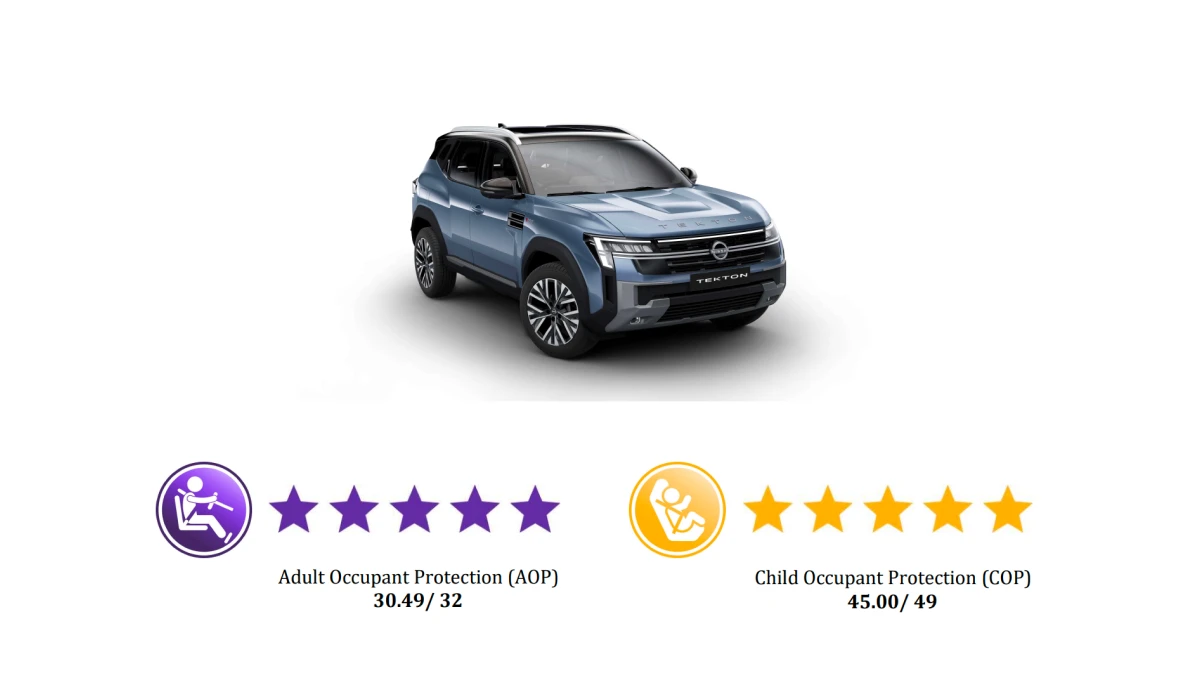
The highly competitive midsize SUV market in India has a disruptive new entrant that is prioritizing occupant safety right out of the gate. Japanese automaker Nissan has officially introduced its highly anticipated flagship, the Nissan Tekton, at a striking introductory baseline price of ₹10.49 Lakh (ex-showroom).
Even before standard deliveries commence on July 20, the midsize SUV has achieved a major milestone by securing a perfect 5-star safety rating under the official Bharat New Car Assessment Programme (BNCAP) crash evaluation parameters.
Dissecting the Crash Test Scorecard
The Bharat NCAP evaluation heavily tests structural integrity across different types of impacts. Because the Tekton serves as the direct mechanical platform twin to the newly debuted Renault Duster, the vehicle’s structural performance was evaluated based on shared body engineering, chassis load pathways, and uniform factory safety equipment.
To see exactly where the SUV gained and lost points across the specialized safety sub-categories, the official BNCAP data registry is broken down below:
| BNCAP Safety Category | Tested Crash Metric Parameters | Maximum Point Allocation | Official Points Secured | Resulting Percentage / Star Rating |
| Adult Occupant Protection (AOP) | Frontal & Side Deformable Barrier Impacts | 32.00 Points | 30.49 Points | 5-Star Rating |
| Child Occupant Protection (COP) | Dynamic Dummies, CRS Installation & Assessment | 49.00 Points | 45.00 Points | 5-Star Rating |
| Frontal Offset Test (64 kmph) | Structural Cabin Deflection & Airbag Timing | 16.00 Points | 14.49 Points | Good / Adequate Body Protection |
| Side Barrier Test (50 kmph) | Lateral Intrusion & Side Airbag Coverage | 16.00 Points | 16.00 Points | Perfect Full Point Clearance |
| Child Restraint System (CRS) | ISOFIX Anchor Stability & Installation | 12.00 Points | 12.00 Points | Perfect Full Point Clearance |
The Fine Print: Real-World Occupant Analysis
A deeper look at the Adult Occupant Protection (AOP) breakdown shows that the Tekton’s passenger cabin remained completely stable during the high-speed 64 kmph frontal offset crash. Both the driver and front co-driver received a “Good” protection rating across their heads, necks, thighs, and pelvic zones.
Chest protection for the driver was marked as “Adequate,” while passenger chest protection scored high with a “Good” rating. When it came to lateral impacts, the standard side chest and curtain airbags deployed flawlessly, helping the Tekton claim a perfect 16 out of 16 points in the side movable barrier evaluation.
Child Safety Excellence: A Major Asset for Families
For families, the Child Occupant Protection (COP) score is highly reassuring. Utilizing rearward-facing child seats attached via standard rear ISOFIX anchor points, the Tekton secured a perfect 24 out of 24 dynamic score for both 18-month-old and 3-year-old child dummies during crash impacts. It only lost small fractions of a point in the structural vehicle assessment category due to specific labeling guidelines, finishing with a strong 45 out of 49 total points.
Uncompromised Standard Safety Equipment
A core reason why this 5-star safety rating applies uniformly across the entire variant family—stretching from the base Visia trim up to the top-tier Tekna+ configuration—is Nissan’s refusal to skim on baseline safety hardware.
Every single variant of the Tekton comes equipped out of the factory with:
- Six Airbags As Standard: Dual front, front side, and full-length side curtain airbags.
- Active Electronic Safety Systems: Electronic Stability Control (ESC), Traction Control, and Hill Start Assist.
- Occupant Restraints: Three-point seatbelts with pre-tensioners and load limiters for all seating positions.
- High-Tier Trims (Tekna+): A sophisticated Level 2 ADAS active safety suite adding Adaptive Cruise Control, Blind-Spot Monitoring, Lane Keep Assist, and Collision Detection with Autonomous Emergency Braking.
Shaking Up the Segment
The safety scores hit the market at a crucial time. Safety has rapidly transitioned from a luxury addition to a primary dealbreaker for Indian buyers.
The Tekton is launching directly into a segment crowded with popular alternatives like the Hyundai Creta, Kia Seltos, Maruti Suzuki Grand Vitara, and its twin, the Renault Duster. It also squares up against newer entries like the Tata Sierra. By matching the elite safety standards of premium alternatives right at launch, Nissan has stripped away a major talking point from its competitors.
Final Takeaway
The Nissan Tekton represents a calculated step forward for the brand in India. Backed by solid platform architecture, standard 6-airbag protection, and a highly competitive entry price point, it stands out as an attractive option for family buyers. If you’ve been looking for a spacious midsize cruiser that places a high premium on structural crash protection, keeping the Tekton at the top of your shortlist is a smart choice.
To watch the exact crash impact tests, analyze cabin deformation frames, and see how the safety assist systems perform under real-time simulated conditions, check out this Nissan Tekton BNCAP Crash Assessment Video Analysis.
