


Ask any Indian family currently shopping for a ₹25 lakh to ₹30 lakh SUV why they haven’t switched to an electric vehicle yet, and you will almost always hear the same answer. They love the idea of silent, low-cost daily commuting through city traffic, yet they aren’t quite ready to plan a 900-kilometre highway road trip around unpredictable public fast chargers.
That exact hesitation is what the MG Hector Tomahawk PHEV sets out to eliminate. By pairing a 20.5kWh rechargeable battery and a punchy electric motor with a 1.5-litre petrol engine, MG is offering Indian buyers a genuine plug-in hybrid SUV capable of 115km of claimed electric-only driving and up to 1,100km of combined range.
To see whether those brochure promises actually hold up on Indian highways, Autocar India took the Tomahawk PHEV on an ambitious roughly 930km run from Gurugram to Ahmedabad—loaded up with four adults and their luggage—with a single goal: complete the entire journey without stopping once for fuel or a charge.
The result proves that plug-in hybrid technology has serious merit on Indian roads. Still, living with the Hector Tomahawk PHEV also reveals a handful of ergonomic and pricing compromises that buyers need to weigh carefully before signing a cheque.
Pricing, BaaS Strategy, and the ₹5 Lakh Question
Before looking at how the SUV drives, it helps to understand where MG has placed it on the price sheet. Standard ex-showroom prices for the MG Hector Tomahawk PHEV run between ₹25.70 lakh and ₹27.80 lakh.
To soften that upfront outlay, MG has also rolled out its Battery-as-a-Service (BaaS) programme for the Tomahawk PHEV. Opting for BaaS drops the starting price of the vehicle down to ₹21.79 lakh, paired with a separate battery rental fee of ₹3.20 per kilometre. For buyers who prefer lower initial loan amounts and predictable per-kilometre usage costs, BaaS makes the entry price far more approachable.
| Key Detail | MG Hector Tomahawk PHEV |
| Ex-Showroom Price Range | ₹25.70 lakh – ₹27.80 lakh |
| BaaS Starting Price | ₹21.79 lakh |
| BaaS Battery Rental | ₹3.20 per kilometre |
| Battery Capacity | 20.5kWh |
| Fuel Tank Capacity | 52 litres |
| Claimed EV-Only Range | 115km |
| Claimed Combined Range | Up to 1,100km |
| Seating Layout | 7 seats |
There is, however, one major financial hurdle sitting right inside MG’s own showroom: the Tomahawk PHEV carries roughly a ₹5 lakh premium over its all-electric counterpart. That is not loose change. Paying an extra five lakh rupees for the peace of mind of a petrol engine means buyers have to be honest about how often they actually take long-distance highway trips versus staying inside city limits.
Exterior Styling: Familiar, Functional, and Slightly Understated
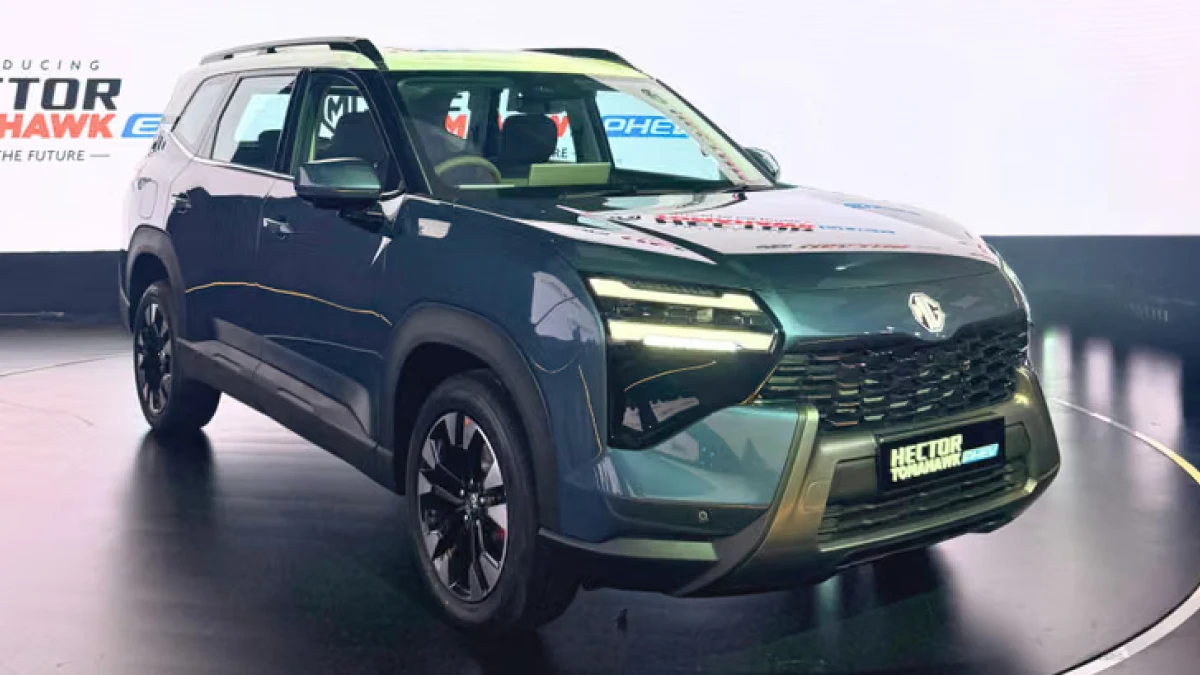
Parked next to its pure-electric sibling, the Tomahawk PHEV looks noticeably more traditional. While the EV wears a largely sealed-off nose, the plug-in hybrid needs airflow for its petrol engine—so MG has fitted a functional front grille finished with chrome inserts.
Below the rectangular LED headlamps sit gloss-black trim accents, anchored at the bottom by a chunky silver skid-plate-style bumper element that adds a touch of ruggedness. Rounding out the exterior details are:
- An illuminated MG logo on the nose
- 18-inch dual-tone alloy wheels
- Prominent black cladding around the wheel arches
- Roof rails and wraparound rear tail-lamps
- A two-tone rear bumper
- Red brake callipers reserved for the top-spec trim
Overall, the styling is clean, contemporary, and cohesive. If there is one mild critique to level at its exterior, it is road presence. While neat and well-proportioned, the Tomahawk PHEV doesn’t project the sheer, intimidating visual bulk that some larger three-row rivals command in a rearview mirror.
Inside the Cabin: Rich Materials Meet Touchscreen Overload
Open the doors, and the Hector Tomahawk PHEV immediately makes a strong first impression. The dark brown and black interior colour scheme looks genuinely upmarket, backed up by generous swathes of soft-touch leatherette across the dashboard and door pads.
As expected from an MG, the equipment list is stacked with crowd-pleasing luxury features:
- A massive 15.6-inch central touchscreen paired with an 8.8-inch digital instrument cluster
- Panoramic sunroof
- Powered and ventilated front seats with a driver-seat memory function
- Wireless Apple CarPlay and Android Auto
- 50W wireless smartphone charger
- 10-speaker Infinity audio system
- Powered tailgate and multi-colour ambient lighting
- Connected-car technology
Everyday cabin storage is well thought out too, with a sizeable glovebox, roomy door pockets, and deep stowage tucked beneath the front centre armrest.
Where the cabin stumbles is usability on the move. By funnelling far too many everyday vehicle functions into that 15.6-inch screen—and stripping away conventional physical buttons—MG has made simple adjustments unnecessarily distracting. Compounding the issue, the touchscreen interface itself is not always intuitive to navigate. Having to poke through sub-menus just to tweak basic settings while cruising at highway speeds is a frustration that a simple row of physical switches would have easily prevented.
Seating Comfort and Boot Practicality Across Three Rows
As a seven-seat family SUV, how the Hector Tomahawk PHEV treats passengers across all three rows matters just as much as its tech sheet.
Up front, the seats themselves are well-cushioned and supportive, yet the underlying packaging creates an ergonomic compromise. Because the floor sits relatively high and the seat base is slightly on the shorter side, taller drivers end up in a slightly knees-up seating position that reduces under-thigh support over multi-hour stints.
Move back to the middle row, and the Tomahawk PHEV hits its stride. Passengers here are treated to generous legroom, airy headroom, reclining backrests, and integrated rear sunshades. For chauffeur-driven owners or families doing long interstate drives, the second row is easily the best place to sit.
The third row, meanwhile, follows the familiar midsize seven-seater script. Headroom is surprisingly acceptable, but legroom is tight—making the rearmost bench best reserved for children or adults on short city hops rather than cross-state journeys.
| Boot Configuration | Available Luggage Capacity | Practical Use Case |
| All Three Rows Up | 192 litres | Daily school runs and small soft weekend bags |
| Third Row Folded Flat | 528 litres | Comfortable luggage space for four to five passengers on long highway trips |
With the third row folded away, opening up 528 litres of cargo room turns the Tomahawk PHEV into a genuinely practical five-seat tourer capable of swallowing full-sized family suitcases without a struggle.
Powertrain and Driving Performance: Seamless Four-Mode Engineering
The real star of the Hector Tomahawk PHEV sits beneath the bonnet. MG pairs a 1.5-litre naturally aspirated Atkinson-cycle petrol engine with a strong permanent-magnet electric motor and a 20.5kWh battery pack. Power goes strictly to the front wheels via a Dedicated Hybrid Transmission (DHT) equipped with an electromagnetic clutch.
| Powertrain & Charging Parameter | Specification |
| Petrol Engine | 1.5-litre naturally aspirated Atkinson-cycle (102hp / 125Nm) |
| Electric Motor | Permanent-magnet motor (201hp / 237Nm) |
| Battery Capacity | 20.5kWh |
| Transmission & Drivetrain | Dedicated Hybrid Transmission (DHT), Front-Wheel Drive |
| 3.3kW AC Home Charging (10–100%) | Approximately 7.5 hours |
| 25kW DC Fast Charging (30–80%) | Approximately 35 minutes |
Notice how the electric motor—delivering 201hp and 237Nm—does far more heavy lifting than the 102hp petrol engine. That is by design. Rather than making the driver babysit complicated switches, the DHT brain automatically cycles between four distinct operating modes:
- Pure EV Mode: The electric motor drives the front wheels silently using battery power alone.
- Series Hybrid Mode: The petrol engine fires up solely to act as an onboard generator feeding electricity, while the electric motor continues driving the wheels.
- Parallel Hybrid Mode: Both the petrol engine and electric motor work together to deliver maximum propulsion when overtaking or climbing inclines.
- Engine Direct Drive Mode: At steady cruising speeds where combustion efficiency peaks, the petrol engine clutches in to drive the wheels directly.
What impresses most from behind the wheel is how polished this whole mechanical orchestra feels. Transitions between electric power and the petrol engine happen smoothly and almost invisibly. Acceleration builds progressively without jerky surges, and the SUV retains plenty of responsive mid-range punch even at brisk highway speeds. Stamp hard on the accelerator from a standstill and you will notice a hint of torque steer tugging at the wheel, though it stays mild and easily manageable.
Real-World Range: Putting the 1,000km Claim to the Test
Plenty of hybrid cars look extraordinary on laboratory test cycles only to disappoint on real highways. The Hector Tomahawk PHEV backed up its numbers where it counts.
On paper, the 20.5kWh battery delivers 115km of electric-only range—more than enough for most urban commuters to cover two or three days of office runs without burning a drop of petrol, especially since an overnight 3.3kW AC charge takes roughly 7.5 hours from 10% to 100% (while 25kW DC fast charging tops it up from 30% to 80% in about 35 minutes).
Combined with its 52-litre petrol tank, MG quotes up to 1,100km of total range. On Autocar India’s real-world test from Gurugram to Ahmedabad—carrying four people plus luggage—the SUV completed the ~930km stretch without a single fuel or charging stop, leading to the clear conclusion that hitting around 1,000km in the real world is genuinely achievable with measured driving. For Indian highway tourers, crossing nearly a thousand kilometres non-stop without ever hunting for a working highway charger is a massive practical advantage.
Ride Quality, Handling, and Braking Feel
Out on open expressways, the Hector Tomahawk PHEV feels calm and planted. High-speed stability is reassuring, vertical body movements over bridge expansion joints are kept neatly in check, and body roll through sweeping bends remains well contained. Handling is predictable rather than sporty, and drivers who like tweaking steering feel can adjust steering weight via the custom driving mode.
Slow things down on broken city tarmac, however, and the low-speed ride feels firmer than ideal—though it is worth noting that the test vehicle was running higher-than-recommended tyre pressures, which likely exaggerated sharp bumps.
The one dynamic area that genuinely needs polish is the brake pedal. While the adjustable regenerative braking modes work smoothly and predictably, the physical brake pedal lacks crisp initial bite, forcing the driver to press firmer than expected during sudden stops.
MG Hector Tomahawk PHEV: Pros and Cons
| What Works Well (Pros) | What Could Be Better (Cons) |
| Smooth, responsive, and seamlessly calibrated hybrid powertrain | Heavy over-reliance on the touchscreen with minimal physical buttons |
| Genuinely useful 115km claimed EV-only range for daily commutes | Slightly knees-up front seating posture due to high floor and short squab |
| Proven ~930km–1,000km real-world highway range without stops | Third-row legroom is tight for adults on long journeys |
| Spacious, comfortable second row with recline and sunshades | Brake pedal lacks sharp initial bite |
| Loaded feature list and practical 528-litre boot (3rd row folded) | Steep ~₹5 lakh price premium over its pure-electric counterpart |
The Verdict: Should You Buy the MG Hector Tomahawk PHEV?
The MG Hector Tomahawk PHEV makes one of the strongest real-world arguments yet for plug-in hybrids in India. It delivers exactly what it promises: quiet, petrol-free urban commuting during the workweek, paired with the effortless ability to knock out a 930km interstate road trip on the weekend without once checking a charging app. Add in its smooth DHT powertrain, plush second-row comfort, and generous feature list, and it stands out as a genuinely clever family SUV.
Still, it isn’t the automatic right answer for every buyer. If your daily driving rarely leaves the city and you already have home charging, paying roughly ₹5 lakh extra over the pure-electric version is tough to justify—and you will still have to live with the screen-heavy ergonomics, slightly knees-up front seats, and soft initial brake bite.
If, however, you have a home charging point for weekday commutes and regularly embark on long-distance highway drives where charging infrastructure still feels hit-or-miss, the MG Hector Tomahawk PHEV hits a rare sweet spot that conventional petrol, diesel, and pure-electric SUVs simply cannot match on their own.
