


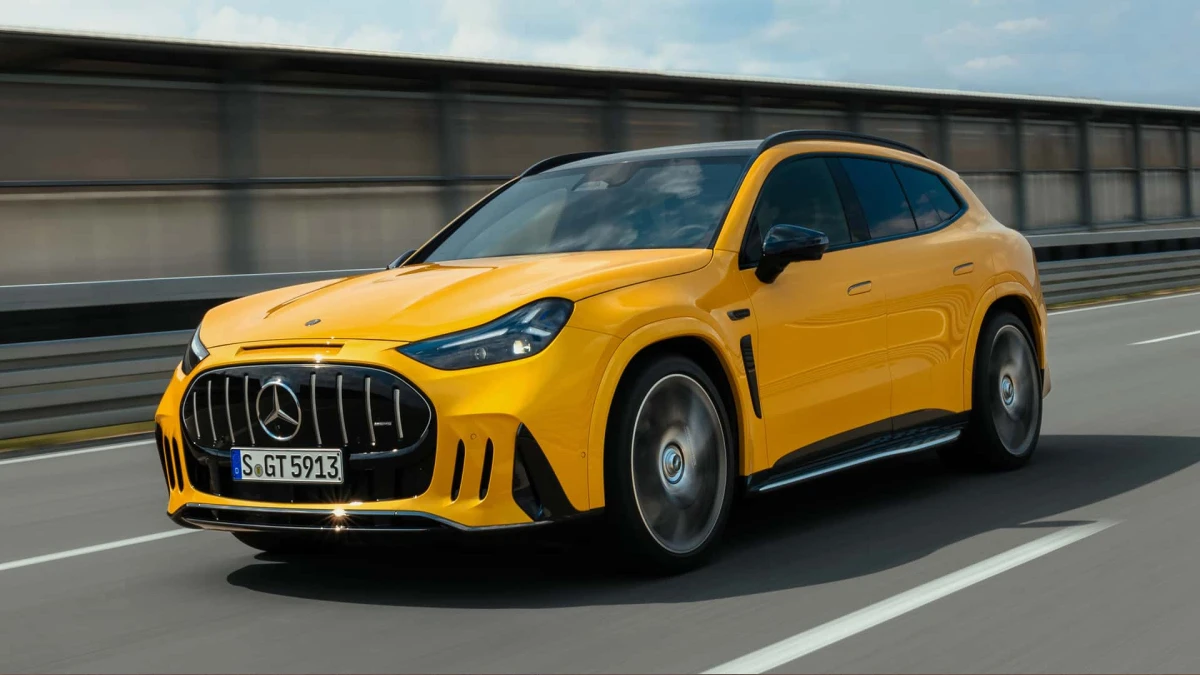
Mercedes-AMG has officially fired its heaviest artillery into the high-performance electric vehicle sector with the global reveal of its first bespoke all-electric SUV.
Designed entirely in Affalterbach from the ground up, the flagship Mercedes-AMG GT 63 SUV delivers a staggering peak output of 1,169hp and 2,000Nm of torque. However, sheer power is only part of the story. Utilizing an advanced 800V electrical architecture and battery options up to 128kWh, Mercedes claims this massive SUV can achieve up to 700km of WLTP range and accept mind-bending DC charging speeds of up to 710kW.
Set to be offered in three distinct power tiers—the GT 53, GT 55, and the terrifying GT 63—this is AMG’s definitive statement on the future of zero-emission grand touring.
Mercedes-AMG GT SUV: Variant-Wise Power and Performance
AMG is offering a tiered approach to performance, ensuring there is a model for varying levels of bravery. All versions utilize the AMG Performance 4MATIC+ fully variable all-wheel-drive system.
| Variant | Maximum Power | Maximum Torque | Battery Options | Motor Layout |
| GT 53 | 544 hp | 800 Nm | 106 kWh | 2 Synchronous Motors |
| GT 55 | 816 hp | 1,860 Nm | 106 / 128 kWh | 3 Axial-Flux Motors |
| GT 63 | 1,169 hp | 2,000 Nm | 106 / 128 kWh | 3 Axial-Flux Motors |
While the GT 53 uses a traditional dual-motor setup, the GT 55 and GT 63 employ a highly advanced tri-motor layout featuring lightweight axial-flux motors on the rear axle.
Editorial Context: It is crucial to understand that the 1,169hp figure on the GT 63 represents its absolute peak output, typically accessed during launch control. Its continuous, sustained output is officially rated at a still-massive 721hp. This distinction highlights the immense cooling capabilities required to sustain high-speed performance without battery derating.
Acceleration and Top Speed
The physics-defying acceleration figures put this large SUV firmly into hypercar territory.
- GT 63: 0–100km/h in 2.7 seconds (without rollout), or 2.5 seconds (with rollout).
- GT 55: 0–100km/h in 3.1 seconds (without rollout).
- GT 53: 0–100km/h in 4.2 seconds (without rollout).
For ultimate top-end speed, both the GT 63 and GT 55 can hit 270km/h when equipped with the optional AMG Driver’s Package, while the GT 53 tops out at 250km/h.
(Note: “Rollout” is a drag-racing metric that excludes the first foot of vehicle movement from the timer, resulting in slightly faster published times than a true dead-stop measurement).
Battery, Electric Range and Charging
Range anxiety and charging downtime are the traditional enemies of performance EVs. AMG aims to obliterate both.
| Version / Battery | Claimed WLTP Range | Maximum DC Charging |
| GT 53 (106kWh) | 597–668 km | 600 kW |
| GT 55 / 63 (106kWh) | 525–585 km | 600 kW |
| GT 55 / 63 (128kWh) | 620–700 km | 710 kW |
The charging capabilities are industry-leading. Mercedes claims the 128kWh battery version can accept up to 710kWof DC fast charging. Under optimal conditions, this allows the SUV to add up to 454km of WLTP range in just 10 minutes, executing a 10–80% state-of-charge sprint in a mere 12 minutes. The smaller 106kWh battery is equally impressive, charging from 10–80% in just 11 minutes at 600kW.
The Real-World Caveat: These phenomenal charging speeds require highly specialized, ultra-high-power charging infrastructure that is currently exceedingly rare. In the real world, your charging speed will be bottlenecked by the station you plug into, and your actual range will fluctuate based on your driving aggression, ambient weather, and tire choice.
What Makes the AMG GT SUV’s Battery Different?
This isn’t a standard Mercedes EQ battery retrofitted for AMG use. The powerpack was developed with direct knowledge transfer from the Mercedes-AMG Petronas Formula 1 team.
- 800V Architecture: Allows for thinner, lighter wiring and rapid charging.
- Direct Liquid Cooling: Unlike conventional batteries that cool the entire module, this system circulates non-conductive cooling liquid directly around every single cylindrical cell.
- Thermal Management: A massive central cooling system ensures the battery remains in its optimal temperature window during repeated full-throttle acceleration runs or sustained high-speed track use, severely delaying the thermal throttling that plagues lesser EVs.
Exterior Design and Aerodynamics
The GT SUV abandons the slippery, jellybean shapes of the standard EQ range in favor of brutal, muscular aggression.
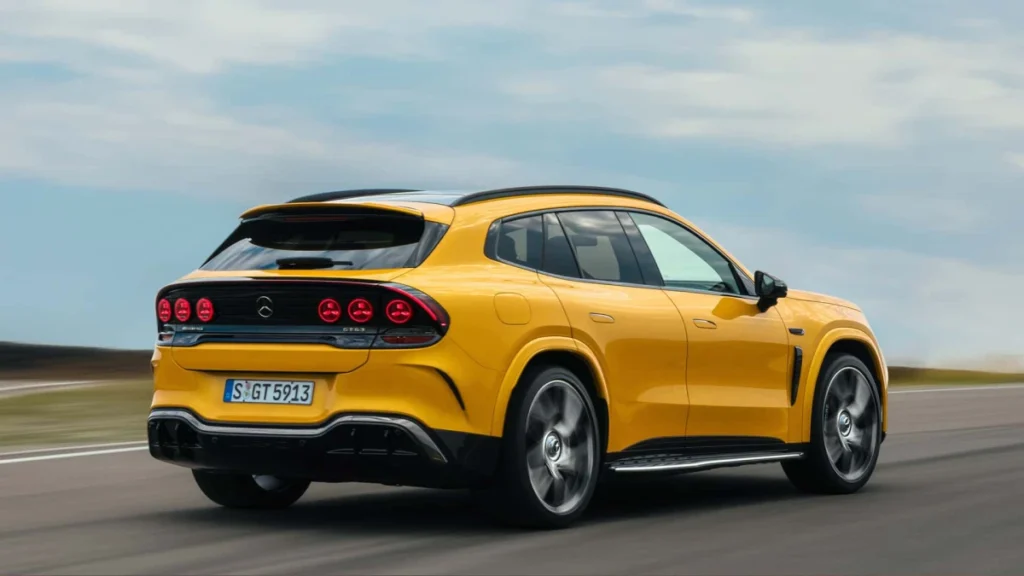
It features an incredibly wide track, massive swollen shoulders, and a low, sloping roofline that sacrifices absolute headroom for aerodynamic efficiency. The front fascia is dominated by an AMG-specific grille (with optional illumination) and striking star-shaped daytime-running lights.
Aero management is highly active: a front air-control panel opens and closes to balance cooling needs against aerodynamic drag, while the GT 55 and GT 63 feature an active rear spoiler that adjusts automatically at high speeds. The rear is signed off with six dramatic, circular turbine-style taillights.
Interior and Technology
Inside, the cabin balances hardcore AMG aesthetics with immense digital real estate.
- Displays: A 10.2-inch digital instrument cluster pairs with a massive 14-inch central infotainment display. A 14-inch passenger-side screen is optional.
- Software: The system runs the latest MBUX architecture, uniquely integrating AI agents including ChatGPT, Microsoft Bing, and Google Gemini for advanced voice assistance.
- Telemetry: Dedicated AMG Performance, AMG Set-Up, and AMG Track Pace applications allow drivers to monitor real-time battery temperatures, torque vectoring, and lap times.
- Layout: Despite the sloping roof, it remains a practical five-seat cabin featuring a three-seat rear bench, covered by a panoramic glass roof with switchable transparency.
AMG Active Ride Control+ Suspension
Translating 2,000Nm of torque into usable grip requires extraordinary chassis hardware.
Standard on the GT 63 (and optional on the GT 55), the AMG Active Ride Control+ suspension system utilizes adjustable air springs paired with active pitch and roll stabilization. This completely eliminates traditional anti-roll bars, replacing them with interconnected hydraulic actuators that actively fight body roll in corners while allowing individual wheel articulation over rough tarmac.
Combined with active rear-wheel steering and fully variable torque distribution capable of sending power to individual wheels in milliseconds, the heavy SUV promises sports-car-level cornering precision.
Boot Space and Practicality
Despite the hypercar performance, it remains a highly practical family hauler. The manufacturer lists a generous 607-litre boot with the rear seats in place, expanding to a cavernous 1,740 litres with the bench folded flat. Furthermore, the absence of a massive V8 engine allows for a dedicated 78-litre “frunk” (front trunk) to neatly store charging cables.
Mercedes-AMG GT SUV Price and Launch Timeline
Patience is required. The GT 53 will be the first variant to hit the European market, with order books opening at a starting price of €113,050 (including German VAT). The more extreme GT 55 and GT 63 variants are not scheduled to follow until spring 2027.
Production will take place at the historic Mercedes-Benz Sindelfingen plant in Germany.
India Launch Context: As of October 2026, Mercedes-Benz India has absolutely no official timeline regarding local availability or pricing for the AMG GT SUV. Direct currency conversions are futile; when it does eventually arrive, heavy import duties and luxury taxes will inflate the price tag significantly.
(Note: Base prices for GT 55 and GT 63 in the widget are estimates based on standard AMG pricing hierarchies, as official figures are pending).
Rivals — Porsche Cayenne Electric and Other Performance SUVs
When the AMG GT SUV finally hits the streets, it will face a firing squad of elite electric performance.
Its most direct and ruthless rival will be the upcoming Porsche Cayenne Electric, which will counter AMG’s brute force with Porsche’s legendary handling dynamics. It will also square off against the Lotus Eletre R (905hp) and the upcoming electric iteration of the Range Rover Sport.
When comparing these titans, buyers must look beyond the headline horsepower figure. The true measure of engineering dominance will be determined by sustained thermal management, real-world WLTP range, and how effectively the suspension can mask the immense weight of the battery packs during high-speed cornering.
Our Verdict
The 2028 Mercedes-AMG GT SUV is a violent, unapologetic expansion of AMG’s electric portfolio. By pairing up to 1,169hp and 2,000Nm of torque with an incredible 700km range and 710kW charging capabilities, Affalterbach has effectively silenced range-anxiety critics while delivering hypercar acceleration.
The integration of F1-derived battery cooling and the Active Ride Control+ suspension proves that this SUV is engineered for sustained abuse, not just a single 0-100km/h party trick. The ultimate test, however, will be whether it can deploy this physics-bending performance consistently while retaining the plush touring comfort expected of a vehicle wearing the three-pointed star. For Indian buyers, the wait will be long, but the sheer scale of the engineering on display suggests it will be worth it.
FAQs
How much power does the 2028 Mercedes-AMG GT SUV produce?
The flagship GT 63 variant produces a peak output of 1,169hp and 2,000Nm of torque. The GT 55 produces 816hp, and the GT 53 produces 544hp.
What is the claimed range of the Mercedes-AMG GT SUV?
Depending on the battery and variant, the SUV claims a WLTP range spanning from 525km up to a maximum of 700km on the 128kWh battery.
How quickly can the AMG GT SUV charge?
Equipped with an 800V architecture, the 128kWh battery can accept DC fast charging up to an incredible 710kW, allowing a 10–80% charge in just 12 minutes.
What battery options are available?
Buyers can choose between a 106kWh battery pack or a larger 128kWh battery pack on the GT 55 and GT 63 variants.
How fast is the Mercedes-AMG GT 63 SUV?
The GT 63 can accelerate from 0–100km/h in 2.7 seconds (without rollout) and hit an optional top speed of 270km/h.
What are the differences between GT 53, GT 55 and GT 63?
The GT 53 utilizes a dual-motor setup, while the GT 55 and GT 63 utilize a highly advanced tri-motor setup featuring axial-flux rear motors for massively increased horsepower and torque.
Will the Mercedes-AMG GT SUV launch in India?
As of October 2026, Mercedes-Benz has not announced an official launch date or expected pricing for the Indian market.
