


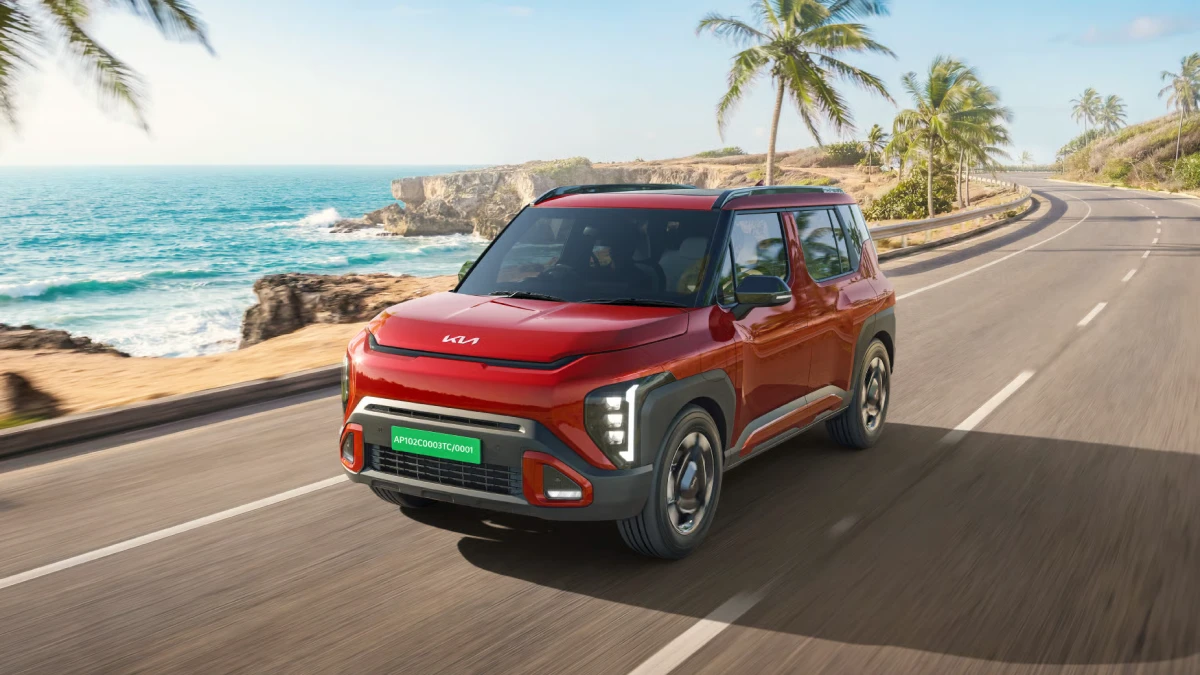
Kia Motors India has outlined its strategic roadmap targeting 10 core models by 2030, with eight of those models featuring electrified or alternative-fuel powertrains. Rather than committing exclusively to pure battery electric vehicles (BEVs), Kia is deploying a multi-powertrain model designed to meet diverse Indian driving conditions, infrastructure limits, and price points.
From localized mass-market EVs like the newly launched Syros EV to a strong-hybrid Kia Seltos and factory-fitted CNG models, Kia’s long-term plan targets an annual sales volume of 410,000 units and a 7.6% domestic market share by the end of the decade.
Here is an in-depth breakdown of Kia’s product slate, technology rollout, and market positioning.
1. Kia India 2030 Strategy at a Glance
Kia’s dual-track policy balances zero-emission battery electric vehicles with transitional technologies like strong hybrids and CNG. The company projects that electrified vehicles (EVs and hybrids combined) will account for nearly 43% of its total domestic sales by 2030.
The table below summarizes the key pillars, target models, powertrain distribution, and volume goals under the Kia India 2030 expansion plan:
| Strategic Pillar | Core Focus / Powertrain Tech | Target Models / Nameplates | Projected Market Impact & Goal |
| Mass-Market Electrification | Dedicated BEV platforms with 420–525 km range | Syros EV, Carens Clavis EV, EV6, EV9 | Capture high-volume urban EV market; establish local assembly |
| Localized Strong Hybrids | Parallel-hybrid powertrains (Localized ICE + Motor) | Seltos Strong-Hybrid, Future Mid-Size MPVs | Direct challenge to Maruti/Toyota hybrid dominance |
| Factory-Fitted CNG | Integrated Dual-Cylinder / Underbody CNG setups | Syros CNG, Sonet CNG, Carens CNG | Lower daily running costs for fleet & suburban buyers |
| Flagship Technology halo | Imported e-GMP Architecture (800V ultra-fast charging) | Kia EV6 GT, Kia EV9 Flagship SUV | Premium brand perception and tech demonstration |
| Overall 2030 Targets | 10 Models (8 Electrified/Alt-Fuel) | Full SUV and MPV Portfolio | 410,000 annual sales; ~7.6% Indian PV market share |
2. Mass-Market EV Lineup: Syros EV and Carens Clavis EV
The cornerstone of Kia’s domestic EV expansion relies on localized, high-volume models built in India rather than high-cost CBU imports. Following the global halo launches of the EV6 and EV9, Kia is focusing on practical, family-oriented electric platforms.
- Kia Syros EV: Positioned in the competitive sub-4 meter crossover space, the Syros EV features an Extended Range (ER) variant powered by a 51.4 kWh floor-mounted battery pack delivering an MIDC-certified range of up to 526 km. Delivering 169 bhp and 255 Nm of torque, it brings multi-mode regenerative braking, single-pedal iPEDAL driving, and 39-minute fast charging to urban buyers.
- Kia Carens Clavis EV: Aimed at family buyers and executive fleet transport, the Carens Clavis EV shares core drivetrain architecture with the Syros EV. It prioritizes 3-row seating utility, low operational noise/vibration profiles (NVH), and flexible cargo configurations.
Kia Electric Vehicle Portfolio Specification Matrix
| Vehicle Model | Segment / Body Style | Battery Capacity / Output | Claimed Range / Charging Time | Target Audience |
| Kia Syros EV (Standard) | Sub-4M Crossover | ~42 kWh / 134 bhp | ~400 km / 10-80% in 45 mins | City commuters & young professionals |
| Kia Syros EV (Extended) | Sub-4M Tallboy SUV | 51.4 kWh / 169 bhp / 255 Nm | 526 km (MIDC) / 10-80% in 39 mins | Long-distance suburban & highway users |
| Kia Carens Clavis EV | 3-Row Family MPV | 51.4 kWh / 169 bhp | ~450 km (MIDC) / Fast Charging Capable | Large families & premium fleet buyers |
| Kia EV6 | Electric Crossover (Import) | 77.4 kWh / Up to 320 bhp | 708 km (ARAI) / 10-80% in 18 mins (350kW) | Luxury EV enthusiasts |
| Kia EV9 | Flagship 3-Row EV SUV | 99.8 kWh / 379 bhp | 561 km (WLTP) / 800V Ultra-Fast Charging | Executive luxury & tech early-adopters |

3. Strong-Hybrid Localization: The Seltos Hybrid Strategy
While electric vehicles continue their steady growth, Kia recognizes that charging infrastructure limitations and highway range anxiety make Strong Hybrids (HEVs) an attractive middle ground for many buyers.
The company has officially confirmed engineering development on a Strong-Hybrid version of the popular Kia Seltos mid-size SUV.
- Localization Drive: To keep price tags competitive against established rivals like the Toyota Urban Cruiser Hyryder and Maruti Suzuki Grand Vitara, Kia is heavily localizing hybrid components—including electric drive motors, power control units, and battery packs—within India.
- Real-World Efficiency: The Seltos Hybrid will combine an efficient petrol engine with a self-charging electric motor, allowing the SUV to run on pure electric power during low-speed, stop-and-go city traffic while delivering 22+ km/l fuel efficiency without requiring wall chargers.
- Platform Flexibility: By adapting its mid-size architecture, Kia can potentially offer the Seltos plate across petrol, diesel, strong-hybrid, and pure-electric configurations in the future depending on market requirements.
4. Transitioning to Factory-Fitted CNG Vehicles
To capture cost-conscious buyers who want minimal per-kilometer running costs, Kia is actively moving away from third-party or dealer-level CNG kits in favor of factory-fitted CNG technology.
Why Factory CNG Matters for Kia’s Growth
- Safety & Integration: Factory-installed CNG setups integrate gas injectors, high-pressure lines, and dual ECU management directly into the manufacturing pipeline, preserving vehicle safety ratings and factory warranties.
- Boot Space Optimization: Kia is studying twin-cylinder and underbody tank configurations similar to those used by market leaders, eliminating the issue of a traditional bulky CNG tank consuming all available trunk space.
- Model Selection: Factory CNG options are being evaluated across the Kia Carens MPV, Syros, and Sonet lineups to challenge Maruti Suzuki and Tata Motors in high-volume urban markets.
Fuel Technology Comparison: Electric vs. Hybrid vs. CNG
| Metric / Dimension | Battery Electric (BEV) | Strong Hybrid (HEV) | Factory CNG (Bi-Fuel) |
| Fuel / Energy Source | Grid Electricity (DC/AC Chargers) | Petrol + Regenerative Energy | Compressed Natural Gas + Petrol |
| Per-Kilometer Running Cost | Lowest (₹0.80 – ₹1.20 / km) | Moderate (₹3.50 – ₹4.20 / km) | Low (₹2.20 – ₹2.80 / km) |
| Infrastructure Reliance | Public Fast-Charging Network | Standard Petrol Pumps (No Charging) | CNG Station Network |
| Upfront Vehicle Cost | Premium (Due to Battery Pack) | Mid-to-High Tier | Affordable / Budget-Friendly |
| Best Utility Profile | Daily City Commuting & Urban Hubs | High-Mileage Highways & Long Trips | High-Frequency Urban & Commercial Travel |
5. Market Drivers: Why Multi-Powertrains Win in India
Kia India’s strategy reflects the realities of the Indian automotive market heading toward 2030:
- Infrastructure Disparities: While Tier-1 metropolitan areas are expanding DC fast-charging networks rapidly, Tier-2 and Tier-3 cities still face charging gaps. Offering hybrids and CNG alongside EVs allows Kia to capture sales across all geographic tiers.
- Fluctuating Battery Costs: Maintaining ICE, hybrid, and CNG alternatives protects Kia’s sales margins against potential global lithium or raw-material supply shocks.
- Consumer Freedom of Choice: Rather than forcing buyers into a single powertrain category, Kia’s approach allows customers to choose based on their daily mileage, home charging access, and budget constraints.
Final Summary
Kia India’s 2030 roadmap is a practical, multi-technology growth plan. By pairing localized electric crossovers like the Syros EV with strong-hybrid Seltos variants and factory-fitted CNG offerings, Kia is positioning itself to cater to every buyer segment in the Indian passenger vehicle market.
