


Five years ago, the industry narrative was simple: EVs will rapidly replace petrol and diesel, end of story. Fast forward to today, and the script has flipped. Mercedes-Benz is aggressively launching plug-in hybrids, MG has rolled out an entirely flexible platform, BYD is championing its Dual Mode Intelligent Hybrid system, and Toyota is doubling down on the strong hybrids it pioneered. Even BMW continues to expand its PHEV lineup.
Suddenly, everyone isn’t just building EVs. They are building multiple powertrains.
The Automotive Industry Has Changed
Earlier, the roadmap looked like a straight line: ICE → EV.
Today, that linear path has fractured into a spectrum: ICE → Hybrid → Plug-in Hybrid → Range Extender → EV → Hydrogen.
The industry has collectively realized a hard truth: one solution doesn’t fit every country, every climate, or every driver.
Why EVs Alone Can’t Solve Every Problem
Electric vehicles are phenomenal, but they face distinct hurdles depending on the market:
- Charging Infrastructure: Highly developed in parts of Europe and China, but lagging in regions like India.
- Apartment Living: Not everyone has a dedicated driveway for a home charger.
- Long Highway Trips: Charging anxiety remains a psychological barrier for single-car households.
- Cold Weather: Sub-zero temperatures can slash battery range.
- Grid Limitations: Expanding infrastructure requires massive national investment.
- Changing Incentives: Governments worldwide (like the USA and parts of Europe) are adjusting or pulling back EV subsidies, heavily altering purchase prices.
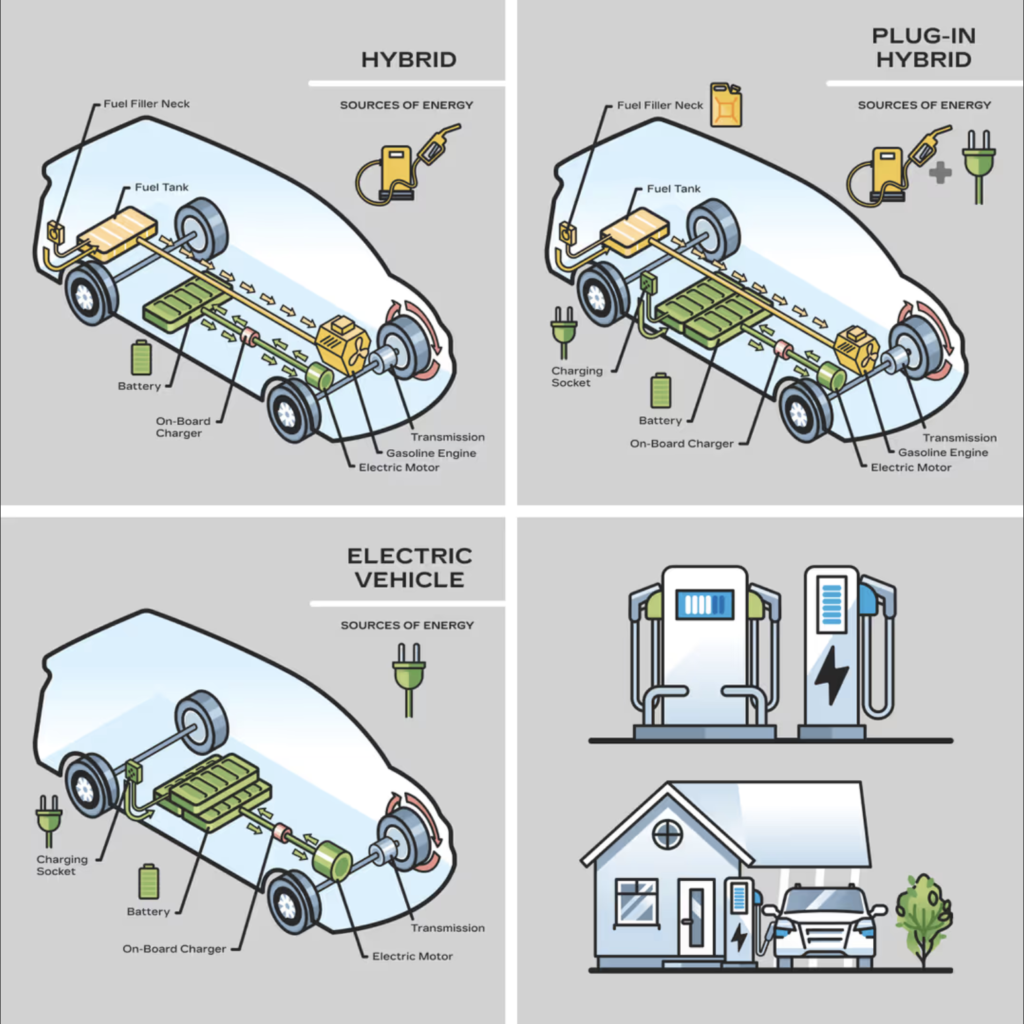
Understanding Every Electrified Powertrain
Strong Hybrid
A strong hybrid uses both a battery-powered electric motor and a petrol engine. There is no external charging. The engine charges the battery, and the battery assists the engine (or drives the car independently at low speeds).
- Examples: Toyota Innova Hycross, Toyota Camry, Honda City e:HEV.
- Pros: Incredible fuel efficiency, zero range anxiety, seamless transition.
- Cons: Small electric-only range, still emits tailpipe emissions.
Plug-in Hybrid (PHEV)
A PHEV features a much larger battery that you charge externally, alongside a petrol engine. You can drive roughly 50-100 km purely on electric power. Once depleted, the petrol engine kicks in for long trips.
- Examples: Mercedes-Benz GLE 350e, Volvo XC60 Recharge.
- Pros: Electric for daily commutes, petrol for weekend road trips.
- Cons: Heavy, expensive, and requires disciplined daily charging to be effective.
Range Extender (EREV)
Often misunderstood, a range extender car is always driven by its electric motor. The petrol engine never directly turns the wheels; it acts purely as an onboard generator to create electricity for the motor and battery.
- Examples: Nissan e-Power, upcoming MG and BYD models, Li Auto, and the historical BMW i3 REx.
- Why China Loves It: Delivers the smooth, instant-torque feel of an EV without the range anxiety.
Pure EV (BEV)
The simplest architecture: a massive battery pack and an electric motor. No petrol engine, no exhaust, no complex mechanical transmission.
- Pros: Zero tailpipe emissions, instant torque, lowest running costs.
- Cons: Reliant entirely on charging infrastructure, heavy batteries.
Why Flexible Platforms Are Becoming the New Normal
Instead of spending billions to develop four separate chassis for four different powertrains, manufacturers are designing one architecture that handles them all. MG’s ADAPT platform is a prime example. This single platform can roll out an EV, a Strong Hybrid, a Plug-in Hybrid, or a Range Extender.
This drastically cuts manufacturing costs, simplifies supply chains, and future-proofs the brand against sudden shifts in government regulations or consumer demand. This flexibility is arguably the biggest structural evolution in modern automotive manufacturing.
Why Battery Sizes Are Growing in Plug-in Hybrids
Early PHEVs offered a meager 30 km of electric range. Today, that number has surged to 100 km, 125 km, and even more in newer models. This means most users can handle their entire daily commute purely on battery power without burning a drop of fuel, reserving the petrol engine strictly for weekend getaways. It is the truest realization of the “best of both worlds” promise.
Why Toyota Still Leads Hybrid Technology
While Chinese brands are aggressively pursuing PHEVs and Range Extenders, they rarely challenge Toyota on Strong Hybrids. Through cars like the Prius, Hyryder, and Camry, Toyota has refined its hybrid synergy drive over 25 years. This decades-long head start in managing the complex software and mechanical handoffs between engine and motor is exactly why Toyota still owns the crown for pure hybrid efficiency.
Regional Strategies: China, Europe, and India
Why China Is Focusing on Plug-in Hybrids
Brands like BYD, Li Auto, Geely, and Great Wall are dominating the PHEV and Range Extender space. Thanks to massive manufacturing scale, cheap battery cells, and strong government support, they can package large batteries into affordable vehicles that offer vast electric ranges alongside fuel backup.
Why Europe Loves Plug-in Hybrids
In Europe, brands like BMW, Mercedes, Audi, and Porsche lean heavily into PHEVs. The continent’s strict emissions regulations, low-emission urban zones, and heavily incentivized company-car tax structures make PHEVs highly attractive for motorway commuters who also drive in tight city centers.
Why India Is Different
India’s adoption curve is entirely different. Public charging is still improving, and long highway trips remain challenging for pure EVs. While diesel historically ruled the SUV segment, the current tax structure severely impacts hybrid adoption: EVs enjoy a low 5% GST, while strong hybrids face much higher luxury tax brackets. This tax discrepancy affects adoption in India far more than the technology itself.
Hybrid vs Plug-in Hybrid vs EV
| Feature | Hybrid | Plug-in Hybrid | Pure EV |
| External Charging | ❌ | ✅ | ✅ |
| Petrol Engine | ✅ | ✅ | ❌ |
| Electric Range | Very Low | 50-150 km | Full Range |
| Highway Travel | Excellent | Excellent | Depends on chargers |
| City Travel | Excellent | Excellent | Excellent |
| Running Cost | Low | Very Low | Lowest |
| Purchase Price | Medium | High | High |
Is Plug-in Hybrid Really the Best of Both Worlds?
It depends entirely on your habits. If you charge it at home daily, it is amazing. If you don’t charge it, you are lugging around a heavy battery, an electric motor, and a petrol engine. Your fuel economy drops due to the excess weight, running costs rise, and you pay a premium for technology you aren’t utilizing.
Home Charging Matters More Than People Think
Many buyers purchase PHEVs thinking, “I have petrol backup, so I don’t need a home charger.” This defeats the purpose. Home charging is the key that unlocks the technology. Without a dedicated plug at home or work, the battery remains underused, and a PHEV essentially becomes a heavy, less efficient petrol car.
Could Plug-in Hybrids Replace Diesel SUVs?
As emission norms strangle diesel engines, manufacturers are pivoting. MG is explicitly targeting the diesel SUV segment (like the XUV7XO Diesel), and Mercedes is launching Diesel PHEVs to bridge the gap. While diesel offers unmatched highway efficiency, the sheer refinement and low-speed torque of a PHEV electric motor present a highly viable, cleaner future for heavy SUVs.
New Technology Coming
The powertrain evolution isn’t stopping here. The next wave includes:
- Integrated Drive Units: 10-in-1 systems combining motors, inverters, and gears to save space and weight.
- Higher Thermal Efficiency: Engines explicitly designed with electromagnetic clutches just to generate electricity.
- Software-Defined Vehicles (SDVs): Over-the-air (OTA) updates tweaking battery management and power delivery.
- Falling Battery Costs: Making large-battery PHEVs cheaper to produce.
Future Trends (2027-2035)
Expect a deeply fragmented market rather than a single winner. We will see more hybrids, longer-range PHEVs, highly efficient Range Extenders, and EVs utilizing solid-state batteries. Powertrains will be software-optimized, and flexible manufacturing platforms will rule the decade.
Timeline of Electrification (1997–2035)
- 1997: Toyota Prius launches, pioneering the strong hybrid.
- 2010s: Early hybrids evolve while EVs prove viability.
- 2020s: Massive growth of PHEVs and Range Extenders to cure range anxiety.
- 2025+: Flexible platforms normalize multi-powertrain manufacturing.
- 2030+: Solid-state batteries and smart charging redefine pure EV capabilities.
Brand Strategy Comparison
| Brand | Current Powertrain Focus |
| Toyota | Strong Hybrids |
| Honda | Strong Hybrids + EVs |
| MG | EVs + PHEVs + Range Extenders |
| BYD | EVs + PHEVs |
| Mercedes-Benz | PHEVs + EVs |
| BMW | PHEVs + EVs |
| Volvo | PHEVs + EVs |
Beginner’s FAQ: Understanding the Technology
If all these terms still feel like a foreign language, here is a simplified breakdown to help you navigate the showroom floor:
1. What is the main difference between a Hybrid and a Plug-in Hybrid? A standard hybrid (often called a “Strong Hybrid” or “Self-Charging Hybrid”) charges its own battery automatically using the petrol engine and regenerative braking—you never plug it into a wall. A Plug-in Hybrid (PHEV) has a much larger battery that you must plug in to fully charge, granting you 50-100 km of pure electric driving before the engine is needed.
2. What happens if my Plug-in Hybrid runs out of battery on the highway? Nothing scary! Once the battery depletes its electric-only range, the car automatically and seamlessly switches to running on the petrol engine, acting exactly like a normal hybrid car. You will never be stranded as long as you have petrol in the tank.
3. I live in an apartment and can’t charge a car at home. Which one should I buy? If you don’t have guaranteed home or workplace charging, skip the Plug-in Hybrid and the Pure EV. A Strong Hybrid is your best bet—you fuel it up with petrol exactly like a regular car, but you get incredible fuel efficiency because it manages its own electric battery automatically.
4. What exactly is a Range Extender? Is it a hybrid or an EV? Think of it as an electric car that carries its own portable power plant. The car is always driven exclusively by the electric motor, giving you that smooth, instant EV acceleration. The petrol engine on board never drives the wheels directly; it only turns on to act as a generator, creating electricity for the battery when it gets low.
5. Are EVs really cheaper to run? Yes, if you charge at home, the cost per kilometer is significantly lower than buying petrol or diesel. However, fully electric cars are often more expensive to purchase upfront. You have to balance the higher sticker price with the lower daily running costs, reduced maintenance, and local government tax benefits to see if it saves you money in the long run.
Final Verdict
The future of mobility isn’t about replacing one technology with another—it’s about matching the right technology to the right customer. A city commuter with home charging may find an EV ideal. A family that regularly travels long distances might prefer a plug-in hybrid. Buyers who want lower fuel consumption without changing their driving habits may still choose a strong hybrid. Rather than converging on a single solution, the industry is expanding its choices, and that’s likely to define the next decade of automotive innovation.
Image Source – folksmotor

4 Comments
Pingback: MG Hector Tomahawk PHEV Launched at ₹25.70 Lakh With 1,100 km Range
Pingback: MG Hector Tomahawk EV Launched at ₹19.50 Lakh With 517 km Range
Pingback: Spinny Partnership with Nissan, MG And Tesla Reshape Vehicle Exchange Ecosystem
Pingback: JSW Combat to Debut on December 4: 360hp PHEV SUV Details - Motor Futurist