


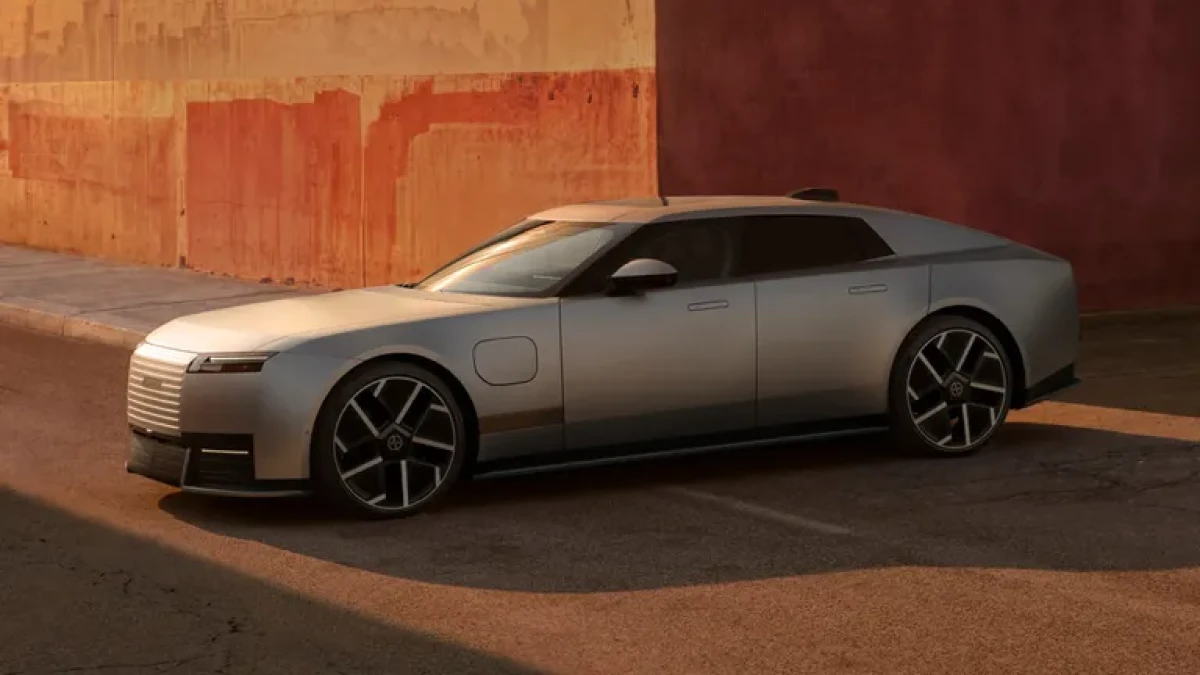
Jaguar has permanently closed the chapter on its traditional design language with the reveal of the production-spec Type 01, marking the first all-new model of the brand’s highly controversial, entirely rebooted era. Evolving from the dramatic Type 00 concept into a road-going four-door electric GT, the Type 01 combines a staggering 1,030hp tri-motor powertrain with a 120kWh battery and a claimed 720km WLTP range.
This isn’t simply another luxury electric vehicle designed to chase sales volumes. Jaguar is utilizing the Type 01 as a complete philosophical reset, actively walking away from its traditional styling cues to redefine its future as an ultra-luxury, design-led manufacturer.
Jaguar Type 01: What Is It?
The Type 01 serves as the foundational pillar for the British automaker’s reinvention. It is the production realization of the Type 00 concept showcased in late 2024, functioning as a hyper-premium four-door electric grand tourer.
Underneath the striking bodywork, the car is built around the brand-new Jaguar Electric Architecture (JEA), a dedicated 850V platform engineered specifically for this new generation of vehicles. The resulting vehicle features extremely low, wide proportions and a strict four-seat layout. Every surface has been designed to physically distance Jaguar from its heritage aesthetic, leaning heavily into a design ethos the company describes as “exuberant modernism.”
Global deliveries for the Type 01 are officially scheduled for mid-2027. The Indian market is expected to follow suit just a few months later, cementing Jaguar’s intentions to aggressively push its new flagship into global luxury hubs.
Jaguar Type 01 Design – Jaguar Looks Completely Different Now
The visual identity of the Type 01 is intentionally polarizing, shedding decades of recognizable design heritage in favor of brutalist, slab-sided modernism.
New “Strikethrough” Front Design
The most immediate shock is the front fascia. Jaguar has introduced a new horizontal “strikethrough” design element that gives the vehicle a pronounced, grille-like appearance—a bold stylistic choice for a pure EV that requires minimal front cooling. Hidden behind this facade are active aerodynamic shutters that silently handle thermal management.
Flanking the strikethrough are four-line DRLs and what the company claims are the slimmest headlights ever fitted to a production Jaguar. Traditionalists will also notice a glaring omission: the iconic leaping Jaguar mascot has been entirely removed from the bonnet, replaced by a minimalist aesthetic.
23-Inch Wheels and Long Proportions
The physical footprint of the Type 01 is vast, emphasizing a low-slung, stretched stance.
| Dimension / Element | Jaguar Type 01 |
| Wheelbase | 3.2 metres |
| Height | 1,400 mm |
| Wheels | 23-inch |
| Drag coefficient | 0.23 Cd |
Achieving a 0.23 Cd drag coefficient is a testament to the vehicle’s aerodynamic efficiency, ensuring that the massive 23-inch wheels and blunt nose do not severely compromise high-speed highway cruising range.
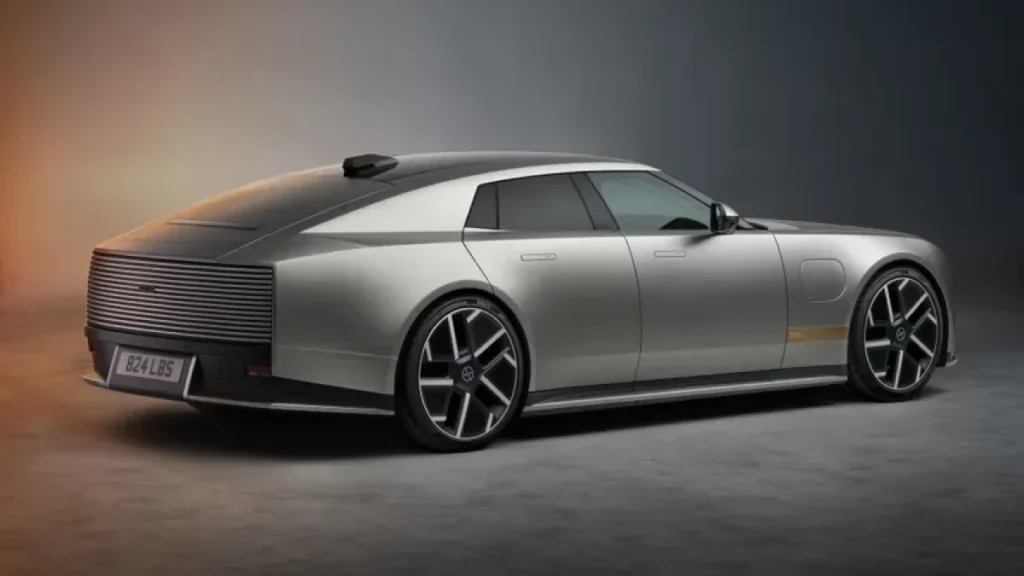
No Rear Windscreen
This is undeniably the Type 01’s most radical, conversation-starting design choice: it does not have a conventional rear windscreen.
Jaguar’s design team concluded that the severely sloping roofline would render a traditional glass rear window virtually useless for visibility. Instead, the rear is completely enclosed in bodywork. To see behind, the driver relies entirely on a roof-mounted high-definition camera that feeds a crisp, real-time image to a digital rear-view mirror inside the cabin. Down below, an active rear spoiler deploys across three distinct positions depending on vehicle speed and driving modes to manage downforce.
Jaguar Type 01 Interior and Features
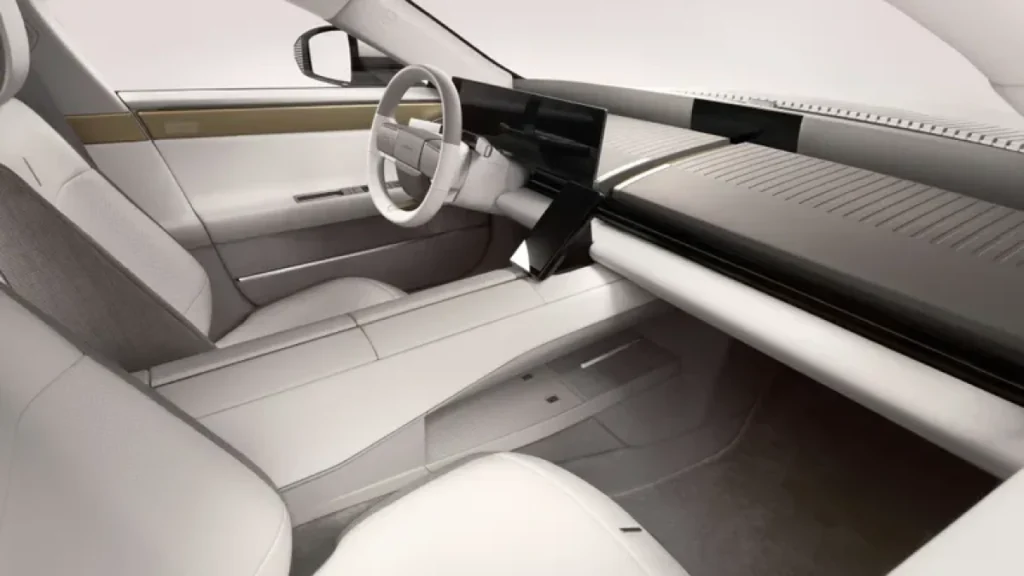
Stepping inside the Type 01 reveals an environment that heavily blends austere minimalism with cutting-edge technology, albeit with some undeniable packaging compromises dictated by the exterior styling.
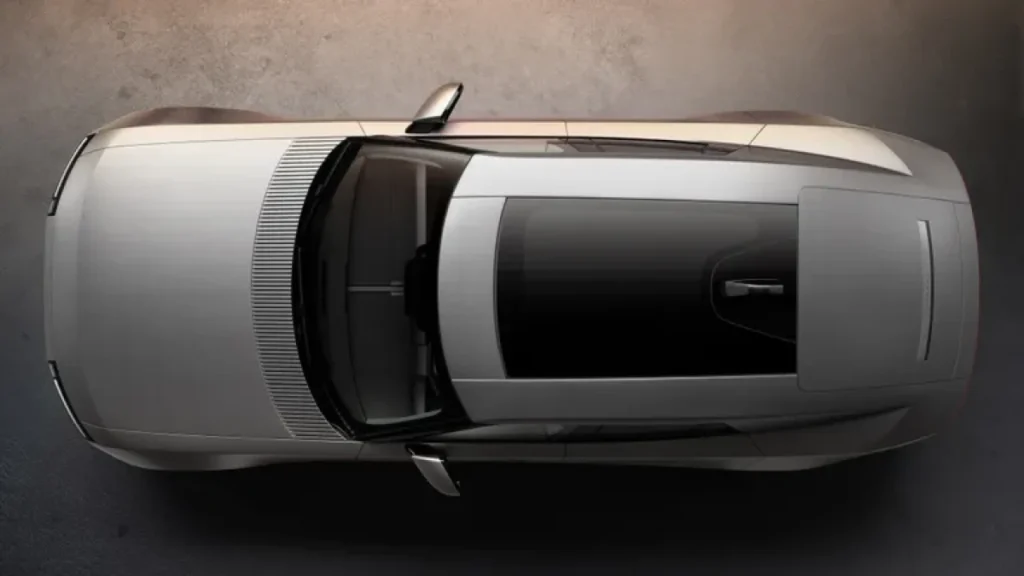
The four-seat cabin is bathed in natural light courtesy of a massive panoramic glass roof. Front occupants are treated to heavily sculpted seats featuring integrated heating, cooling, and multi-program massage functions. A prominent central spine physically divides the interior into four distinct zones, with cleverly integrated storage areas and brass-finished luxury elements running the length of the tunnel. Rear passengers are provided with their own dedicated touchscreen controller for climate and media management.
The dashboard is dominated by a sweeping, single 24-inch OLED display. This continuous screen seamlessly merges the instrument cluster and infotainment interface, smartly positioning driver-critical telemetry to the right and passenger-focused entertainment to the left, while minimizing physical switchgear.
The Packaging Compromise:
However, the aggressive design extracts a heavy toll on practicality. The low 1,400mm roofline severely limits rear headroom, while the thick pillars and small side windows create an environment that feels far more “intimate” than spacious. Furthermore, the low-set seating and sloping roof make rear entry and exit noticeably difficult for taller passengers. The Type 01 prioritizes aesthetic drama over conventional limousine comfort.
Jaguar Type 01 Battery and Range
To propel a vehicle of this size, Jaguar has engineered a highly complex energy storage system.
| Specification | Jaguar Type 01 |
| Battery capacity | 120 kWh |
| Usable capacity | 118 kWh |
| Battery chemistry | NMC |
| Claimed range | Up to 720 km (WLTP) |
| Architecture | 850V |
| Motors | 3 |
| Drive | AWD |
Instead of utilizing a standard, flat “skateboard” battery pack that would inevitably raise the floor and ruin the low roofline, Jaguar split the massive 120kWh battery into five distinct modules. This highly unusual architecture allowed engineers to carve out deeper rear footwells, desperately clawing back some ergonomic comfort for second-row passengers.
Jaguar Type 01 Performance – 1,030hp and 1,365Nm
The performance metrics of the Type 01 push it firmly into hypercar territory, making it the most powerful road-going Jaguar ever manufactured.
Propulsion is handled by a brutal tri-motor setup, deploying two independent motors at the rear axle and a single motor at the front. The combined output is a staggering 1,030hp and 1,365Nm of torque.
Despite lugging around a kerb weight of approximately 2.7 tonnes, the electric GT violently dispatches the 0–100kph sprint in just 3.2 seconds. However, Jaguar’s engineering priority was not merely securing the absolute fastest launch time in the 1,000hp+ club. The focus is squarely on “power in reserve” and sustained high-speed dominance, evidenced by its ferocious 100–180kph acceleration time of just 4.0 seconds.
Jaguar Type 01 Charging
The bespoke 850V JEA architecture translates directly into elite-tier charging capabilities, ensuring the grand tourer lives up to its long-distance billing.
When plugged into a 350kW DC fast charger, the Type 01 can rapidly replenish up to 321km of range in a mere 13 minutes. A standard 10–80 percent top-up takes approximately 22 minutes under optimal conditions. In a highly practical touch, Jaguar has integrated twin AC charging ports—one on each side of the vehicle—eliminating the frustration of having to awkwardly reverse or stretch cables at tight public charging bays.
Jaguar Type 01 Ride and Handling
Jaguar has armed the Type 01 with a vast array of chassis technology to mask its 2.7-tonne mass and deliver a true grand-touring experience.
The GT rides on highly adaptable switchable air suspension paired with twin-valve active dampers, allowing it to seamlessly transition from a plush highway cruiser to a tightly controlled sports sedan. The dual rear motors facilitate true mechanical torque vectoring across the rear axle, violently pivoting the heavy car into corners.
Crucially, the inclusion of aggressive rear-wheel steering drastically improves low-speed agility, reducing the wall-to-wall turning circle of this 5.2-metre behemoth to an incredibly manageable 11.5 metres.
Jaguar Type 01 Boot Space
The prioritization of style naturally compromises ultimate utility. The Type 01 offers 450 litres of cargo capacity. The boot itself is relatively shallow, though Jaguar has engineered some additional hidden storage compartments underneath the boot floor for charging cables and smaller items. It is adequate for weekend luggage, but certainly not class-leading.
Jaguar Type 01 India Launch and Expected Price
The global rollout for the Type 01 will commence with international deliveries scheduled for mid-2027. The Indian market is firmly on the roadmap, expected to receive the flagship EV a few months after its global debut.
While international pricing is slated to start around the £120,000 mark, the Jaguar Type 01 expected price in India is projected to hover around ₹2 crore (ex-showroom). Official Indian pricing, variant packaging, and allocation details will be confirmed closer to the 2027 launch window.
Jaguar Type 01 Rivals
Jaguar is aggressively repositioning itself upward. The brand no longer views mainstream luxury models as direct peers, aiming instead for the whitespace sitting above traditional German flagships and just below the ultra-exotic echelons of Rolls-Royce and Bentley.
| Model | Position |
| Jaguar Type 01 | Ultra-luxury electric GT |
| Porsche Taycan | Performance luxury EV |
| Audi e-tron GT | Electric performance GT |
| Mercedes-AMG GT 4-Door EV | Performance luxury GT |
| BMW i7 | Luxury electric limousine |
| Lotus Emeya | High-performance luxury EV |
What Makes Jaguar Type 01 Different?
If you only take away five things about Jaguar’s new flagship, make it these:
- It has 1,030hp: The tri-motor powertrain formally inducts Jaguar into the elite 1,000hp+ performance EV club.
- It has no rear windscreen: A high-definition rear camera completely replaces conventional rear glass, enabling the dramatic sloping roofline.
- The battery is split into five modules: Instead of a flat skateboard, the 120kWh pack is fractured to allow for deeper rear footwells and a lower roof.
- It has a 24-inch interior display: A single, massive OLED screen effortlessly combines the instrument cluster and infotainment interface.
- Jaguar has completely changed its design language: The Type 01 aggressively abandons decades of heritage styling in pursuit of stark, uncompromised modernism.
Our Verdict
The Jaguar Type 01 is less about competing purely on spreadsheet numbers and infinitely more about redefining what a Jaguar looks, feels, and drives like in the 21st century.
Its 1,030hp output, 720km claimed WLTP range, and brutal 3.2-second acceleration ensure its performance credentials are unassailable. But the far more fascinating story is the sheer audacity of its design. The split battery architecture, the complete erasure of the rear windscreen, the massive 24-inch display, and the menacing 23-inch wheels prove just how far Jaguar is willing to venture from its safe, established identity.
The ultimate question remains: Will ultra-luxury buyers accept the inherent compromises in rear-seat headroom and everyday usability in exchange for such dramatic, polarizing exclusivity? We will find out in 2027.
FAQ
What is the Jaguar Type 01?
The Jaguar Type 01 is a hyper-premium four-door electric grand tourer (GT) and the brand’s first all-new production model of its completely rebooted era.
How powerful is the Jaguar Type 01?
The GT utilizes a sophisticated tri-motor setup (two rear, one front) producing a combined 1,030hp and 1,365Nm of torque.
What is the Jaguar Type 01 range?
Jaguar claims an impressive range of up to 720km (WLTP) on a single charge.
What is the Jaguar Type 01 battery capacity?
It features a 120kWh NMC battery pack, with 118kWh of usable capacity, operating on an 850V architecture.
When will Jaguar Type 01 launch in India?
Global deliveries are scheduled to begin in mid-2027, with the Indian launch expected to follow a few months later.
What will the Jaguar Type 01 cost in India?
It is expected to cost around ₹2 crore (ex-showroom), although the official India price has not yet been announced.
Does the Jaguar Type 01 have a rear windscreen?
No. To preserve its dramatic exterior design, the vehicle uses a high-definition rear camera that feeds a digital rear-view mirror instead of conventional glass.

1 Comment
Pingback: BYD Denza Enters India: Z9 GT and D9 Luxury EVs Coming Soon