


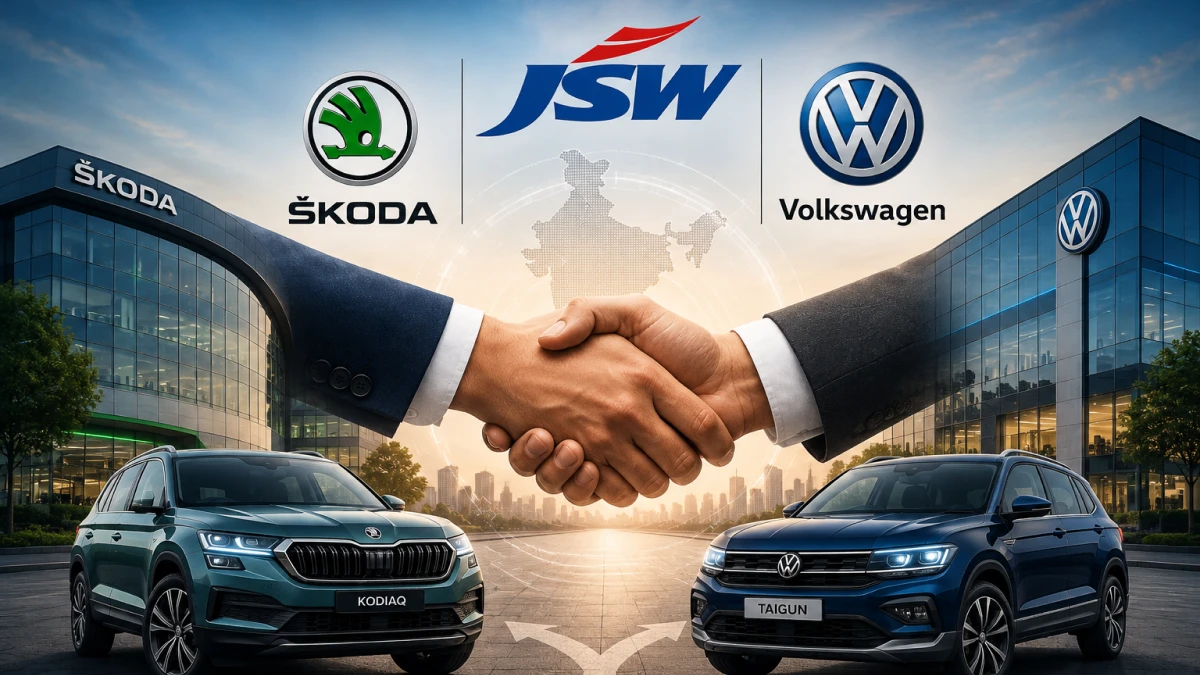
The proposed strategic partnership between Indian industrial giant JSW Group and German automotive titan Volkswagen Group has encountered a critical legal roadblock. A long-standing tax dispute involving Skoda Auto Volkswagen India Private Limited (SAVWIPL), valued at approximately ₹12,000 crore ($1.4 billion), has resurfaced as a major sticking point during joint venture negotiations.
As both entities finalize valuation models and capital allocation structures, JSW Group has taken a firm stance: any past tax liabilities originating from the dispute must remain exclusively with Volkswagen.
The Genesis of the ₹12,000 Crore Tax Dispute
The legal dispute traces back to late 2024, when Indian customs authorities served a show-cause notice to Skoda Auto Volkswagen India.The core of the allegation lies in the import practices governing vehicle assembly kits brought into the country between 2012 and 2024.
Indian tax authorities allege that Volkswagen misclassified shipments to lower its import tax burden:
- The Allegation:Authorities claim Volkswagen imported nearly complete vehicles in disassembled forms, declaring them as individual, standalone components rather than Completely Knocked-Down (CKD) vehicle kits.
- Duty Disparity:Individual auto components attract basic customs duties ranging between 5% and 15%.In contrast, CKD vehicle kits attract a duty of 30% to 35%.
- Financial Impact:By clearing shipments as individual components over a 12-year window, authorities argue that the automaker underpaid customs duties.Including potential interest and penalties, total liabilities are estimated between ₹12,000 crore and ₹20,000 crore.
| Parameter | Individual Component Classification | CKD Kit Classification |
| Applicable Customs Duty | 5% – 15% | 30% – 35% |
| Assembly Level | Independent spare parts | Complete/near-complete vehicle kits |
| Alleged Practice | Declared state for imports | Actual functional state claimed by authorities |
| Primary Financial Impact | Lower duty payout | Standard statutory duty requirement |
Vehicles Under Investigation
The tax investigation spans multiple premium and mass-market nameplates sold across Volkswagen Group’s Indian brand portfolio. The primary models cited in official notices include:
- Skoda:Kodiaq, Superb
- Volkswagen:Tiguan
- Audi:A4, Q5
Volkswagen has denied any wrongdoing.The company maintains that its import operations fully complied with Indian customs laws and regulations.Volkswagen challenged the tax demand in court, leaving the matter unresolved.
In mid-2026, the Bombay High Court ruled that Volkswagen’s legal challenge must undergo a fresh hearing after an earlier judicial bench failed to deliver a judgment within the mandated timeframe.As a result, the dispute remains pending without a final judicial determination.
Why the Tax Liability Matters to JSW Group
In September 2026, JSW Group and Volkswagen Group signed a non-binding Memorandum of Understanding (MoU) to establish a joint venture for passenger vehicles in India.The proposed structure targets a 51:49 equity split, combining Volkswagen’s global product platforms with JSW’s local supply chain and manufacturing expertise.
However, due diligence assessments have brought contingent liabilities into sharp focus:
| Entity | Primary Intent | Position on Tax Liability |
| JSW Group | Expand Indian automotive footprint beyond MG Motor | Demands full tax indemnity; liabilities must remain with VW |
| Volkswagen Group | Share manufacturing costs, risks, and localized EV investment | Contests tax demand in court; seeks clean JV asset valuation |
JSW Group’s leadership has signaled that it will not assume financial exposure stemming from actions predating the joint venture. Absorbing a potential ₹12,000 crore payout would alter the unit’s valuation and drain capital intended for localized research, plant expansions, and new product development.
Strategic Implications for the Proposed Alliance
The timing of this disagreement creates operational headwinds for both partners:
1. Valuation and Capital Contributions
Uncertainty over contingent liabilities complicates enterprise valuation. If the court upholds the customs demand, Volkswagen must fund the settlement independently, directly reducing the net assets transferred into the joint venture.
2. Leadership Transitions
Negotiations experienced additional friction following the departure of former Skoda CEO Klaus Zellmer, who was instrumental in structuring the India alliance. Re-aligning corporate priorities under new leadership has slowed momentum toward finalizing terms.
3. JSW’s Broader Automotive Ambitions
JSW’s automotive portfolio extends beyond its discussions with Volkswagen.The group holds a major stake in JSW MG Motor India (in partnership with China’s SAIC Motor) and has launched commercial electric vehicle operations. While JSW remains eager to scale its passenger vehicle presence, its diversified position allows it to negotiate terms without taking on legacy liabilities.
Future Outlook for the JSW-Volkswagen Deal
Despite these challenges, both companies continue discussions, targeting a binding agreement. The partnership offers significant strategic value:
- Localization Drive: Joint development of cost-competitive localized platforms for internal combustion engines (ICE), hybrids, and battery electric vehicles (BEVs) tailored for India and export markets.
- Risk Sharing: Co-investing in next-generation architecture lowers capital expenditure requirements for both parent brands.
Resolution of the alliance hinges on how the companies structure legal indemnities. Whether through escrow arrangements, valuation adjustments, or ring-fenced legal guarantees, Volkswagen must provide clarity on its past liabilities before the joint venture can proceed.
Read – JSW Group in Advanced Talks for Majority Stake in Skoda Auto Volkswagen India
