


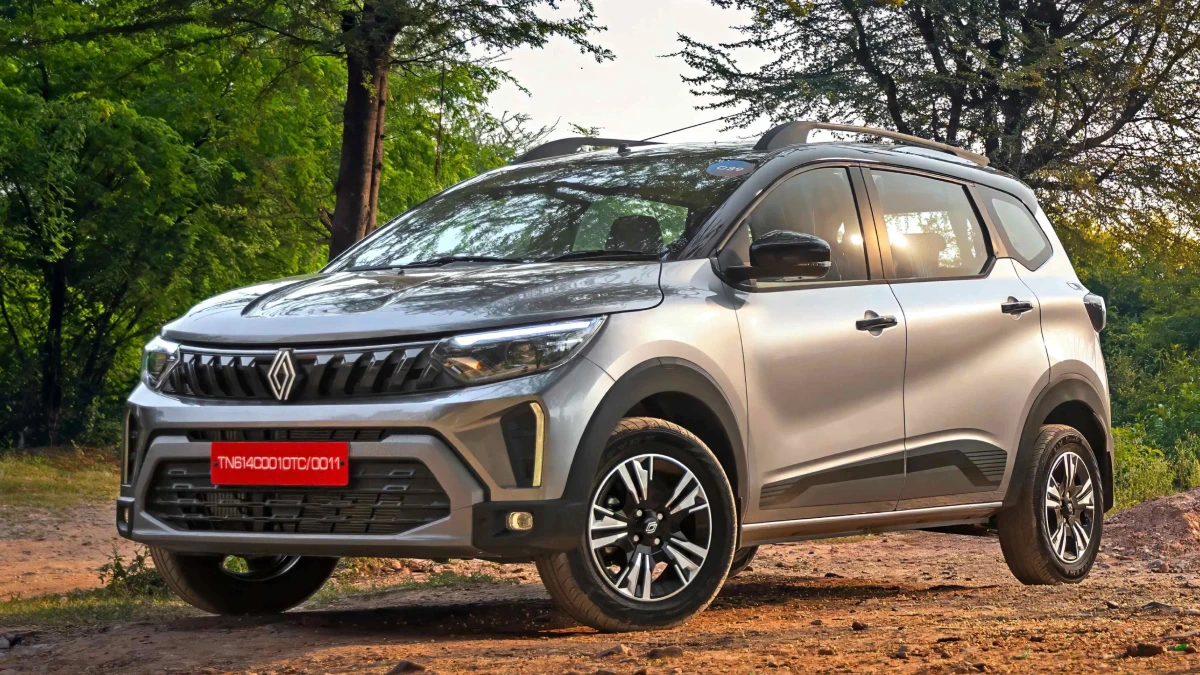
Renault has finally addressed the most glaring criticism of its highly practical compact MPV with the launch of the Renault Triber Turbo. Swapping the underwhelming naturally aspirated block for a punchy 1.0-litre turbo-petrol engine producing 100 PS and 180 Nm of torque, Renault has injected a much-needed dose of performance into its clever seven-seater.
Prices for the Triber Turbo start aggressively at ₹7.84 lakh for the entry-level Evolution variant and climb to ₹8.99 lakh for the fully loaded Emotion Turbo (ex-showroom).
This new turbo engine isn’t just about boasting a higher horsepower figure on a brochure. The massive injection of torque promises to make a night-and-day difference when the Triber is fully loaded with passengers and luggage. Having put the new powertrain through its paces, it is clear that this mechanical update fundamentally alters the Triber’s character.
Here is our comprehensive guide to the new Renault Triber Turbo, incorporating real-world review insights, detailed variant breakdowns, engine specs, claimed mileage, and whether it justifies the premium over the standard model.
Renault Triber Turbo Price in India
Renault has kept the variant lineup streamlined, offering the new turbo-petrol engine across three distinct trims.
| Variant | Powertrain | Ex-showroom Price |
| Evolution Turbo | 1.0L Turbo MT | ₹7.84 lakh |
| Techno Turbo | 1.0L Turbo MT | ₹8.53 lakh |
| Emotion Turbo | 1.0L Turbo MT | ₹8.99 lakh |
The top-spec Emotion version commands a ₹1.15 lakh premium over the entry-level Evolution Turbo. Additionally, Renault offers a stylish dual-tone exterior paint option across the range for an extra ₹21,000.
While these turbo iterations demand a noticeable premium over the corresponding naturally aspirated versions, buyers aren’t just paying for cosmetic tweaks. The additional investment buys a completely different engine character, upgraded cooling, and recalibrated safety electronics.
Engine and Real-World Performance: Power to the People
The most significant upgrade hides under the bonnet. The Triber Turbo utilizes a modern 1.0-litre, three-cylinder turbocharged petrol engine.
| Specification | Triber Turbo | Naturally Aspirated Triber |
| Engine | 1.0-litre turbo-petrol | 1.0-litre naturally aspirated |
| Cylinders | 3 | 3 |
| Maximum power | 100 PS | 72 PS |
| Maximum torque | 180 Nm | 96 Nm |
| Gearbox | 5-speed manual | 5-speed MT / AMT |
| Claimed mileage | Up to 21 kmpl | Up to 19.76 kmpl |
Why 180 Nm Matters More Than 100 PS
While 100 PS sounds impressive for a sub-4-metre vehicle, the true game-changer for everyday drivability is the 180 Nm of peak torque—a massive 84 Nm jump over the standard car.
A naturally aspirated small-capacity petrol engine typically requires you to rev it hard just to extract its performance, making it loud and inefficient. The new turbo engine, by contrast, is engineered to deliver a thick wave of torque much lower in the rev range.
Review Insights: Out on the road, this translates to a vehicle that never feels short of pulling power, even when all seven seats are occupied. It confidently addresses the biggest shortcoming of the older Triber. Overtaking on single-lane highways and climbing steep mountain ghats no longer requires constant downshifting and planning miles ahead.
However, there is a catch. Below the 2,000 rpm mark—before the turbocharger fully spools up—the engine exhibits a noticeable hesitance, very similar to the sluggishness of its naturally aspirated counterpart. This off-boost lag is likely the result of an ECU fuel mapping heavily prioritized for maximum fuel economy. To make smooth, rapid progress in the city, drivers will need to consciously keep the rev needle hovering around or above that 2,000 rpm threshold.
Upgraded Thermal Management
Turbochargers generate immense heat. To cope with the 100 PS output, Renault has thoroughly reworked the Triber’s thermal management system. It now features a state-of-the-art BLDC (Brushless DC) fan cooling system—technology typically reserved for hybrids and EVs—which results in a 35 percent higher air intake for far more efficient and reliable engine cooling.
Gearbox: 5-Speed Manual (With a CVT on the Horizon)
At launch, Renault is exclusively pairing the new turbo engine with a five-speed manual gearbox.
Review Insights: This 5-speed transmission is not the slickest unit in the segment. Shifting gears feels distinctly notchy, and it takes a conscious, physical effort to slot the lever into the gates. Fortunately, Renault has paired this gearbox with an incredibly light clutch pedal, which significantly alleviates driver fatigue during heavy stop-and-go city traffic.
For buyers who refuse to drive a manual, there is good news: Renault has slated a smooth CVT automatic transmission to arrive for the Triber Turbo in the near future. Until then, if you desperately require an automatic today, you will have to settle for the naturally aspirated Triber’s AMT (Automated Manual Transmission).
Ride Comfort, Handling, and NVH
Renault hasn’t simply bolted a turbocharger to the existing block and called it a day. The increased power output demanded a holistic dynamic upgrade.
Ride Quality: The Triber Turbo exhibits an impressively mature and composed ride quality. Considering its relatively light 1-tonne kerb weight, the MPV shows remarkable composure out on the open highway, effortlessly soaking up road undulations without tossing the passengers around.
Handling and Steering: The steering setup remains heavily tailored for urban environments. It is exceedingly light, making tight parking maneuvers a breeze, but it is virtually devoid of any real mechanical feedback at higher speeds.
Braking and NVH: Braking performance remains adequate and feels largely similar to the naturally aspirated version, safely bringing the MPV to a halt even when fully loaded. However, Noise, Vibration, and Harshness (NVH) levels remain a sore point. Cost-cutting is evident here; high levels of road, tyre, and wind noise easily penetrate the cabin, becoming quite apparent as you cross the 80 kmph mark.
Renault Triber Turbo Mileage: Claimed vs Real-World
Renault officially claims an ARAI-certified fuel efficiency figure of 21 kmpl for the Triber Turbo. Interestingly, this makes the powerful turbo model mathematically more efficient on paper than the naturally aspirated manual Triber (19.76 kmpl).
The Real-World Reality: Buyers must approach this 21 kmpl figure with realistic expectations. Turbo-petrol engines are notoriously sensitive to throttle inputs. While the turbo can sip fuel gently during steady highway cruising, instances of sudden acceleration or heavy city traffic will cause the mileage to drop much quicker than in a naturally aspirated motor. In everyday real-world driving scenarios, expect the Triber Turbo to be noticeably less fuel-efficient than its official rating, and almost certainly thirstier than the NA version when driven with a heavy foot.
Interior, Space, and the Missing Spare Wheel
The Triber’s defining characteristic has always been its ingenious packaging—delivering genuine seven-seat flexibility within sub-4-metre exterior dimensions.
The cabin features an 8-inch touchscreen infotainment system with wireless Android Auto and Apple CarPlay, an automatic climate control system, a cooled center console, and a push-button start.
Seating Comfort: The removable third-row seats remain the Triber’s ultimate Unique Selling Proposition (USP). You can remove them entirely to liberate a cavernous 625 litres of cargo space. Dedicated AC vents, adjustable headrests, and three-point seatbelts are present all the way in the back. However, space is a premium. The second row feels tight if you attempt to squeeze in three full-sized adults. Furthermore, for passengers relegated to the third row, the close proximity of their heads to the rear tailgate remains a safety and comfort concern.
The Missing Spare Wheel: In a controversial packaging move, the Triber Turbo has done away with its underbody-mounted spare tyre. This omission is in anticipation of future factory-fitted CNG tanks utilizing that exact space. What you get instead is a tyre inflator and a puncture repair kit. Buyers who frequently travel through remote areas should factor this in.
Safety Upgrades
With more power comes the need for better electronic safety nets. Renault has recalibrated the active safety hardware for the new powertrain.
- Retuned Electronics: The Anti-lock Braking System (ABS), Electronic Stability Control (ESC), and traction control have been specifically retuned to manage the Turbo version’s abrupt torque delivery.
- Standard Safety: The vehicle is equipped with six airbags, ISOFIX child seat mounts, hill-start assist, and a tyre-pressure monitoring system (TPMS).
- Crash Rating: It is also worth remembering that the pre-facelift Triber secured a highly commendable 4-star rating in Global NCAP crash tests, providing a solid structural baseline.
Renault Triber Turbo: Which Variant Should You Buy?
Evolution Turbo: The Entry-Level Powerhouse
Price: ₹7.84 lakh
The Evolution serves as the gateway into the turbo range. This is the definitive variant for buyers who desperately want the 100 PS / 180 Nm engine but refuse to breach the ₹9 lakh barrier. You miss out on premium tech, but you secure the advanced turbo powertrain for just ₹7.84 lakh.
Techno Turbo: The Sensible Middle Ground
Price: ₹8.53 lakh
Sitting comfortably between the two extremes, the Techno Turbo costs ₹69,000 more than the Evolution. This variant represents the “sweet spot” for most buyers, bundling the essential convenience and technology features (like the touchscreen and automatic climate control) that modern families demand, without demanding the full premium of the top-spec model.
Emotion Turbo: The Fully Loaded Flagship
Price: ₹8.99 lakh
At just a whisker under ₹9 lakh, the Emotion Turbo combines the potent new engine with the most comprehensive luxury and safety package available in the Triber portfolio. If you intend to keep the vehicle for over five years and value modern conveniences like a digital cluster and wireless charging, this top variant easily justifies its price tag.
Renault Triber Turbo vs Naturally Aspirated Triber
The ultimate question for prospective buyers is whether the turbo engine is genuinely worth the extra cash.
Stick with the naturally aspirated Triber if:
- Your daily driving is strictly confined to low-speed, bumper-to-bumper city traffic.
- You rarely carry more than three or four passengers.
- Achieving the absolute lowest initial purchase price is your primary goal.
- You absolutely require an automatic transmission today (via the NA model’s AMT).
Upgrade to the Triber Turbo if:
- You frequently utilize all seven seats or haul heavy cargo.
- You regularly embark on long-distance highway road trips.
- You demand confident, stress-free overtaking performance.
- You live in or frequently travel through hilly, mountainous terrain.
- You view the Triber as a long-term, primary family highway vehicle.
Our Verdict: Is It Worth It?
The Renault Triber Turbo is one of the most meaningful product updates in the Indian compact MPV segment. By engineering a punchy 100 PS, 180 Nm turbo-petrol powertrain and supporting it with advanced BLDC cooling and retuned ESC, Renault has successfully cured the MPV of its lethargy.
Yes, the evident cost-cutting remains. The manual gearbox is noticeably notchy, the cabin suffers from high NVH levels at speed, and the omission of a physical spare wheel is frustrating.
However, these shortcomings are easily outweighed by the vehicle’s immense strengths. The Triber has always been a cleverly packaged, highly versatile, and value-for-money people mover. With the addition of the turbo engine, you finally have the pulling power necessary to utilize all seven seats without feeling like a rolling roadblock on the highway.
Our Pick: Triber Turbo Techno (₹8.53 lakh). It strikes the perfect equilibrium, delivering the muscular engine and essential modern features while intelligently avoiding the full financial weight of the flagship trim.
FAQs
What is the price of the Renault Triber Turbo?
The new Triber Turbo is priced from ₹7.84 lakh (ex-showroom) for the base Evolution variant, extending up to ₹8.99 lakh for the top-spec Emotion Turbo.
How much power does the Triber Turbo produce?
The advanced 1.0-litre turbo-petrol engine generates an impressive 100 PS of peak power and 180 Nm of torque.
What is the real-world mileage of the Triber Turbo?
While Renault claims an ARAI-certified figure of 21 kmpl, real-world mileage is expected to be lower, especially in heavy traffic or under hard acceleration, due to the turbo engine’s sensitivity to throttle inputs.
Does the Triber Turbo have an automatic gearbox?
No, the Triber Turbo is currently launched exclusively with a 5-speed manual transmission. However, a CVT automatic variant is officially slated to arrive soon.
Does the Renault Triber Turbo have a spare wheel?
No. In anticipation of future CNG variants, the underbody spare wheel has been removed. The vehicle is supplied with a tyre inflator and puncture repair kit instead.
Which Renault Triber Turbo variant is best?
For the majority of family buyers, the mid-spec Techno Turbo offers the optimal balance of modern convenience features, safety, and aggressive pricing.
Read – Skoda Slavia Facelift Launch on October 6
