


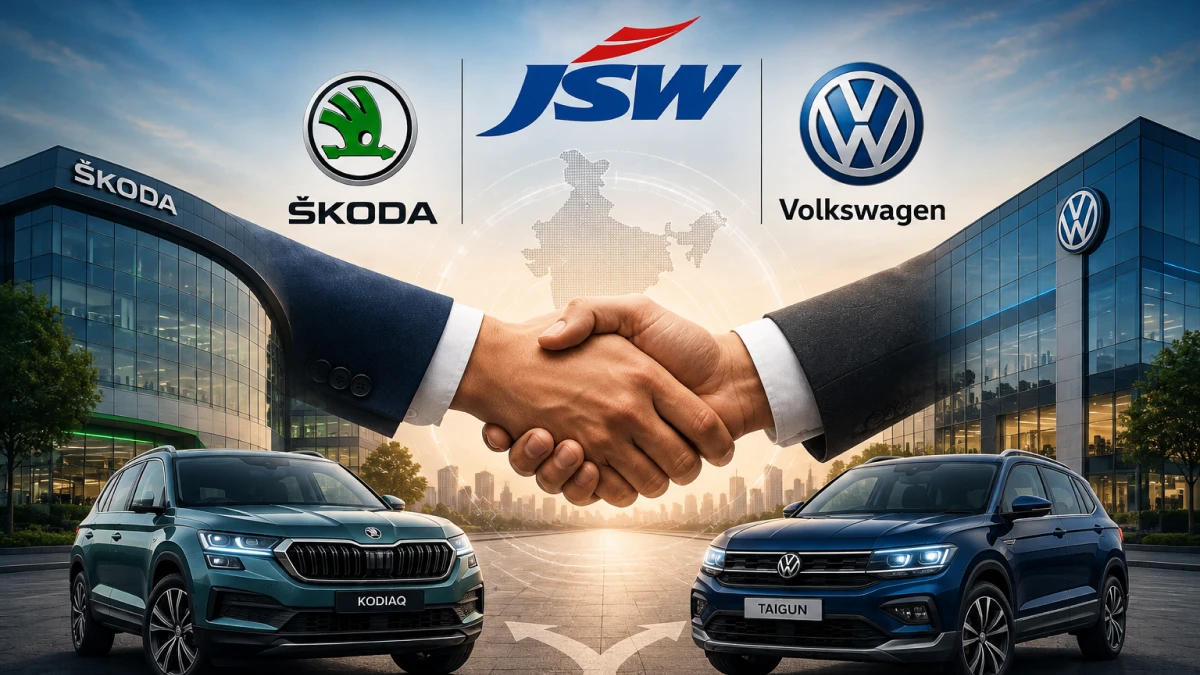
In what could become one of the most consequential structural realignments in the Indian automotive industry, the Sajjan Jindal-led JSW Group is in advanced, late-stage negotiations to acquire a 51 percent majority stake in Skoda Auto Volkswagen India Private Limited (SAVWIPL). The proposed transaction involves forming a new standalone joint venture (JV) company that would give JSW operational control over Volkswagen Group’s mass-market manufacturing assets, vehicle platforms, and retail distribution across India.
The two conglomerates are working toward signing a non-binding Memorandum of Understanding (MoU), supported by visits from senior global executives from Skoda Auto AG and Volkswagen AG to India. The proposed equity infusion aims to fund localized electric vehicle (EV) development, lower manufacturing import dependencies, and provide Volkswagen with a local partner to share capital expenditure.
1. Structural Overview: Proposed 51:49 Joint Venture Framework
Under the structure being negotiated, JSW Group would hold a controlling 51 percent equity stake, with the Volkswagen Group retaining 49 percent. The alliance would operate as a standalone corporate entity independent of JSW’s existing passenger car partnership, JSW MG Motor India.
The deal transfers mass-market internal combustion engine (ICE) and new energy vehicle (NEV) operations—including manufacturing facilities, sales, marketing, and vehicle export rights—into the new joint venture. However, Volkswagen Group’s luxury and super-luxury marques will be excluded from the transaction to preserve their independent global brand structures.
The table below outlines the core parameters, shareholding terms, and scope of the proposed JSW-Skoda Auto Volkswagen joint venture:
| Joint Venture Parameter | Proposed Transaction Specification | Strategic & Operational Scope |
| Equity Shareholding Ratio | 51% JSW Group : 49% Volkswagen Group | Gives JSW Group majority ownership and operational control |
| Legal Structure | Standalone Manufacturing Joint Venture | Operates independently of JSW MG Motor India |
| Manufacturing Assets Included | Chakan Plant (Pune, Maharashtra) | Transfer of assembly lines, stamping, and engine facilities |
| Mass-Market Brands Covered | Skoda Auto & Volkswagen Passenger Cars | Covers localized ICE models, new EV platforms, and exports |
| Luxury Brands Excluded | Audi, Porsche, Lamborghini, Bentley | Excluded from the mass-market JV scope |
| Primary Capital Objective | Funding localized India Main Platform (IMP) EVs | Accelerates EV localization and lowers import duties |
| Timeline Horizon | Non-Binding MoU Expected Within Months | Financial due diligence & valuation ahead of final signing |
2. Asset & Operational Scope: Mass-Market Scope vs. Luxury Exclusions
A key aspect of the agreement is the clear division between mass-market passenger operations and high-margin luxury divisions. Volkswagen Group currently manages six brands in India under SAVWIPL. The proposed JV centers on high-volume localized platforms (India 2.0 and the upcoming IMP EV platform) while excluding super-luxury lines.
Operational Division Framework:
- Included Mass-Market Brands: Skoda Auto and Volkswagen Passenger Cars. The JV will oversee production, local supplier development, dealership network expansion, and export hubs for models like the Skoda Kushaq, Slavia, Kylaq, and Kodiaq, alongside the Volkswagen Taigun, Virtus, Tiguan, and Tayron.
- Excluded Luxury Marques: Porsche, Lamborghini, and Bentley. These ultra-luxury brands will remain 100 percent owned and managed by Volkswagen AG through direct import and specialized retail operations.
- Carve-Out for Audi: Although Audi vehicles are locally assembled at the Chhatrapati Sambhajinagar (Aurangabad) plant, Audi’s brand management, commercial strategy, and sales operations will remain outside the mass-market JV.
The table below summarizes the brand division across the proposed joint venture:
| Vehicle Brand / Division | Market Segment | Assembly Location (India) | Status in Proposed JSW Alliance |
| Skoda Auto | Mass-Market / Premium | Chakan (Pune) & Sambhajinagar | Included in 51:49 JV |
| Volkswagen Passenger Cars | Mass-Market / Premium | Chakan (Pune, Maharashtra) | Included in 51:49 JV |
| Audi India | Premium Luxury | Chhatrapati Sambhajinagar (CKD) | Excluded (Retains Separate VW Control) |
| Porsche India | High-Performance Luxury | CBU Imports (Import Units) | Excluded (100% Volkswagen Control) |
| Lamborghini India | Super-Luxury Sports Cars | CBU Imports (Import Units) | Excluded (100% Volkswagen Control) |
| Bentley Motors | Ultra-Luxury Touring | CBU Imports (Import Units) | Excluded (100% Volkswagen Control) |
3. Financial Rationale & India Main Platform (IMP) Localized EV Architecture
The partnership addresses structural challenges for both conglomerates. Despite operating in India for over two decades, Volkswagen Group’s market share in the passenger vehicle segment stood at 2.34 percent in FY2026. High capital demands for next-generation EV platforms, coupled with cost-cutting pressures from European headquarters, led Volkswagen to seek a strategic local partner to share investment risks.
For JSW Group, acquiring a majority stake provides immediate access to European engineering, established automotive manufacturing facilities in Chakan, and an active retail distribution network. This alliance aligns with JSW’s broader $3.2 Billion automotive investment commitment announced for Maharashtra and Odisha.
Localized EV Development: The IMP Architecture
Equity capital injected by JSW Group will primarily fund the development and localization of Volkswagen Group’s India Main Platform (IMP). Derived from the China Main Platform (CMP), IMP is an entry-level born-electric architecture adapted for Indian road conditions, regulatory standards, and supply chain pricing.
- Cost Optimization via Local Suppliers: Localizing battery packaging, electric drive units (EDUs), and power electronics is expected to reduce manufacturing costs by 25 to 30 percent compared to direct CBU/CKD imports.
- Multi-Body Style Strategy: The IMP architecture will underpin electric SUVs for both Skoda and Volkswagen brands, competing directly with domestic EV platforms like Tata Motors’ acti.ev and Mahindra’s INGLO architecture.
4. Market Share Matrix: Indian Passenger Vehicle Segment Distribution
To understand the market dynamics driving this joint venture, it helps to analyze the market share distribution within India’s passenger vehicle industry.
The table below contrasts SAVWIPL’s position against major domestic and international manufacturers based on official industry registration data for FY2026:
| OEM Automotive Group | Major Retailed Brands in India | FY2026 Indian Market Share (%) | Primary Market Strength / Focus |
| Maruti Suzuki India | Maruti Suzuki | 40.85% | Mass-market volume, extensive dealer reach |
| Hyundai Motor India | Hyundai | 14.20% | Feature-rich SUVs, diverse powertrains |
| Tata Motors Passenger Vehicles | Tata Motors | 13.65% | EV leadership, 5-Star safety ratings |
| Mahindra & Mahindra | Mahindra | 11.40% | High-demand SUV portfolio (Scorpio N, XUV700) |
| Kia India | Kia | 5.94% | Premium tech, rapid platform scaling |
| Skoda Auto Volkswagen India | Skoda, VW, Audi, Porsche, Lambo | 2.34% | Strong German engineering, crash safety |
| JSW MG Motor India | MG Motor | 1.40% | Tech innovation, BaaS EV models |
| Combined Target Entity | Skoda + VW + MG (JSW Synergy) | ~3.74% (Combined Potential) | Cross-brand manufacturing synergies |
5. Manufacturing Footprint & Asset Transfers
The proposed transaction will restructure Volkswagen’s manufacturing assets in Maharashtra. The primary manufacturing complex in Chakan, Pune, will be transferred to the new joint venture entity.
The table below details the operational capacities and platform capabilities of the manufacturing assets involved in the JV negotiation:
| Manufacturing Facility | Installed Annual Capacity | Current Vehicle Platforms Produced | Future Role Under Proposed JSW JV |
| Chakan Plant (Pune, Maharashtra) | ~200,000 Vehicles / Year | MQB-A0-IN (Kushaq, Slavia, Taigun, Virtus) | Transfers to 51:49 JV; will host IMP EV lines |
| Chhatrapati Sambhajinagar Plant | ~40,000 Vehicles / Year | MQB-A (Kodiaq, Tiguan) + Audi CKD Assembly | Assembles high-end models; facility shared |
| JSW Aurangabad Project (Proposed) | Planned $3.2B EV Facility | Commercial Vehicles & Born-EV Platforms | Independent JSW facility for broader EV plans |
6. Strategic Impact on India’s Automotive Landscape
If finalized, a majority-owned JSW joint venture with Skoda Auto Volkswagen will impact the Indian automotive ecosystem across three main areas:
- Capital Infusion for Electrification: Localizing the India Main Platform (IMP) gives Volkswagen a cost-competitive EV architecture designed specifically for price-sensitive emerging markets.
- Expansion of JSW’s Automotive Footprint: Adding majority ownership of Skoda-VW’s assets to its 35 percent stake in JSW MG Motor India positions Sajjan Jindal’s conglomerate as a prominent multi-brand automotive group.
- Optimized Capacity Utilization & Exports: JSW’s supply chain experience in steel, energy, and infrastructure can optimize raw material sourcing at Chakan while expanding vehicle exports to Southeast Asia, Africa, and the Middle East.
Strategic Summary & Next Steps
The proposed 51:49 manufacturing joint venture between JSW Group and Skoda Auto Volkswagen India represents a significant strategic shift. By bringing in local capital, locking in majority ownership, and sharing the financial burden of electric vehicle development, the partnership provides Volkswagen with a sustainable long-term model in India.
As both parties conduct financial due diligence and work toward signing a non-binding Memorandum of Understanding, the deal could establish a new blueprint for international carmakers seeking long-term growth in India’s competitive automotive market.

