



Audi India has confirmed a revised product roadmap through 2027, committing to three major new vehicle launches. The German luxury automaker is expanding its presence in the D-segment SUV, full-sized flagship, and pure-electric luxury vehicle categories.
The upcoming models utilize Volkswagen Group’s new Premium Platform Electric (PPE) and Premium Platform Combustion (PPC) architectures. By introducing these platforms, Audi India aims to capture growing demand in the EV and ICE luxury SUV markets while competing against Mercedes-Benz and BMW.
1. Executive Summary: Audi’s 3-Model Strategy Through 2027
Audi’s strategic roadmap focuses on three main vehicles: the Audi Q6 e-tron (built on the 800V PPE architecture), the 3rd-Generation Audi Q5 (utilizing the PPC platform with mild-hybrid tech), and the Audi Q9 (a three-row luxury flagship SUV).
The table below summarizes the expected launches, platforms, estimated pricing, and market targets for Audi India through 2027:
| Upcoming Audi Model | Architecture / Platform | Expected Launch Window (India) | Projected Ex-Showroom Price | Primary Segment Target |
| Audi Q6 e-tron | PPE (800V Electric Architecture) | Q4 2026 | ₹1.00 Crore – ₹1.10 Crore | Mid-size Luxury Electric SUV |
| 3rd-Gen Audi Q5 | PPC (Premium Platform Combustion) | Q1 2027 | ₹70.00 Lakh – ₹78.00 Lakh | Executive D-Segment Luxury SUV |
| Audi Q9 Flagship | PPC Extended Platform | Q2 2027 | ₹1.30 Crore – ₹1.50 Crore | Full-Size 3-Row Luxury SUV |
2. Model 1: Audi Q6 e-tron — The 800V PPE Electric Benchmark
The Audi Q6 e-tron is the first vehicle built on the Premium Platform Electric (PPE) co-developed with Porsche. Featuring an 800-volt electrical architecture, the Q6 e-tron bridges the gap between the smaller Q4 e-tron and the larger Q8 e-tron in Audi’s lineup.
The table below outlines the core battery, motor, and charging specifications for the India-spec Audi Q6 e-tron:
| Specification Category | Audi Q6 e-tron Quattro | Audi SQ6 e-tron (Performance Variant) |
| Battery Capacity (Gross / Net) | 100 kWh / 94.9 kWh Lithium-Ion | 100 kWh / 94.9 kWh Lithium-Ion |
| Motor Layout & Drive Type | Dual-Motor All-Wheel Drive (Quattro) | Dual-Motor All-Wheel Drive (Quattro) |
| Peak Power Output | 388 HP (285 kW) | 517 HP (380 kW with Launch Control) |
| Peak Torque Output | 535 Nm | 820 Nm |
| 0 to 100 km/h Acceleration | 5.9 Seconds | 4.3 Seconds |
| Claimed WLTP Range | Up to 625 km | Up to 598 km |
| DC Fast Charging Architecture | 800V (270 kW Peak DC Fast Charge) | 800V (270 kW Peak DC Fast Charge) |
| 10% to 80% Fast Charge Time | 21 Minutes | 21 Minutes |
Key Technological Features:
- Digital Stage Curved Display: Features a free-standing MMI panoramic display combining an 11.9-inch Audi virtual cockpit with a 14.5-inch MMI touch display using Android Automotive OS.
- Passenger Display Screen: An optional 10.9-inch front passenger display with active privacy mode allows video streaming without distracting the driver.
- Second-Generation Digital OLED Rear Lights: Features 360 OLED segments that generate customized light signatures and communication alerts to warn trailing traffic of hazards or accidents.
3. Model 2: 3rd-Generation Audi Q5 — PPC Platform & Mild-Hybrid Tech
The 3rd-Generation Audi Q5 transitions the brand’s mid-size SUV to the Premium Platform Combustion (PPC) architecture. Equipped with MHEV Plus (48V mild-hybrid system), the new Q5 delivers smoother city driving and reduced fuel consumption.
The table below highlights the mechanical, dimensional, and engine parameters for the 3rd-Gen Audi Q5:
| Parameter / Feature | 3rd-Gen Audi Q5 (PPC Architecture) | Previous 2nd-Gen Audi Q5 | Functional Benefit |
| Platform Architecture | PPC (Premium Platform Combustion) | MLB evo Architecture | Enhanced chassis rigidity and electronics |
| Engine Configuration | 2.0L 4-Cylinder TFSI Turbo-Petrol | 2.0L 4-Cylinder TFSI Petrol | MHEV Plus electric motor boost |
| Max Power Output | 204 HP (150 kW) | 249 HP | Balanced power delivery and fuel economy |
| Max Torque Output | 340 Nm @ 1,600–4,500 rpm | 370 Nm | Instant electric torque assist at low revs |
| Hybrid Assistance | 48V MHEV Plus (18 kW / 230 Nm Assist) | 12V Mild-Hybrid System | Enables short zero-emission low-speed maneuvers |
| Transmission & Drive | 7-Speed S-Tronic Dual-Clutch / Quattro | 7-Speed S-Tronic / Quattro | Faster gear shifts and active vectoring |
4. Model 3: Audi Q9 — Full-Sized 3-Row Luxury Flagship
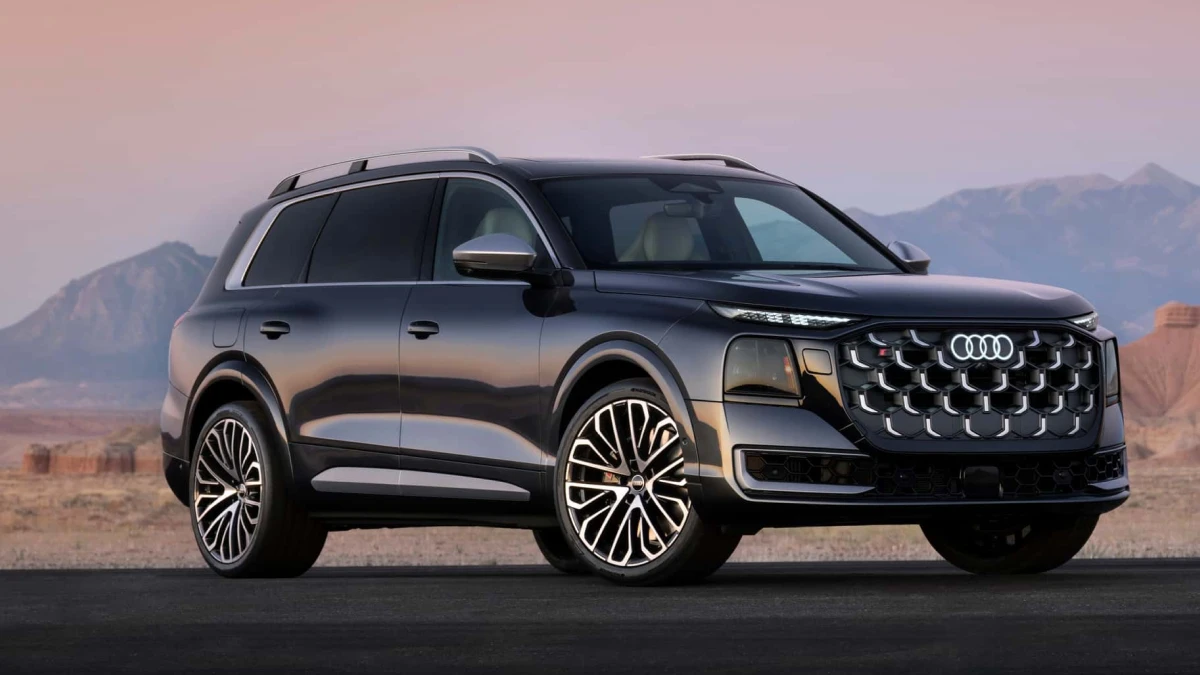
The Audi Q9 fills a gap in Audi’s lineup, providing a full-sized 3-row luxury SUV to compete directly against the BMW X7 and Mercedes-Benz GLS.
Measuring over 5.2 meters in length, the Q9 offers a spacious cabin with three seating rows. Built on an extended version of the PPC platform, it features dynamic air suspension and active roll stabilization.
The table below contrasts the expected specifications of the Audi Q9 against its primary 3-row luxury rivals:
| Parameter / Spec | Audi Q9 Flagship | BMW X7 xDrive40i | Mercedes-Benz GLS 450 |
| Expected Launch in India | Q2 2027 | Available | Available |
| Engine Architecture | 3.0L V6 Turbo Petrol + 48V MHEV | 3.0L TwinPower Turbo Inline-6 | 3.0L Inline-6 Turbo Petrol |
| Max Power Output | ~350 HP – 380 HP | 381 HP | 381 HP |
| Max Torque Output | ~500 Nm | 520 Nm | 500 Nm |
| Overall Length | ~5,220 mm | 5,181 mm | 5,209 mm |
| Seating Layout Options | 6-Seater (Captain) & 7-Seater | 6-Seater & 7-Seater | 7-Seater Layout |
| Suspension Tech | Adaptive Air Suspension + Roll Control | Executive Drive Pro Air Suspension | AIRMATIC Air Suspension System |
| Estimated Price Range | ₹1.30 Crore – ₹1.50 Crore | ₹1.30 Crore | ₹1.32 Crore |
5. Strategic Context: Competitive Matrix in India’s Luxury Segment
Audi’s 3-model rollout through 2027 addresses competitive pressure from Mercedes-Benz India and BMW India, both of which have expanded their local lineups with new-generation EV and ICE platforms.
The table below illustrates Audi India’s positioning across three luxury segments:
| Luxury Segment Tier | Audi’s Upcoming Offering | Primary Mercedes Competitor | Primary BMW Competitor | Key Audi Competitive Advantage |
| Mid-Size Luxury Electric SUV | Audi Q6 e-tron | Mercedes-Benz EQE SUV | BMW iX xDrive50 | 800V PPE platform with 270 kW charging |
| Executive D-Segment SUV | 3rd-Gen Audi Q5 | Mercedes-Benz GLC | BMW X3 | PPC Platform with 48V MHEV Plus tech |
| Full-Size 3-Row Flagship SUV | Audi Q9 | Mercedes-Benz GLS | BMW X7 | Spacious 3rd-row seating + MMI glass cockpit |
Strategic Verdict: A Timely Expansion for Audi India
Audi India’s plan to launch three new models by 2027 provides a structured expansion strategy. By leveraging the 800V PPE architecture for the Q6 e-tron, introducing the PPC platform for the 3rd-Gen Q5, and entering the full-size 3-row segment with the Q9 flagship, Audi is strengthening its position in India’s luxury automotive market.

