


Tata Motors has long established itself as a pioneer in raising crash safety standards across the Indian automotive landscape. From introducing the country’s first 5-star Global NCAP-rated vehicle to making six airbags standard across almost its entire portfolio, safety remains the core pillar of the brand’s identity.
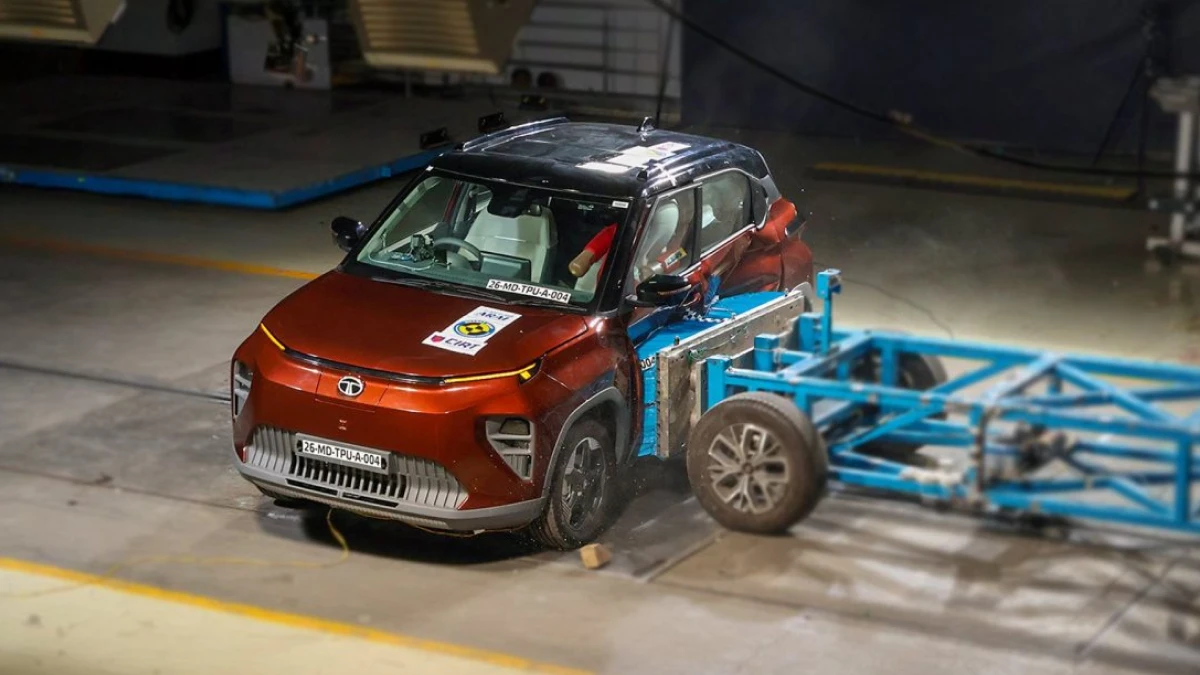
Continuing this momentum, the 2026 Tata Punch EV Facelift has officially achieved a flawless 5-star safety rating from Bharat NCAP (BNCAP). Tested under India’s independent crash evaluation protocol, the electric micro-SUV demonstrated exceptional structural integrity, scoring near-perfect points in both Adult Occupant Protection (AOP) and Child Occupant Protection (COP). Crucially, this 5-star crash test rating applies universally across the entire variant lineup—from the entry-level Smart trim all the way to the range-topping Empowered+ Oxide edition.
Decoupling the Crash Scores: How the Punch EV Performed at Bharat NCAP
Crash testing isn’t just about whether a car earns 5 stars; the granular point distribution reveals how well a chassis absorbs and dissipates kinetic energy during high-speed impacts. Built on Tata’s dedicated acti.ev (Advanced Connected Tech-Intelligent Electric Vehicle) architecture, the Punch EV facelift features ultra-high-strength steel reinforcements, reinforced door sills, and a battery enclosure designed to prevent thermal runaway even in severe side collisions.
In the official BNCAP evaluation, the Punch EV facelift scored 31.09 out of 32 points for Adult Occupant Protection and 45.00 out of 49 points for Child Occupant Protection.
The detailed breakdown matrix below highlights the exact test scores and structural performance metrics of the facelifted model against its internal combustion engine (ICE) counterpart and key electric competitors:
| Parameter / Safety Evaluation | Tata Punch EV Facelift (2026) | Tata Punch (ICE Version) | Citroën eC3 |
| Bharat NCAP Overall Rating | 5 Stars | 5 Stars | 0 Stars (Global NCAP) |
| Adult Occupant Protection (AOP) | 31.09 / 32.00 Points | 30.58 / 32.00 Points | 20.86 / 34.00 Points |
| Frontal Offset Crash Score | 15.28 / 16.00 Points | 14.58 / 16.00 Points | 5.60 / 16.00 Points |
| Side Movable Barrier Score | 15.80 / 16.00 Points | 16.00 / 16.00 Points | 15.26 / 16.00 Points |
| Side Pole Impact Test | PASSED (OK) | PASSED (OK) | NOT APPLICABLE |
| Child Occupant Protection (COP) | 45.00 / 49.00 Points | 45.00 / 49.00 Points | 10.55 / 49.00 Points |
| CRS Dynamic Test Score | 24.00 / 24.00 Points | 24.00 / 24.00 Points | 0.00 / 24.00 Points |
| CRS Installation Assessment | 12.00 / 12.00 Points | 12.00 / 12.00 Points | 10.55 / 12.00 Points |
| Standard Airbag Count | 6 Airbags (All Variants) | 2 Airbags (6 on top trims) | 2 Airbags |
| Electronic Stability Control (ESC) | Standard (All Variants) | Standard | Not Standard |
Deep Dive into the Crash Test Mechanics
During the Bharat NCAP evaluation, cars undergo three primary physical crash impacts inside controlled testing facilities: a 64 km/h frontal offset deformable barrier crash, a 50 km/h side movable deformable barrier impact, and a 29 km/h side pole impact test.
1. Frontal Offset Deformable Barrier Test
Hitting the aluminum honeycomb crash barrier at 64 km/h, the Punch EV facelift registered 15.28 out of 16 points. The passenger cell remained structurally stable throughout the impact. Dummy telemetry indicated “Good” protection for the head, neck, and knees of both the driver and front passenger. The footwell area remained intact without excessive pedal intrusion, minimizing the risk of lower leg injuries for the driver.
2. Side Movable Barrier & Pole Impact Tests
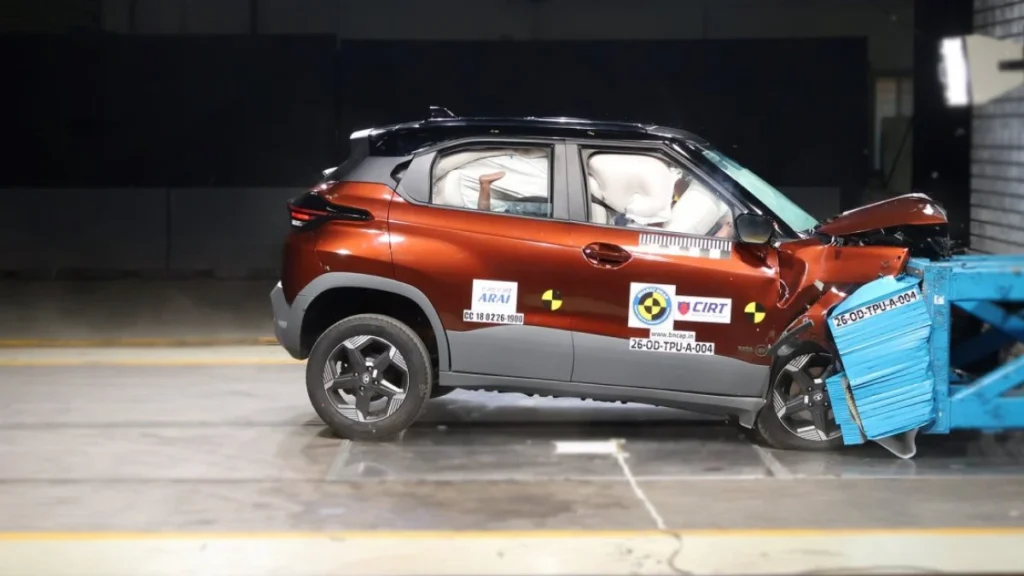
Side collisions are notoriously dangerous for electric vehicles because the impact zone is close to both passenger torsos and low-mounted high-voltage battery packs. In the side barrier test, the Punch EV facelift delivered a near-perfect score of 15.80 out of 16 points.
When subjected to the rigorous Side Pole Impact Test—where the vehicle is propelled sideways into a rigid steel pole to evaluate curtain airbag deployment and roof pillar strength—the side curtain airbags deployed in milliseconds, earning the vehicle a clear pass grade.
Child Occupant Protection: Full Marks for Dynamic Safety
In the Child Occupant Protection category, the Punch EV facelift earned a perfect 24 out of 24 points in dynamic crash testing. Using 18-month-old and 3-year-old child dummies secured in rearward and forward-facing ISOFIX Child Restraint Systems (CRS), the car completely prevented head movement during both frontal and side impacts.
Active & Passive Safety Features: Standard Across All Trims
Tata Motors’ decision to standardize safety gear means buyers do not need to stretch their budget to the top-spec variant to get 5-star protection. Every single variant of the Punch EV facelift leaves the factory floor equipped with a comprehensive suite of active and passive safety features.
Key standard safety technologies include:
- Six Airbags: Dual front airbags, front side airbags, and full-length side curtain airbags extending to the rear seats.
- Electronic Stability Control (ESC): Active yaw-rate control that prevents vehicle skids during sudden high-speed evasive maneuvers.
- Roll-Over Mitigation: Uses braking pressure on individual wheels to stabilize the chassis if steep body roll is detected.
- ISOFIX Child Seat Anchors: Standardized metal mounting brackets located on the outer rear seats for quick, secure child seat installation.
- Disc Brakes on All Four Wheels: Enhanced thermal heat dissipation and shorter stopping distances compared to traditional rear drum brakes.
- Pedestrian Protection Systems: Soft-yielding front bumpers and hood crumple zones designed to absorb impact energy in pedestrian collisions.
Mid & Top-Spec Safety Additions
Higher trims add modern driver assistance hardware, including a 360-degree Surround View camera with blind-spot view monitoring, a blind-spot warning system, Electronic Parking Brake (EPB) with Auto Hold, and Hill Descent Control.
The acti.ev Platform Advantage: Battery & High-Voltage Safety
Designing an electric vehicle isn’t just about protecting human bodies; it requires protecting the high-voltage electrical architecture to eliminate electrical shock hazards and battery fires during a collision.
The Punch EV’s acti.ev architecture incorporates dedicated crash-member extrusions surrounding the battery pack. In the event of a severe crash, pyrotechnic safety switches instantly isolate the high-voltage battery (400V system) from the rest of the car within milliseconds. The battery casing itself is IP67-rated for dust and water ingress, ensuring that flooding or structural impact does not trigger electrical short circuits.
Market Impact: Setting the Benchmark for Compact EVs
With a full 5-star BNCAP safety rating now officially locked in, the Tata Punch EV facelift solidifies its position as one of the safest mass-market electric vehicles available in India. In a market where urban commuters are increasingly prioritizing safety alongside low running costs, Tata’s refusal to compromise on chassis strength gives it a major competitive advantage.
For buyers choosing between micro-SUVs and entry-level electric hatchbacks, the 5-star scorecard provides total peace of mind. Whether navigating congested city commutes or traveling on national highways, the Punch EV facelift proves that compact size does not mean compromising on passenger protection.
Final Takeaway
Safety has shifted from a luxury add-on to a non-negotiable buyer priority in the Indian market. The 2026 Tata Punch EV facelift’s stellar performance at Bharat NCAP reaffirms that Tata Motors continues to lead the industry in democratizing 5-star safety. By combining robust battery protection, standard six airbags, and structural integrity across every variant, the Punch EV sets a high safety bar for all upcoming compact electric vehicles to follow.
