


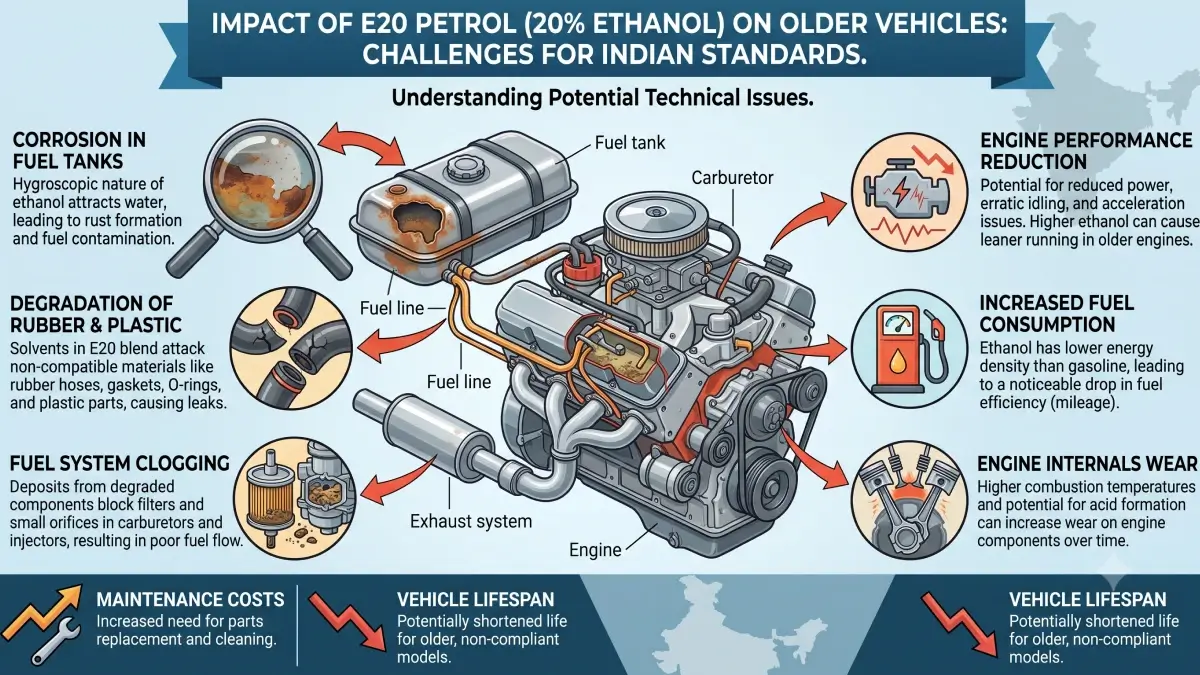
The nationwide shift to E20 fuel (a blend of 20% ethanol and 80% regular fossil fuel) has taken an unexpected turn. While government bodies and state-run oil companies have consistently defended the safety of the green transition, a recently resurfaced, unpublished study by the Automotive Research Association of India (ARAI) has sparked intense debate across the automotive industry.
The leak comes just days after the Ministry of Petroleum and Natural Gas and top auto industry executives publicly dismissed social media rumors regarding widespread engine failures. However, the details of the internal ARAI study introduce concrete technical data to the conversation, highlighting long-term maintenance risks for a specific group of motorists: owners of legacy vehicles designed for lower ethanol blends.
The Core Findings: Rubber Degradation and Efficiency Loss
The central revelation from the internal ARAI report involves material compatibility. While the testing confirmed that E20 petrol causes no structural damage to metallic engine components, laboratory immersion tests revealed a clear negative impact on non-metallic parts.
When exposed to a continuous 20% ethanol blend over extended periods, critical rubber-based fuel system components—including flexible fuel hoses, internal gaskets, structural seals, and vital O-rings—showed accelerated wear and material degradation. The authors of the study concluded that these components “may need early replacement” if a vehicle engineered for E10 or lower fuel is run continuously on the higher E20 blend.
Furthermore, the study confirmed what many motorists have suspected at the pump: an inevitable drop in fuel economy. Because ethanol has a lower calorific value (energy density) than pure fossil fuel, it takes more fluid to generate the same combustion energy. The controlled laboratory trials documented a clear, consistent mileage drop across tested models.
Standard WordPress Specification Matrix
The following matrix synthesizes the specific technical findings from the unpublished ARAI report, contrasting laboratory durability results against the broader government targets:
| Technical Parameters Checked | Observed Results in Controlled Trials | Real-World Operational Context |
| Average Fuel Mileage Drop | Documented Loss Ranging Between 2% to 6% | Driven by Ethanol’s Lower Energy Density |
| Impact on Metal Components | Zero Structural Degradation Identified | Safe for Engine Blocks, Pistons, and Tanks |
| Elastomer & Rubber Elements | Accelerated Softening, Swelling, and Cracking | Impacts Legacy Fuel Hoses, Gaskets, and O-Rings |
| BS4 Engine Durability (400 Hrs) | Acceptable Operational Performance Maintained | No Immediate Component Failures Logged |
| BS6 Turbo Engine Durability | Exhaust Valve Thermomechanical Issue at 265 Hrs | Cause Debated; Needs Full 2,000-Hour Testing |
| Two-Wheeler Durability Tests | Clean Bill of Health Across Three Major Brands | Tailpipe Emissions Remained Within Limits |
| Primary Environmental Gain | Significant Drop in Tailpipe CO and HC Emissions | Supports India’s National Biofuel Objectives |
| National Fiscal Benefit | Saved Over ₹1.90 Lakh Crore in Foreign Exchange | Drastically Decreases Crude Oil Import Bills |
Mixed Results in Engine Durability Testing
Beyond basic material degradation, the leaked report details mixed results from engine durability testing conducted across different manufacturers. On the positive side, testing on a BS4 passenger vehicle engine over a 400-hour period yielded acceptable performance with no unexpected component wear. Similarly, durability testing conducted by three separate two-wheeler manufacturers revealed no major mechanical concerns, indicating that smaller, simpler engines handle the fuel blend well.
However, a significant warning sign emerged during high-stress testing of a modern, turbocharged BS6 engine. The study noted a thermomechanical failure of an exhaust valve after 265 hours of continuous operation under load.
Industry experts have urged caution before blaming the fuel blend alone, noting that valve failures can stem from various design factors and that full durability certifications typically require 2,000 hours of testing. Nevertheless, the finding highlights the complex thermal challenges that arise when introducing higher oxygen content into high-compression, turbocharged engines.
The Policy Dilemma: Older Fleets vs. National Mandates
The emergence of this internal data highlights a widening gap between official energy policy and consumer reality. From a macroeconomic perspective, the E20 mandate is an undeniable success. By reaching its 20% blending target five years ahead of schedule, the government has substituted over 310 lakh metric tonnes of crude oil imports and reduced carbon dioxide emissions by roughly 930 lakh metric tonnes.
The Legacy Fleet Challenge: The real issue is timeline management. Vehicles manufactured after April 2023 are factory-validated with ethanol-resistant materials, and post-April 2025 models feature specific ECU tuning to optimize E20 combustion. However, a significant portion of the active vehicle fleet on Indian roads consists of older, pre-2023 models. For these legacy owners, the risk is not sudden engine failure, but rather a slow increase in long-term maintenance costs.
Looking Ahead
The government stands firmly behind the E20 roadmap, supported by field data from major manufacturers like Maruti Suzuki, which reported zero ethanol-related service failures across millions of older vehicles serviced this year.
To resolve consumer anxiety and clear up lingering confusion, independent consumer groups are now calling on testing agencies to release the full details of these durability studies. Providing clear, model-specific compatibility guidelines and transparent maintenance advice will allow India to meet its ambitious green energy goals without leaving older vehicle owners with unexpected repair bills.
