


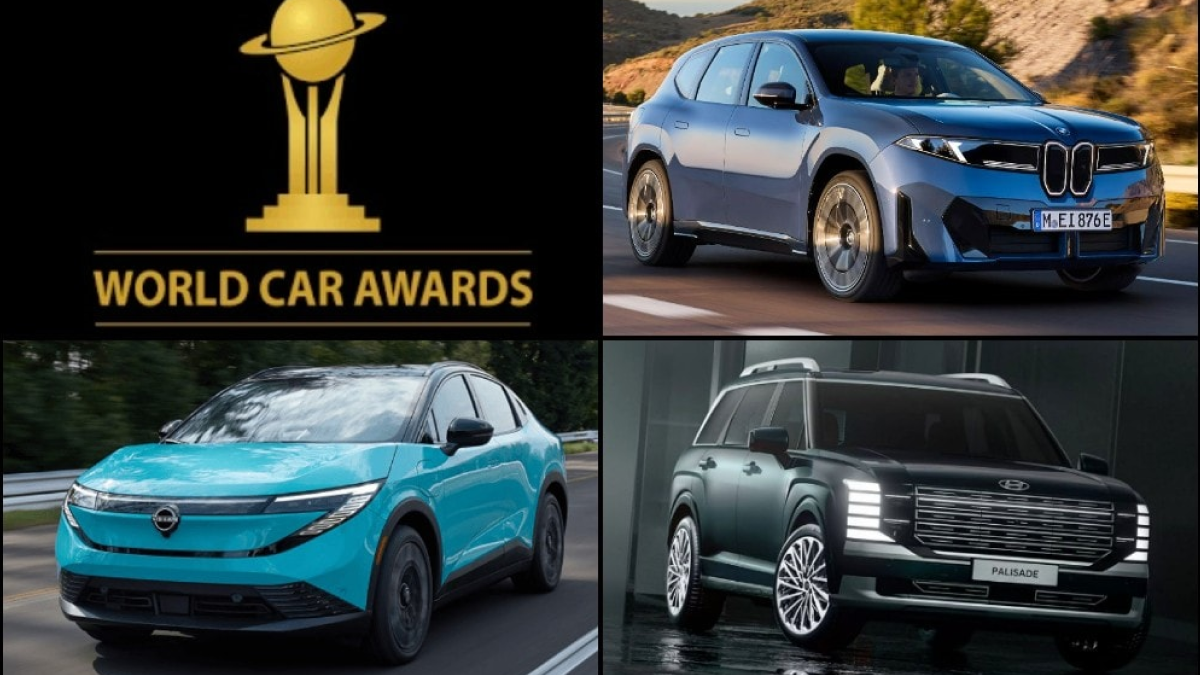
The global automotive industry has reached a decisive milestone with the official announcement of the “Top Three in the World” finalists for the 2026 World Car of the Year (WCOTY) awards. Following a rigorous evaluation process by a jury of 98 international journalists from 33 countries, three distinct vehicles have emerged as the frontrunners for the most prestigious title in the business. The ultimate winner will be crowned on April 1, 2026, during the opening media breakfast of the New York International Auto Show.
This year’s shortlist is particularly noteworthy for its technological diversity, pitting a cutting-edge European EV against a legendary Japanese nameplate and a massive, traditional family hauler from South Korea.
BMW iX3: The Neue Klasse Pioneer
The BMW iX3 leads the charge for the Bavarian automaker, representing a critical pivot in its electrification strategy. Unlike the previous iX3, which shared its architecture with internal combustion models, the 2026 finalist is built on the much-anticipated Neue Klasse platform.
Jurors have lauded the iX3 for its 800-volt software-defined architecture, which allows for significantly faster charging times and a range exceeding 600 kilometers. By making the final three, the iX3 proves that BMW has successfully married its traditional “Ultimate Driving Machine” dynamics with a digital-first electric soul. It is also a finalist in the World Electric Vehicle category, highlighting its dual-threat potential.
Nissan Leaf: The Rebirth of a Legend
Perhaps the most surprising entry in the final three is the third-generation Nissan Leaf. Long known as the world’s first mass-market electric hatchback, the 2026 Leaf has been completely reimagined as a sleek, high-tech crossover.
Moving away from its budget-oriented roots, the new Leaf incorporates Ariya-inspired design language and advanced ProPILOT 2.0 driver assistance. Its inclusion in the WCOTY finals is a testament to Nissan’s ability to reinvent a legacy badge for a more premium, SUV-hungry global market. Like the BMW, the Leaf is pulling double duty as a finalist for the World Electric Vehicle award.
Hyundai Palisade: The Last Stand for Internal Combustion
In a field dominated by battery-electric vehicles, the second-generation Hyundai Palisade stands as the lone representative for internal combustion. As a full-size, three-row SUV, the Palisade has captured juror attention through its “bold luxury” design philosophy and a redesigned interior that rivals premium European marques.
While most of its competitors in the January longlist were EVs, the Palisade’s presence in the final three confirms that there is still significant global demand for high-capacity, long-distance family cruisers. Its 3.5-liter V6 and hybrid-assisted options offer a pragmatic alternative to the electrification trend, focusing on sheer utility and passenger comfort.
A Global Perspective on Mobility
The selection of these three vehicles reflects a maturing global market where “value” is no longer just about price, but about the integration of safety, sustainability, and emotional appeal. Beyond the main category, the 2026 awards will also honor winners in the Luxury, Performance, Urban, and Design categories, with models like the Cadillac Vistiq and the BMW M2 CS also vying for trophies.
As the industry gathers in New York this April, the 2026 World Car of the Year announcement will serve as a definitive barometer for whether the world is ready to fully embrace the next generation of EVs or if traditional, versatile SUVs still hold the crown.
