


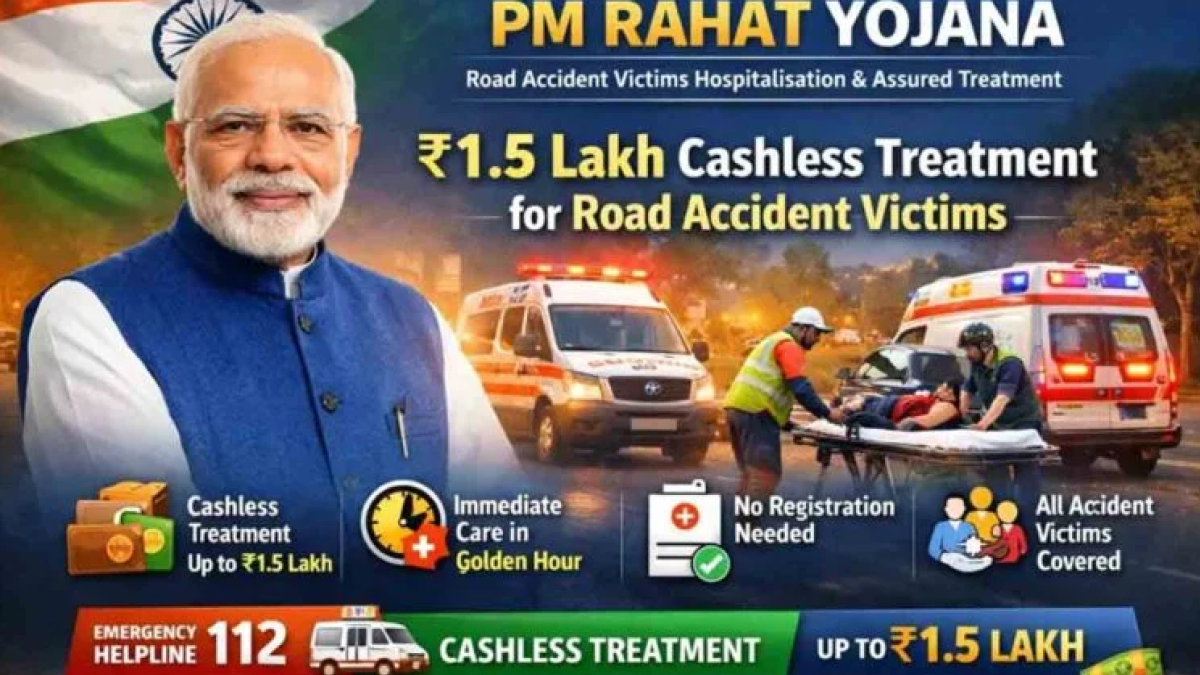
In a landmark shift for Indian road safety, Prime Minister Narendra Modi officially approved the PM RAHAT (Road Accident Victim Hospitalization and Assured Treatment) scheme on February 14, 2026. This initiative—one of the first major decisions announced from the new ‘Seva Teerth’ office—is designed to ensure that no life is lost due to a victim’s inability to pay for immediate trauma care.
With nearly 50% of road fatalities in India being preventable through timely intervention, PM RAHAT targets the “Golden Hour” to slash the country’s high accident mortality rates.
The Cashless Core: How It Works
The primary goal of the PM RAHAT scheme is to eliminate the requirement for upfront deposits or advance payments at hospitals during medical emergencies.
- Financial Cap: Every eligible road accident victim is entitled to cashless treatment up to ₹1.5 lakh.
- Time Sensitivity: This coverage is active for the first seven days from the date of the accident.
- Universal Coverage: The scheme applies regardless of the road category—whether the mishap occurs on a National Highway, a state road, or a narrow urban lane.
Stabilisation and the 112 Ecosystem
The scheme introduces a structured “Stabilisation Period” to ensure accountability without delaying care. Victims are eligible for:
- 24 hours of stabilisation in non-life-threatening cases.
- 48 hours in life-threatening scenarios, subject to police authentication on a shared digital platform.
The integration with the Emergency Response Support System (ERSS) 112 is a game-changer. Any bystander or “Rah-Veer” (Good Samaritan) can dial 112 to identify the nearest designated hospital and dispatch a coordinated ambulance. This digital link between the police, responders, and trauma centers ensures that treatment begins the moment the patient arrives.
Claim Settlement & Technology
To prevent hospitals from facing financial delays, the government has integrated the Electronic Detailed Accident Report (eDAR) platform with the National Health Authority’s TMS 2.0.
- Reimbursement: Payments are made via the Motor Vehicle Accident Fund (MVAF).
- Hit-and-Run Cases: If the offending vehicle is uninsured or flees the scene, the government provides the funds through a dedicated budgetary allocation.
- Speed: Once a State Health Agency approves a claim, hospitals must be paid within 10 days, ensuring they remain motivated to provide uninterrupted care.
Verdict
The PM RAHAT scheme is more than just an insurance policy; it is a technology-driven governance model rooted in compassion. By removing the financial “barrier to entry” at hospital gates, India is finally treating emergency healthcare as a right rather than a privilege.
