


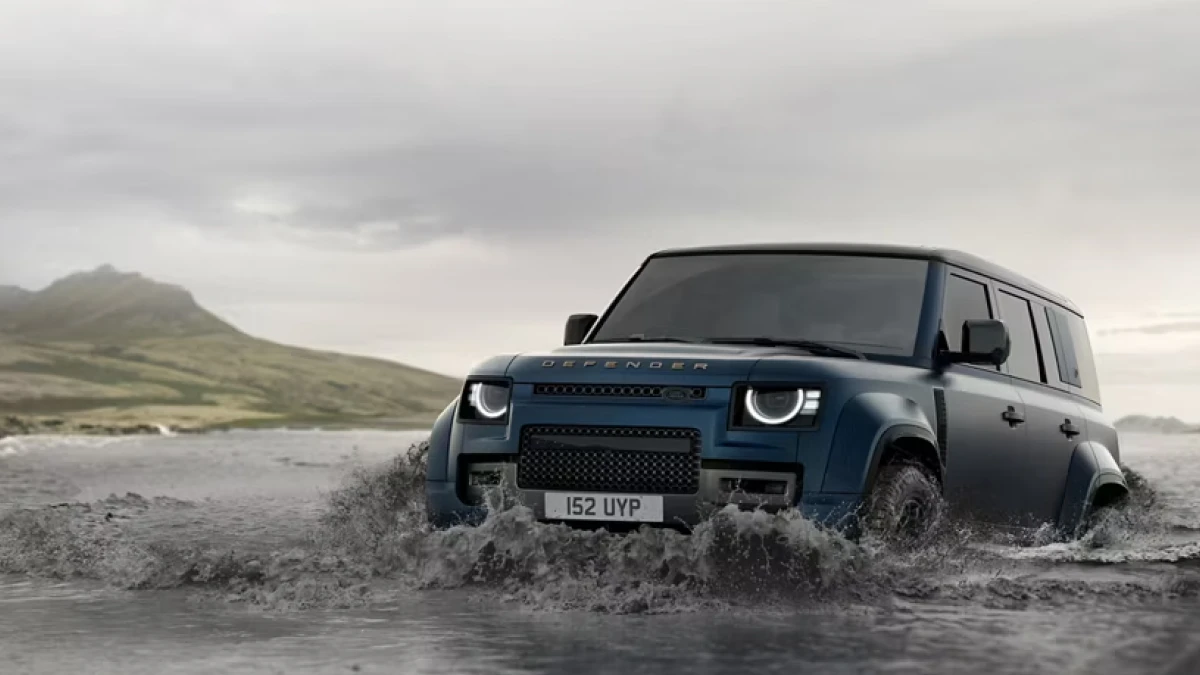
The Land Rover Defender 110 has become significantly more affordable in India, with prices reduced by up to ₹34 lakh following the start of local assembly at Jaguar Land Rover’s Pune facility. The luxury off-road SUV is now available in the X-Dynamic HSE specification with three engine options, with the range starting at ₹99 lakh and going up to ₹1.18 crore, ex-showroom New Delhi.
The price revision follows a change in the way the Defender 110 is manufactured for the Indian market. Previously imported as a completely built-up (CBU) vehicle, the SUV is now being assembled in India through the completely knocked down (CKD) route. This allows JLR to reduce its reliance on importing fully assembled vehicles and lower the costs associated with bringing the SUV to India.
Along with the price reduction, JLR has added several features as standard equipment that were previously optional. Depending on the engine, these additions include adaptive air suspension, three-zone climate control, electrically adjustable front seats with heating and cooling, a Meridian surround sound system and an electronic active differential with torque vectoring.
The new pricing makes the Defender 110 more accessible to buyers looking for a premium SUV with genuine off-road credentials. However, it remains an expensive luxury vehicle, and the final on-road price will be considerably higher than its ex-showroom price.
In this detailed MotorFuturist report, we examine the new Defender 110 prices, engine options, standard features, reasons behind the price reduction, changes following local assembly and how it compares with other premium SUVs available in India.
Land Rover Defender 110 New Price in India
The locally assembled Defender 110 is available in the X-Dynamic HSE specification with three powertrain options: a 2.0-litre turbo-petrol, a 3.0-litre turbo-petrol and a 3.0-litre diesel.
The biggest price reduction applies to the two 3.0-litre versions, both of which are now ₹34 lakh cheaper than their earlier ex-showroom prices.
Land Rover Defender 110: Old vs New Prices
| Defender 110 Variant | Engine | Old Price | New Price | Price Reduction |
|---|---|---|---|---|
| X-Dynamic HSE | 2.0-litre turbo-petrol | ₹1.13 crore | ₹99 lakh | ₹14 lakh |
| X-Dynamic HSE | 3.0-litre turbo-petrol | ₹1.52 crore | ₹1.18 crore | ₹34 lakh |
| X-Dynamic HSE | 3.0-litre diesel | ₹1.52 crore | ₹1.18 crore | ₹34 lakh |
All prices are ex-showroom New Delhi. Prices and equipment should be reconfirmed with an authorised Land Rover dealership before booking.
How Much Cheaper Has the Defender 110 Become?
The reduction varies according to the engine option.
The 2.0-litre turbo-petrol version has received a ₹14 lakh price cut, taking its price below the ₹1 crore mark for the first time under this revised pricing.
The 3.0-litre turbo-petrol and diesel versions have received larger reductions of ₹34 lakh each. Both now cost ₹1.18 crore, compared with their earlier price of ₹1.52 crore.
Percentage Price Reduction
| Engine Option | Previous Price | New Price | Approximate Price Reduction |
|---|---|---|---|
| 2.0-litre turbo-petrol | ₹1.13 crore | ₹99 lakh | 12.4% |
| 3.0-litre turbo-petrol | ₹1.52 crore | ₹1.18 crore | 22.4% |
| 3.0-litre diesel | ₹1.52 crore | ₹1.18 crore | 22.4% |
The percentage reductions are calculated using the rounded prices reported for the old and new models. They should be treated as approximate.
For a luxury SUV buyer, a ₹34 lakh reduction is substantial. It is equivalent to the price of an entire additional car in some mainstream segments. Nevertheless, buyers should remember that the Defender’s insurance, registration, servicing and replacement parts can still involve significant expenses.
Why Has the Land Rover Defender Become Cheaper in India?
The main reason is local assembly.
Until now, the Defender sold in India was imported as a completely built-up vehicle. Under this arrangement, the vehicle is manufactured abroad and brought into India as a finished product.
JLR has now started assembling the Defender 110 at its Pune facility using the completely knocked down route. In this arrangement, vehicles arrive as kits or partially disassembled components and are assembled locally.
The different import and assembly cost structure can reduce the overall cost of supplying the vehicle to the Indian market.
CBU vs CKD: What’s the Difference?
| Factor | CBU: Completely Built-Up | CKD: Completely Knocked Down |
|---|---|---|
| Vehicle condition at import | Fully assembled vehicle | Vehicle components or kits for local assembly |
| Assembly location | Overseas manufacturing facility | Local assembly facility |
| Import-related costs | Generally higher for fully built imported vehicles | Can be lower than those for CBU imports |
| Local operations | Primarily import, distribution and sales | Includes local assembly operations |
| Potential effect on price | Higher landed costs can contribute to a higher retail price | Cost savings may allow a lower retail price |
| Defender 110 in India | Previous supply method | New local assembly method |
The change does not mean the Defender is now an inexpensive SUV to manufacture or own. It means JLR has changed its production and supply arrangement for the Indian market, creating room for lower prices.
It is also important not to confuse this development with a general reduction in luxury-car import duties under a trade agreement. The reported price cut is linked to the transition to local assembly.
Is the Defender 110 Now Made in India?
The Defender 110 is now being assembled locally at JLR’s Pune facility for the Indian market.
This is a significant development for the brand because the Defender has historically been associated with overseas production and fully imported vehicles in India.
However, the change currently applies to the Defender 110 in the X-Dynamic HSE specification covered by the new pricing. It does not mean that every Defender body style and variant is now locally assembled.
Which Defender Models Continue to Be Imported?
| Model | Manufacturing/Supply Status for India |
|---|---|
| Defender 110 X-Dynamic HSE covered by the revised pricing | Locally assembled in Pune |
| Defender 90 | Continues to be imported as a fully built vehicle |
| Defender 130 | Continues to be imported as a fully built vehicle |
| Defender Octa | Continues to be imported as a fully built vehicle |
The Defender 90, Defender 130 and high-performance Defender Octa therefore remain distinct buying propositions. Their prices and equipment should not be assumed to follow the reductions announced for the locally assembled Defender 110.
Land Rover Defender 110 Engine Options and Performance
The locally assembled Defender 110 is offered with three engine choices. Buyers can choose between a 2.0-litre turbo-petrol engine, a more powerful 3.0-litre turbo-petrol engine and a 3.0-litre diesel engine.
The 2.0-litre petrol version is the entry point into the revised range, while the larger engines provide higher performance and different driving characteristics.
Defender 110 Engine Specifications
| Specification | 2.0-Litre Turbo-Petrol | 3.0-Litre Turbo-Petrol | 3.0-Litre Diesel |
|---|---|---|---|
| Fuel type | Petrol | Petrol | Diesel |
| Engine displacement | 2.0 litres | 3.0 litres | 3.0 litres |
| Maximum power | Approximately 300hp | Approximately 400hp | Approximately 350hp |
| Transmission | Automatic | Automatic | Automatic |
| Price | ₹99 lakh | ₹1.18 crore | ₹1.18 crore |
| Primary appeal | Lower entry price | Higher petrol performance | Diesel torque and long-distance usability |
Power figures are rounded. Confirm the exact engine specification and output in the latest India-market brochure before publication or booking.
2.0-Litre Turbo-Petrol: The Entry-Level Defender
The 2.0-litre turbo-petrol engine produces approximately 300hp. It is the most affordable way to enter the locally assembled Defender 110 X-Dynamic HSE range.
Its revised price of ₹99 lakh is particularly significant because it brings the Defender below the ₹1 crore ex-showroom threshold.
For buyers who prefer petrol and do not need the higher output of the 3.0-litre engine, this version offers a lower purchase price while retaining the Defender’s distinctive styling and off-road-oriented design.
3.0-Litre Turbo-Petrol: More Power
The 3.0-litre turbo-petrol engine produces approximately 400hp. It is aimed at buyers who want stronger performance alongside the Defender’s traditional off-road character.
Despite the higher engine output, this variant now costs ₹1.18 crore ex-showroom, matching the price of the 3.0-litre diesel version.
The decision between the petrol and diesel options should depend on driving patterns, fuel preferences, annual distance and the character of performance the buyer wants.
3.0-Litre Diesel: For Buyers Who Prefer Diesel
The 3.0-litre diesel engine produces approximately 350hp. It is likely to appeal to buyers who prefer diesel power delivery and regularly undertake long-distance journeys.
However, fuel efficiency should not be inferred from engine displacement or fuel type alone. The Defender is a large, heavy luxury SUV, and actual consumption depends on traffic, speed, terrain, passenger load and driving style.
Buyers should also check local diesel-vehicle regulations and expected ownership costs before making a long-term purchase decision.
Standard Features: What Has Changed After Local Assembly?
The Defender 110’s price reduction is not the only change. JLR has also added equipment that was previously available as optional extras.
The additions differ by engine variant. The 2.0-litre turbo-petrol version receives equipment valued at up to ₹6.5 lakh, while the 3.0-litre petrol and diesel versions receive additional equipment valued at up to ₹17 lakh.
These values refer to the reported value of the equipment additions, not cash discounts that buyers can claim separately.
Defender 110 2.0-Litre Petrol: New Standard Features
| Feature | What It Offers |
|---|---|
| Adaptive off-road cruise control | Helps manage vehicle speed in supported off-road conditions |
| Air suspension with Adaptive Dynamics | Adjusts suspension behaviour and supports ride-height functionality |
| Three-zone climate control | Allows temperature settings for different cabin zones |
| Cabin air purifier | Helps improve cabin-air quality |
| Front centre console refrigerator | Provides chilled storage within the cabin |
| 14-way electrically adjustable front seats | Allows a wider range of seating adjustments |
| Front-seat heating | Adds warmth in cold conditions |
| Front-seat cooling | Helps improve comfort in hot weather |
| Front-seat memory | Stores selected seat positions |
| Headlight washers | Help clean the headlamp lenses |
| Spare-wheel lock | Adds a security measure for the spare wheel |
| Body-coloured spare-wheel cover | Matches the spare-wheel cover to the exterior finish |
| Manually operated third-row seats | Provides additional seating functionality where equipped |
The most notable additions are the adaptive air suspension, multi-zone climate control, front-seat comfort functions and centre-console refrigerator.
For a luxury SUV costing close to ₹1 crore, these features help improve the overall equipment package. They also reduce the need for buyers to negotiate individual optional extras.
Defender 110 3.0-Litre Petrol and Diesel: Additional Features
The 3.0-litre petrol and diesel versions receive a broader set of equipment additions.
New Standard Features on 3.0-Litre Variants
| Feature | Benefit |
|---|---|
| 20-inch wheels | Larger wheel design and a more substantial visual appearance |
| Illuminated metal treadplates | Adds a premium detail to the cabin entry area |
| Electronic active differential with torque vectoring | Helps manage torque distribution to support traction and handling |
| Four-way manually adjustable winged headrests | Provides additional head-support adjustment |
| Second-row slide and recline adjustment | Allows occupants to adjust rear-seat positioning |
| Heated third-row seats | Adds comfort for third-row occupants where fitted |
| Suede headliner | Gives the cabin a more premium finish |
| Three-zone climate control with rear cooling | Improves temperature management for rear occupants |
| Meridian surround sound system | Provides an upgraded audio experience |
| Head-up display | Projects selected driving information into the driver’s field of view |
The active differential and torque-vectoring hardware are particularly relevant to a vehicle designed for demanding terrain. The audio system, head-up display and climate-control equipment, meanwhile, improve everyday convenience.
Not every buyer will value every feature equally. A driver who spends most of the time on highways may place greater importance on comfort and audio quality, while someone who regularly explores challenging trails may pay closer attention to the vehicle’s off-road systems.
Defender 110 Off-Road Capability: Does It Remain the Same?
The Defender’s appeal is based on more than its styling or luxury features. It is also known for its off-road-oriented engineering.
The transition to local assembly and the revised prices do not, by themselves, indicate that the vehicle has become less capable. However, buyers should verify the exact hardware and equipment fitted to the locally assembled version rather than assuming that every specification from every global Defender variant applies.
Features such as air suspension, off-road cruise control and an electronic active differential can contribute to the vehicle’s capability, depending on the exact specification.
Off-Road Equipment to Consider
| Equipment or Capability | Why It Matters |
|---|---|
| Air suspension | Can provide ride-height adjustment and support clearance requirements in suitable conditions |
| Adaptive off-road cruise control | Helps manage speed over challenging terrain |
| Electronic active differential | Can assist with torque management and traction |
| Terrain-management systems | Help adapt vehicle settings to different driving surfaces, where fitted |
| Four-wheel-drive system | Essential to the vehicle’s off-road capability |
| Tyres | Affect grip on rocks, sand, mud and ordinary roads |
| Approach, departure and breakover angles | Help indicate how the vehicle handles steep changes in terrain |
Off-road performance depends on the complete vehicle setup, including tyres, drivetrain, suspension, ground clearance and driver technique.
Buyers should also remember that expensive wheels and road-oriented tyres may not be ideal for every type of trail. Anyone planning regular off-road trips should discuss the intended use with the dealer and examine the exact tyre and equipment specification.
Defender 110 vs Jeep Wrangler: Which Luxury Off-Roader Should You Consider?
The Jeep Wrangler is a natural alternative for buyers who want a vehicle with a strong off-road identity.
However, the two SUVs differ in price, cabin positioning and their approach to luxury. The Defender 110 is now priced from ₹99 lakh ex-showroom, while the Wrangler occupies a substantially lower price bracket in India.
That makes the Wrangler a useful alternative for buyers who prioritise off-road character over the Defender’s premium positioning and equipment package.
Defender 110 vs Jeep Wrangler
| Factor | Land Rover Defender 110 | Jeep Wrangler |
|---|---|---|
| Price positioning | ₹99 lakh to ₹1.18 crore for the locally assembled X-Dynamic HSE range | Substantially lower; check current variant prices |
| Vehicle character | Luxury SUV with serious off-road credentials | Off-road-focused SUV with a distinctive design |
| Engine choice | 2.0-litre petrol, 3.0-litre petrol and 3.0-litre diesel | Engine availability depends on the current India lineup |
| Seating | Five-seat and additional-seat configurations depend on specification | Seating and body configuration depend on variant |
| Cabin experience | Premium materials and comfort equipment | More rugged, function-focused design |
| Off-road orientation | Strong off-road focus combined with luxury features | Strong off-road focus and distinctive Jeep character |
| Best suited for | Buyers wanting luxury, space and off-road capability together | Buyers prioritising off-road identity and a more accessible purchase price |
The Wrangler is not a direct substitute for every Defender buyer. Someone who wants a large luxury SUV with a premium cabin and a broader equipment package may still prefer the Defender.
However, buyers whose primary requirement is off-road ability should drive both vehicles and decide whether the Defender’s additional size, equipment and luxury justify its significantly higher price.
Defender 110 vs Toyota Fortuner: A Different Kind of SUV
The Toyota Fortuner is another vehicle that may appear on the shortlist of Indian buyers seeking a large, tough SUV.
But it belongs to a much lower price bracket than the locally assembled Defender 110. The two vehicles therefore should not be treated as direct price competitors.
The Fortuner’s appeal centres on its rugged construction, established market presence and practicality. The Defender offers a more premium luxury proposition, along with a substantially different price and equipment package.
Defender 110 vs Toyota Fortuner
| Factor | Land Rover Defender 110 | Toyota Fortuner |
|---|---|---|
| Price bracket | ₹99 lakh to ₹1.18 crore for the specified locally assembled range | Considerably lower; varies by variant |
| Market positioning | Luxury off-road SUV | Premium mainstream SUV |
| Cabin emphasis | Luxury, comfort and technology | Practicality and durability |
| Powertrain choices | Petrol and diesel options in the revised Defender 110 range | Petrol and diesel availability depends on variant |
| Off-road appeal | Designed for luxury travel and demanding terrain | Rugged SUV with off-road-oriented variants |
| Ownership considerations | Premium-car service and replacement-part costs | Different ownership-cost profile; verify current service estimates |
| Best suited for | Buyers prioritising luxury and off-road capability | Buyers wanting a rugged SUV at a lower purchase price |
For buyers with a budget around ₹1 crore, the Fortuner may not provide the same level of luxury or premium equipment as the Defender. But someone who values practical SUV capability over luxury appointments may not need to spend as much as the new Defender costs.
The decision ultimately comes down to whether the additional luxury and engineering justify the price difference for the intended use.
Defender 110 vs Mercedes-Benz G-Class: How Do They Differ?
The Mercedes-Benz G-Class occupies another part of the luxury off-road market. It combines a distinctive design with a premium cabin and a strong brand identity.
The Defender 110 and G-Class are both aspirational vehicles, but their prices, engines, equipment and intended buyer profiles vary. The G-Class range also includes performance-oriented models that should not be compared with the standard Defender on price alone.
Defender 110 vs Mercedes-Benz G-Class
| Factor | Land Rover Defender 110 | Mercedes-Benz G-Class |
|---|---|---|
| Price positioning | Starts at ₹99 lakh for the locally assembled 2.0-litre petrol X-Dynamic HSE | Generally positioned at a substantially higher price point in India; check the current lineup |
| Design | Modern interpretation of a traditional off-road SUV | Iconic boxy styling |
| Powertrain choice | 2.0-litre petrol, 3.0-litre petrol and 3.0-litre diesel | Varies by model and performance version |
| Cabin character | Luxury-oriented, with practical design elements | High-end luxury with a strong emphasis on premium finishes |
| Off-road capability | A core part of the Defender’s identity | A core part of the G-Class’s identity |
| Performance options | Varies by Defender model | Includes high-performance AMG versions |
| Best suited for | Buyers seeking luxury and capability at a lower entry price than the G-Class | Buyers seeking the G-Class’s distinctive design, prestige and premium positioning |
The Defender’s revised pricing makes it a potentially more accessible entry into the luxury off-road category.
That does not make it an equivalent substitute for every G-Class buyer. Brand preference, performance requirements, cabin design and the exact variant all influence the decision.
What Does the Price Cut Mean for Defender Buyers?
The new pricing changes the Defender’s value proposition in three important ways.
1. The Entry Price Is Now Below ₹1 Crore
The 2.0-litre petrol version’s new ₹99 lakh price puts it below the ₹1 crore ex-showroom mark.
That may bring the Defender onto the shortlist of buyers who previously considered the starting price too high.
However, the on-road price will be higher after registration, insurance and other applicable charges.
2. The Larger Engines Are Now More Accessible
The ₹34 lakh reduction on the 3.0-litre petrol and diesel versions is the biggest change.
Buyers who wanted the larger engine options can now consider them at ₹1.18 crore ex-showroom instead of ₹1.52 crore.
The revised prices also mean that the decision between the 3.0-litre petrol and diesel engines is no longer based on a price difference between the two versions, at least at the published ex-showroom level.
3. More Features Are Included as Standard
The additional standard equipment is an important part of the revised package.
The 2.0-litre petrol version receives comfort and convenience features valued at up to ₹6.5 lakh, while the 3.0-litre versions receive additions valued at up to ₹17 lakh.
Buyers should not add these figures directly to the price reduction and treat the result as a cash saving. The equipment value and the price reduction are separate aspects of the revised offering.
Defender 110 Ownership Costs: What Should Buyers Budget For?
A lower purchase price improves affordability, but it does not automatically make a luxury SUV inexpensive to own.
The Defender’s final on-road price depends on the registration location, insurance policy and other applicable charges. Long-term costs also include servicing, fuel, tyres and replacement parts.
Defender 110 Ownership Checklist
| Cost Category | What Buyers Should Check |
|---|---|
| Ex-showroom price | Confirm the selected engine and specification |
| Registration and road tax | Obtain a state-specific quotation |
| Insurance | Compare coverage, deductibles and add-ons |
| Scheduled servicing | Request a written service-cost estimate |
| Extended warranty | Check eligibility, duration and exclusions |
| Roadside assistance | Confirm coverage and renewal costs |
| Fuel | Estimate spending using annual distance and realistic consumption |
| Tyres | Ask about replacement costs and availability |
| Accessories | Confirm which features are standard and which are optional |
| Resale value | Review market data but recognise that future values are uncertain |
Should You Buy the Defender Now?
The revised pricing makes the Defender 110 more attractive to buyers who were already considering it.
However, a ₹14 lakh or ₹34 lakh reduction should not be the only reason to purchase a luxury SUV. Buyers should consider whether the vehicle suits their daily driving, parking requirements, family needs and intended off-road use.
It is also worth confirming the exact equipment included in the locally assembled model, especially if you have been comparing it with a previous CBU specification or a vehicle advertised in existing dealer inventory.
Land Rover Defender 110: Pros and Cons After the Price Cut
Advantages
1. Significant reduction in the purchase price
The larger petrol and diesel versions are now ₹34 lakh cheaper than their previous listed prices.
2. Entry price below ₹1 crore
The 2.0-litre turbo-petrol version now starts at ₹99 lakh ex-showroom.
3. More standard equipment
Previously optional comfort, convenience and technology features have been added to the standard package.
4. Three engine options
Buyers can choose between a 2.0-litre petrol, 3.0-litre petrol and 3.0-litre diesel.
5. Local assembly in India
The CKD assembly programme changes the vehicle’s supply arrangement and supports the revised pricing.
6. Strong luxury and off-road proposition
The Defender combines premium equipment with an off-road-oriented design, making it different from conventional family SUVs.
Disadvantages and Considerations
1. It remains an expensive SUV
Even at ₹99 lakh ex-showroom, the Defender is outside the budget of most mainstream SUV buyers.
2. On-road prices will be higher
Registration, insurance and other applicable charges add to the final cost.
3. Not every Defender model receives the same price reduction
The revised pricing applies to the locally assembled Defender 110 X-Dynamic HSE versions covered by the announcement. Other body styles and the Octa continue to be imported.
4. Luxury ownership costs remain relevant
Servicing, tyres, fuel and replacement parts should be considered before purchase.
5. Variant details need careful checking
Equipment differs by engine and specification. Buyers should confirm the current brochure and final dealership quotation.
Final Verdict: Is the Land Rover Defender 110 Worth Buying After the ₹34 Lakh Price Cut?
The Land Rover Defender 110’s revised pricing is one of the most significant changes to its Indian-market proposition.
The entry-level 2.0-litre turbo-petrol version now costs ₹99 lakh, while the 3.0-litre petrol and diesel versions are priced at ₹1.18 crore each. The reductions of up to ₹34 lakh follow the start of local assembly at JLR’s Pune facility.
The price cut is accompanied by additional standard equipment, including comfort, climate-control and technology features. This makes the revised Defender 110 package more attractive than a price reduction alone would suggest.
The most important distinction is that the Defender remains a luxury SUV with a substantial ownership cost. Buyers should not assume that local assembly makes it comparable in price or running costs to a mainstream SUV such as the Toyota Fortuner.
The Jeep Wrangler is worth considering for buyers who prioritise off-road character, while the Mercedes-Benz G-Class serves a different luxury and prestige-oriented market. The right choice depends on budget, equipment, driving preferences and intended use.
Our recommendation: If you have been considering the Defender 110, the revised pricing makes it worth revisiting your shortlist. Compare the exact engine versions, inspect the newly standard equipment, obtain an on-road quotation and test-drive the vehicle before making a decision. The biggest benefit is not simply the lower sticker price, but the combination of local assembly, a revised price structure and a broader standard equipment package.
Frequently Asked Questions
1. What is the new price of the Land Rover Defender 110 in India?
The locally assembled Defender 110 X-Dynamic HSE starts at ₹99 lakh ex-showroom for the 2.0-litre turbo-petrol version. The 3.0-litre petrol and diesel versions are priced at ₹1.18 crore each.
2. How much cheaper has the Land Rover Defender 110 become?
The 2.0-litre petrol version has received a ₹14 lakh reduction, while the 3.0-litre petrol and diesel versions are ₹34 lakh cheaper than their earlier listed prices.
3. Why has the Defender 110’s price been reduced?
The price reduction follows the start of local assembly at JLR’s Pune facility through the CKD route. This changes the vehicle’s supply arrangement and can reduce costs compared with importing fully assembled vehicles.
4. Is the Land Rover Defender now assembled in India?
Yes. The Defender 110 X-Dynamic HSE covered by the revised pricing is now locally assembled at JLR’s Pune facility.
5. Which Defender variants are locally assembled?
The current programme covers the Defender 110 X-Dynamic HSE specification with 2.0-litre petrol, 3.0-litre petrol and 3.0-litre diesel engine options.
6. Does the Defender 90 also get the price reduction?
The reported revised prices apply to the locally assembled Defender 110 versions. The Defender 90 continues to be imported as a fully built vehicle.
7. Does the Defender Octa become cheaper too?
The Defender Octa continues to be imported as a fully built vehicle and is not included in the locally assembled Defender 110 price revision.
8. What engines are available in the locally assembled Defender 110?
The range includes a 2.0-litre turbo-petrol engine, a 3.0-litre turbo-petrol engine and a 3.0-litre diesel engine.
9. What new features have been added to the Defender 110?
Depending on the engine, new standard equipment includes adaptive air suspension, three-zone climate control, an air purifier, a front centre console refrigerator, electrically adjustable front seats with heating and cooling, a Meridian surround sound system and a head-up display.
10. Is the Defender 110 now cheaper than the Toyota Fortuner?
No. The Defender 110 remains substantially more expensive than the Toyota Fortuner. The two SUVs also differ in luxury equipment, pricing and market positioning.
11. Is the Defender 110 better than the Jeep Wrangler?
Neither is automatically better for every buyer. The Defender combines luxury features with off-road capability, while the Wrangler offers its own distinctive off-road-focused character at a lower price point. A test drive and equipment comparison are recommended.
12. When will deliveries of the locally assembled Defender 110 begin?
Customer deliveries are scheduled to begin on November 15, 2026.
13. Does the price reduction mean the Defender’s quality has changed?
The move to local assembly does not, by itself, establish a change in quality. Buyers should check the manufacturer’s warranty, inspect the vehicle and confirm the exact specifications of the locally assembled version.
14. Is the new Defender 110 price an on-road price?
No. The reported prices are ex-showroom. Registration, insurance and other applicable charges will increase the final on-road cost.
Editorial note: Prices and specifications are subject to change. Confirm the latest engine details, equipment and on-road pricing with an authorised Land Rover dealership before booking.
