


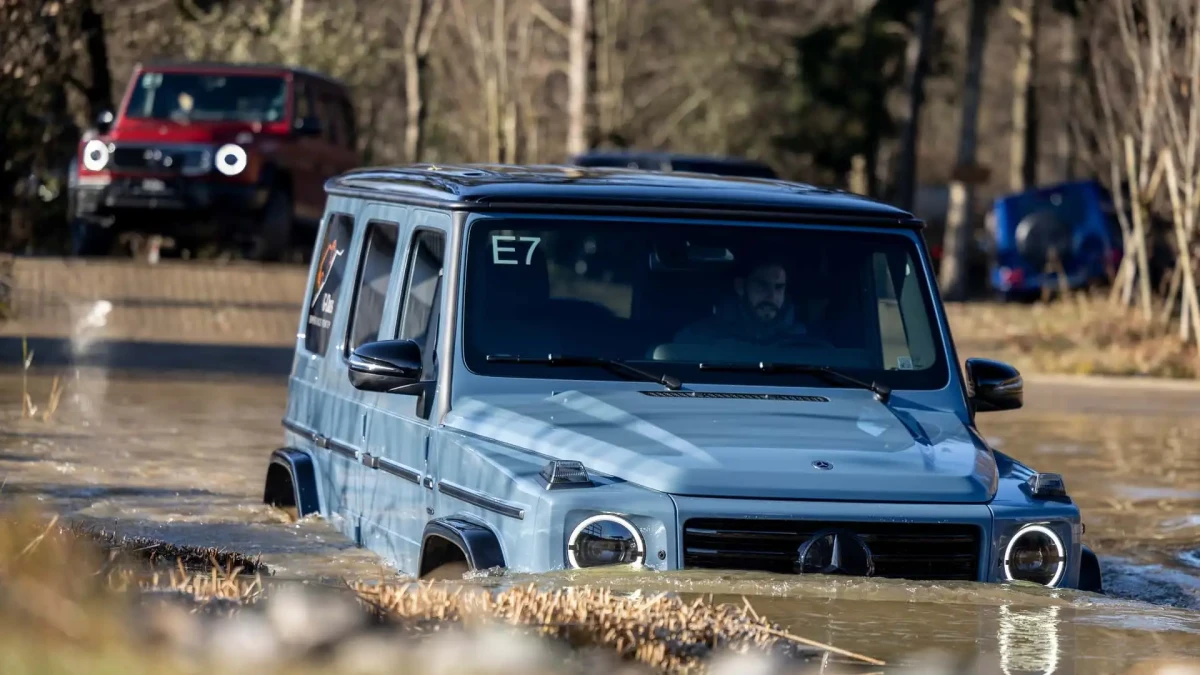
Off-roading has historically relied on raw mechanical capability: heavy-duty ladder frames, mechanical differential locks, long-travel suspensions, and low-range transfer cases. However, as automotive engineering transitions into a software-defined era, Mercedes-Benz is expanding its focus toward intelligent off-road automation.
Recent patent documentation reveals that Mercedes-Benz is developing an advanced suite of off-road navigation algorithms, automated terrain assessment tools, and real-time vehicle-state control systems. Rather than replacing physical hardware, these software systems interact directly with air suspensions, torque-vectoring electric motors, and drive modes to simplify difficult trails.
Key Patent Innovations: How the Technology Works
Mercedes-Benz’s patent portfolio outlines a multi-layered framework designed to handle unpredictable off-road conditions. By utilizing radar, LiDAR, ultrasound, stereoscopic cameras, and vehicle telemetry, the vehicle creates an active 3D profile of the surrounding environment.
| Patent Functionality | Core Technology Utilized | Primary Operational Benefit |
| Real-Time Terrain Assessment | Optical Sensors, Depth Cameras, LiDAR, Ground-Scanning Radar | Evaluates ground density, approach angles, rut depths, and obstacle heights before the vehicle makes surface contact. |
| Automated Driving Sequences | Adaptive Suspension, Active Anti-Roll Bars, Dynamic Torque Distribution | Adjusts wheel articulation, throttle response, and brake vectoring automatically based on terrain feedback. |
| Off-Road Topographic Navigation | Topographic Mapping, Satellite Surface Data, Sensor Analytics | Charts routes around high-risk obstacles such as deep mud, steep inclines, or narrow rock squeezes. |
| Buoyancy & Aquatic Control | Inflatable Wheel-Arch Modules, Quad-Motor Torque Vectoring | Manages floating stability, steering, and current compensation during deep-water crossings. |
Real-Time Terrain Assessment & Predictive Environmental Analysis
Standard on-road driving assistance relies on predictable lane markings, highway signs, and paved road edges. Off-road environments, however, lack structured references.
1. Pre-Surface Scanning
The vehicle scans the upcoming path up to several meters ahead using forward-facing sensor arrays. The system measures surface roughness, identifies hidden rocks, and evaluates gradient angles.
2. Traction and Friction Prediction
By pairing camera data with real-time feedback from wheel-speed sensors and tire pressure monitoring units, the computer calculates the estimated friction coefficient for upcoming surfaces—such as loose gravel, wet clay, or sand dunes.
3. Route Feasibility Index
Before entering a challenging trail segment, the software calculates whether the vehicle’s ground clearance, ramp-over angle, and track width are sufficient to clear obstacles safely.
Dedicated Topographic Off-Road Navigation Systems
Traditional satellite navigation applications are designed around mapped paved roads and marked highways. They often fail when navigating open deserts, dirt trails, or unmapped mountain paths.
Mercedes’ patented off-road navigation technology incorporates geographic information systems (GIS) data, terrain elevation profiles, and crowdsourced trail information.
- Obstacle Avoidance Routing: Re-routes the vehicle around deep riverbeds, unstable rockslides, or excessive side-slopes.
- Variable Clearance Requirements: Adjusts navigation recommendations based on the vehicle’s current air-suspension height and skid-plate configuration.
- Energy Optimization for EVs: Calculates battery consumption on electric models based on slope gradients, surface drag, and trail elevation changes.
Integration with Quad-Motor EV Architectures
While applicable to internal combustion engines, these software-defined off-road capabilities are particularly effective when paired with multi-motor electric vehicles, such as the electric G-Class platform.
- Independent Torque Vectoring: Electric powertrains can adjust torque independently at each wheel in milliseconds, providing precise wheel-slip management on slippery inclines.
- Zero-Delay Traction Response: Electric motors respond instantly without waiting for mechanical differentials to lock or transfer cases to engage.
- Low-Speed Trail Crawling: Precise throttle control allows the vehicle to crawl over steep rocks without slipping or riding the clutch.
Mechanical Hardware vs. Intelligent Software
| Feature Category | Traditional Off-Road Vehicles | Future Software-Defined Off-Roaders |
| Terrain Response | Driver selects preset modes manually (e.g., Mud, Sand, Rock) | System continuously assesses and adapts to terrain automatically |
| Route Selection | Relies entirely on visual spotters and driver intuition | Uses LiDAR, stereo cameras, and topographic mapping |
| Differential Control | Manual mechanical differential lock switches | Automated real-time wheel torque vectoring |
| Trail Guidance | Paper maps, standard GPS, or visual trail markers | Dynamic 3D trail navigation with hazard alerts |
| Wading Capabilities | Fixed intake heights and static depth limits | Adaptive depth scanning with active buoyancy control |
Production Outlook: What Lies Ahead for Mercedes SUVs?
Patent filings protect conceptual intellectual property, meaning these technologies may not enter production immediately. However, these documents highlight Mercedes-Benz’s clear direction toward combining hardware capability with software automation.
Features like predictive terrain scanning and specialized off-road navigation are well-suited for integration into future iterations of the Mercedes-Benz G-Class, GLE, and GLS SUV lineups. By automating complex off-road calculations, Mercedes-Benz aims to make trail driving safer and more accessible for drivers of all skill levels.
Source: DPMA via CarBuzz
