


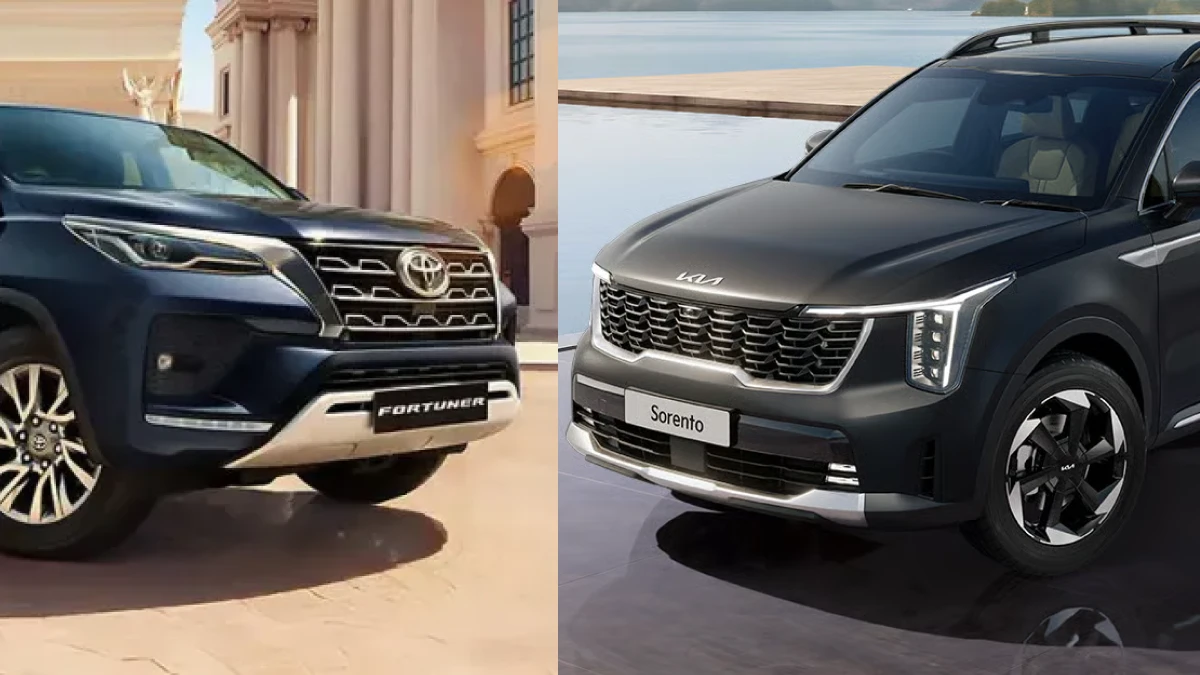
The arrival of the Kia Sorento in India has given buyers looking for a premium three-row vehicle a whole new perspective.For years, the Toyota Fortuner has maintained a strong grip on this space, built on a reputation for unmatched mechanical toughness, extreme reliability, and incredible resale value.
However, buyer expectations in the premium segment are changing. Modern families often value ride quality, highway efficiency, and sophisticated interior technology just as much as rugged ladder-frame capability.
While both the Kia Sorento and Toyota Fortuner offer three rows of seating and standard or optional all-wheel capability, they cater to vastly different driving needs.The Sorento uses a car-like monocoque architecture focused on urban comfort, smart tech, and hybrid efficiency.On the other hand, the Fortuner relies on its traditional body-on-frame platform engineered for heavy-duty hauling, off-road durability, and raw power.
Pricing and Value Proposition
When comparing ex-showroom prices, the Kia Sorento positions itself aggressively, coming in noticeably lower at both the entry point and the top-tier trims compared to the Fortuner.
| Model Variant | Kia Sorento (Ex-Showroom) | Toyota Fortuner (Ex-Showroom) |
| Base Petrol Variant | ₹29.49 Lakh (Hybrid) | ₹34.76 Lakh (2.7L NA) |
| Base Diesel Variant | ₹27.99 Lakh | ₹35.40 Lakh |
| Top Spec / Range Topper | ₹40.39 Lakh | ₹50.46 Lakh (GR-S / 4×4 AT) |
The Sorento undercuts the Fortuner across the board.Buyers looking at a mid-spec Sorento get a modern feature list at a price where the Fortuner barely offers base-to-mid trim equipment. However, the Fortuner’s higher pricing is backed by legendary long-term resale value and lower depreciation rates over a 5-to-7-year ownership cycle.
Powertrains, Engine Options, and On-Road Performance
Under the bonnet, these two SUVs follow fundamentally different engineering routes.Kia prioritizes turbo-charging, dual-clutch transmissions, and strong-hybrid assistance, whereas Toyota sticks to big displacement, naturally aspirated petrol engines and heavy-duty turbo-diesel engines.
| Engine Parameter | Kia Sorento Petrol / Hybrid | Toyota Fortuner Petrol | Kia Sorento Diesel | Toyota Fortuner Diesel |
| Engine Displacement | 1.6L Turbo-Petrol + Motor | 2.7L Naturally Aspirated | 2.2L Smartstream Turbo | 2.8L D-4D Turbo |
| Max Output Power | ~235 hp (Combined System) | ~166 hp | ~193 hp | ~204 hp |
| Max Torque | ~350 Nm (Combined System) | 245 Nm | 442 Nm | 500 Nm (AT) / 420 Nm (MT) |
| Transmission Type | 6-Speed Automatic | 5-Speed MT / 6-Speed AT | 8-Speed Dual-Clutch (DCT) | 6-Speed MT / 6-Speed AT |
| Drivetrain Layout | FWD / Available AWD | RWD (4×2) | FWD / Available AWD | RWD (4×2) / 4×4 with Low Range |
Real-World Performance Dynamics
- Kia Sorento: The 1.6-litre turbo-hybrid is a game-changer for city usage. It moves silently off the line on electric power alone, making stop-and-go bumper-to-bumper traffic stress-free while returning excellent fuel efficiency.On the diesel side, the Sorento’s 2.2-litre engine paired with an 8-speed DCT gives smooth, quick acceleration that feels punchy during highway overtaking.
- Toyota Fortuner:The 2.8-litre diesel is a torque monster.Delivering a massive 500 Nm of torque in the automatic variant, it effortlessly hauls heavy loads, pulls up steep mountain inclines, and cruises comfortably at high highway speeds.The petrol 2.7-litre engine, while extremely reliable, feels underpowered for an SUV of this weight and consumes significantly more fuel.
Seating Configurations and Interior Comfort
Interior flexibility is a major factor for family buyers choosing a three-row vehicle.
| Interior Specs | Kia Sorento | Toyota Fortuner |
| Seating Options | 6-Seater (Captain Seats) & 7-Seater | 7-Seater Only (Bench Row) |
| Second Row Comfort | Individual armrests, slide/recline, ventilation | Sliding/reclining 60:40 split bench |
| Third Row Access | One-touch electric tumble mechanism | Manual tumble and fold |
| Cabin Architecture | Soft-touch trim, ambient lighting, dual screens | Rugged, tactile, durable plastics |
The Kia Sorento stands out by offering a dedicated 6-seater variant with second-row captain’s chairs. This setup provides superior lateral support, individual armrests, and an open walkway to access the third row, making it ideal for chauffeur-driven owners or families with adult children.
The Toyota Fortuner comes strictly as a 7-seater with a central bench in the second row. While it carries seven passengers effectively, the ride over bumpy surfaces is noticeable due to its stiffer rear leaf-spring-derived suspension setup, compared to the Sorento’s smoother independent multi-link rear suspension.
Features, Technology, and Safety Equipment
Kia has equipped the Sorento with a wide array of modern interior features, highlighting the age of the Fortuner’s cabin setup.
| Feature / Tech Comparison | Kia Sorento | Toyota Fortuner |
| Infotainment Screen | Dual 12.3-inch curved setup | 8.0-inch touch display |
| Driver Display | Fully digital 12.3-inch cluster | Analog dials with small MID |
| Audio System | Premium Bose Surround Sound | Standard 11-Speaker JBL System |
| Sunroof | Panoramic Dual-Pane Sunroof | None |
| Driver Assistance (ADAS) | Level 2+ ADAS (29 Features) | Basic Safety Systems (No ADAS) |
| Camera System | 360-Degree Surround Camera with Blind View Monitor | Reverse Camera with Sensors |
| Ventilated Seats | Front & Second Row (Variant dependent) | Front Row Only |
The Sorento acts as a tech hub on wheels. Its Level 2+ ADAS suite offers Adaptive Cruise Control, Lane Keep Assist, Forward Collision Avoidance, and Autonomous Emergency Braking.
The Fortuner covers essential convenience equipment like powered seats, automatic climate control, and smartphone connectivity, but it misses out on features like a panoramic sunroof, a fully digital instrument panel, and advanced driver assistance systems.
Off-Road Capabilities and Suspension Engineering
How these two vehicles manage rough roads and off-road terrain highlights the difference in their core design.
| Off-Road & Chassis Parameter | Kia Sorento | Toyota Fortuner |
| Chassis Type | Monocoque (Unibody) | Ladder-Frame (Body-on-Frame) |
| Ground Clearance | ~176 mm | 225 mm |
| 4WD / AWD System | Electronic On-Demand AWD | Hard-part 4×4 with High/Low Range (H4/L4) |
| Terrain Modes | Snow, Sand, Mud | Multi-Terrain Select (Dirt, Sand, Rock) |
| Differential Lock | Electronic Center Lock | Mechanical Rear Differential Lock |
The Sorento’s monocoque chassis delivers smooth, car-like handling. Body roll is well-controlled through high-speed highway corners, and the ride is quiet and refined over broken city streets. Its electronic AWD handles wet highways, slush, and light gravel trails without issue.
The Fortuner uses a classic off-road setup.With 225 mm of ground clearance, dedicated low-range transfer gears, and a mechanical locking rear differential, it can tackle deep ruts, steep inclines, river crossings, and rocky terrain that would stop a unibody SUV.The trade-off is a firmer ride on city roads, with noticeable body movement over potholes and bumps.
Ownership Costs, Reliability, and Resale Value
Maintenance and Efficiency
- Kia Sorento:The strong-hybrid variant offers impressive fuel efficiency in heavy city traffic.Combined with Kia’s standard warranty packages, overall running costs remain low for suburban family use.
- Toyota Fortuner:While the diesel engine is reasonably efficient on open highways, city driving uses more fuel due to the vehicle’s weight. However, Toyota’s service network and proven engine durability mean these vehicles frequently run past 200,000 kilometers with minimal mechanical issues.
Resale Value
- Toyota Fortuner: The Fortuner holds its value exceptionally well in the Indian pre-owned market. Used models often retain up to 70–75% of their original value after 3 to 4 years of ownership.
- Kia Sorento: Depreciates at a standard rate for premium luxury crossover SUVs, making it a purchase driven by technology, comfort, and feature content rather than resale returns.
Verdict: Which Three-Row SUV Should You Buy?
Both vehicles excel in their target areas. Your choice ultimately comes down to where and how you plan to drive.
Buy the Kia Sorento if:
- Your daily driving is primarily in the city, on suburban roads, or on highways.
- You want lower fuel bills and prefer a strong-hybrid powertrain.
- You prefer a smooth, car-like ride over heavy body-on-frame bounce.
- You want modern cabin tech, a panoramic sunroof, and Level 2+ ADAS safety features.
- You prefer luxurious second-row captain seats.
Buy the Toyota Fortuner if:
- You regularly drive on rough trails, unpaved roads, or off-road conditions.
- You need maximum towing capability and 500 Nm of diesel torque.
- You prioritize long-term mechanical reliability and high resale value.
- You prefer a traditional, high-riding SUV feel with a commanding road presence.
