


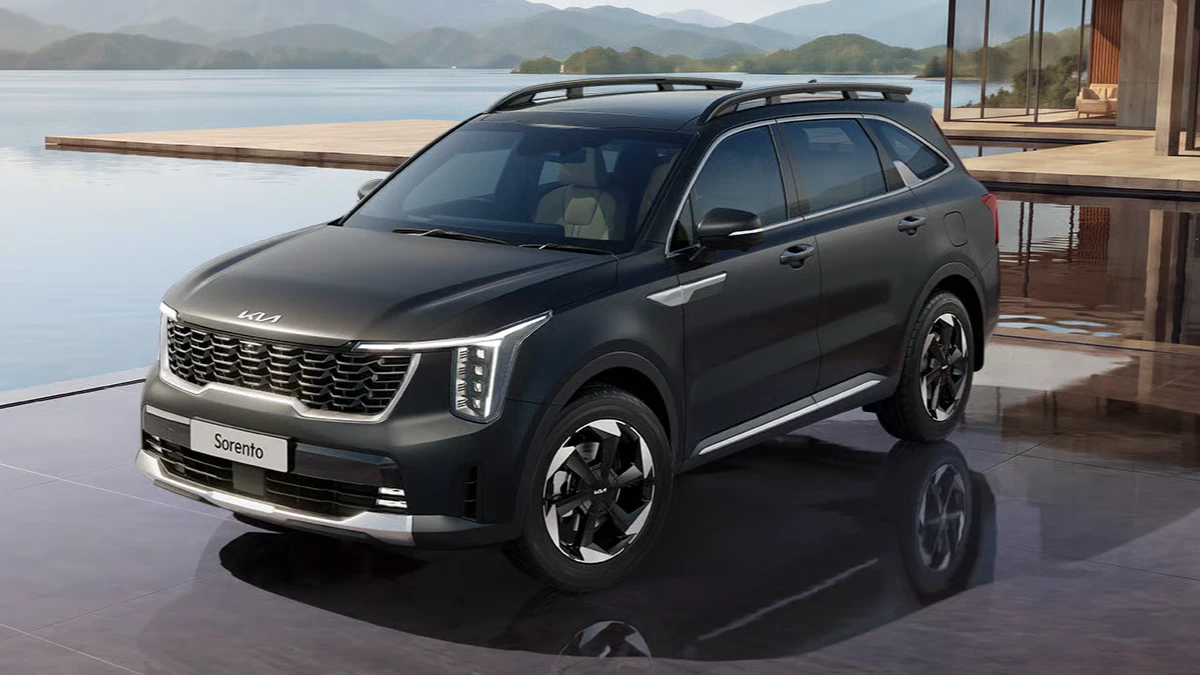
Kia has officially dropped its newest flagship internal combustion SUV into the fiercely competitive Indian market. The Sorento arrives at a sharp introductory starting price of ₹27.99 lakh (ex-showroom), positioning itself squarely against European mainstays like the Skoda Kodiaq and Volkswagen Tayron, as well as the rugged Jeep Meridian.
Manufactured locally at the brand’s Anantapur facility in Andhra Pradesh, the Sorento presents an incredibly rare dilemma for premium three-row SUV buyers. It offers two fundamentally different automatic powertrains: a forward-thinking 1.6-litre turbo-petrol strong hybrid, or an old-school, torque-heavy 2.2-litre diesel.
To complicate matters, you can configure both with Front-Wheel Drive (FWD) or All-Wheel Drive (AWD), and choose between 6- and 7-seat cabin layouts. The right choice ultimately boils down to how you plan to use the vehicle—city commuting versus long-haul highway touring. Here is a definitive breakdown of the two engines.
Kia Sorento Hybrid vs Diesel – Key Differences
Let’s strip away the marketing and look directly at the hardware.
| Specification | Sorento Hybrid | Sorento Diesel |
| Engine | 1.6L turbo-petrol + electric motor | 2.2L turbo-diesel |
| Engine Power | 180 hp | 193 hp |
| Engine Torque | 265 Nm | 442 Nm |
| Electric Motor | 65 hp / 264 Nm | — |
| Transmission | 6-speed automatic | 8-speed DCT |
| Drive Setup | FWD / AWD | FWD / AWD |
| Seating Options | 6 / 7 | 6 / 7 |
| Drive Modes | Normal, Eco, Sport, Smart | Normal, Eco, Sport, Smart |
| Terrain Modes | Snow, Sand, Mud | Snow, Sand, Mud |
The diesel packs 193 hp and 442 Nm. The hybrid’s 1.6-litre combustion engine produces 180 hp and 265 Nm, but it receives a massive injection of instantaneous torque from its 65 hp / 264 Nm electric motor. (Note: Engine and electric outputs peak at different RPMs, so they cannot simply be added together for a combined figure).
The ₹1.5 Lakh Question: Variant Pricing
The pricing strategy is telling. Looking across the variant ladder, the Hybrid commands a consistent premium.
| Variant | Diesel 7-seat | Diesel 6-seat | Hybrid 7-seat | Hybrid 6-seat |
| HTE | ₹27.99 lakh | — | ₹29.49 lakh | — |
| HTE(O) | ₹29.49 lakh | — | ₹30.99 lakh | — |
| HTK | ₹32.49 lakh | ₹32.69 lakh | ₹33.99 lakh | ₹34.19 lakh |
| HTK(A) | ₹33.49 lakh | ₹33.69 lakh | ₹34.99 lakh | ₹35.19 lakh |
| HTX AWD | ₹37.49 lakh | ₹37.69 lakh | ₹38.99 lakh | ₹39.19 lakh |
| HTX(A) AWD | ₹38.49 lakh | ₹38.69 lakh | ₹39.99 lakh | ₹40.19 lakh |
(Note: These are introductory ex-showroom prices up to ₹40.19 lakh, and on-road prices will vary).
Across most comparable trims, the hybrid engine costs exactly ₹1.50 lakh more than the hybrid. This sets up the critical purchasing dilemma: Can the diesel’s extra towing ability and highway stamina justify parting with an extra ₹1.5 lakh?
The 1.6-Litre Strong Hybrid: What Do You Get?
The Sorento becomes the only strong-hybrid application in India currently utilizing a turbocharged petrol engine. Most rivals pair their electric motors with naturally aspirated e-CVT setups (think Toyota Innova Hycross or Maruti Invicto).
Kia’s approach—combining a 1,598cc turbo-petrol unit with a 6-speed torque-converter automatic and an electric motor—delivers a far more conventional, engaging driving experience. Electric assistance makes low-speed crawling incredibly smooth and virtually silent. The strong hybrid system inherently reduces engine workload in urban traffic, presenting a more refined, modern powertrain character without the dreaded “rubber-band” acceleration feel.
We are withholding a definitive fuel economy verdict as Kia currently states that mileage figures are “to be tested.” Official certified numbers will determine actual running-cost superiority.
The 2.2-Litre Diesel: Why Choose Old School?
Don’t write the diesel off as outdated tech just yet. The 2.2-litre burner throws down 442Nm of torque compared to the petrol engine’s 265Nm.
That massive torque advantage is transformative. It translates to effortless overtaking on single-lane highways with a cabin full of luggage. It means stronger, unbothered responses on steep mountain inclines. Paired with a lightning-fast 8-speed Dual-Clutch Transmission (DCT), the diesel remains the undisputed king of long-distance touring.
Which is Better in the City?
Verdict: Hybrid Wins
If your daily routine involves aggressive stop-and-go traffic, the hybrid makes infinitely more sense. The electric motor thrives at low speeds, reducing your reliance on the petrol engine and keeping the cabin dead silent during crawling traffic. A massive three-row diesel SUV is rarely a champion of urban efficiency; if you do primarily short trips, the hybrid’s refinement wins outright.
Which is Better for Highway Driving?
Verdict: Diesel Wins
This is where the 2.2-litre engine earns its ₹1.5 lakh premium. Armed with 442Nm of mid-range shove and an 8-speed DCT, the diesel is built to devour cross-country miles. If you regularly transport six or seven passengers plus cargo, the diesel will pull that weight far more comfortably at triple-digit speeds than the hybrid.
Does AWD Mean I Have to Buy the Diesel?
Absolutely not. Buyers often assume All-Wheel Drive is restricted to rugged diesel trims. Kia has paired AWD with both the Hybrid and the Diesel, specifically on the top-tier HTX and HTX(A) variants.
Both AWD systems include drive modes (Normal, Eco, Sport, Smart) and specialized terrain modes (Snow, Sand, Mud). While this isn’t a hardcore off-roader designed to rival a body-on-frame Fortuner in the jungle, the AWD setup offers phenomenal traction on wet roads, mountain switchbacks, and poor surfaces. You do not have to sacrifice electrification to get four-wheel grip.
6-Seater vs 7-Seater: The Cabin Setup
The Sorento stands out by offering both configurations across the range.
- 6-Seater: Features premium captain chairs in the second row. This is the ultimate setup if the car will be chauffeur-driven or if individual passenger comfort is the priority.
- 7-Seater: Uses a traditional second-row bench. It provides greater cargo and passenger-carrying flexibility, making it the more practical choice for larger families.
Which Kia Sorento Variant Should You Buy?
Here are MotorFuturist’s top recommendations based on value and capability:
- Best Value Hybrid: HTK (₹32.49 lakh)The HTK is the first major jump in equipment over the entry trims. It’s available as a 6- or 7-seater and offers an excellent balance of premium features without breaking the bank.
- Best Value Diesel: HTK (₹33.99 lakh)Following the exact same equipment philosophy as the Hybrid HTK, you pay the ₹1.50 lakh premium solely to secure that crushing 442Nm of torque.
- Best for AWD: HTX (From ₹37.49 lakh)If you demand All-Wheel Drive, the HTX trim is your entry point, available in both powertrains.
The Final Verdict
There is no universal winner here; the best Kia Sorento depends entirely on where you point the steering wheel.
Buy the Hybrid if: Your driving is primarily urban, you value a silent, refined cabin, you want cutting-edge strong-hybrid technology, and you want AWD without having to rely on diesel fuel.
Buy the Diesel if: You chew through high annual highway kilometres, you frequently travel fully loaded with family and luggage, and you prefer the commanding, torque-heavy surge of a traditional premium SUV.
