


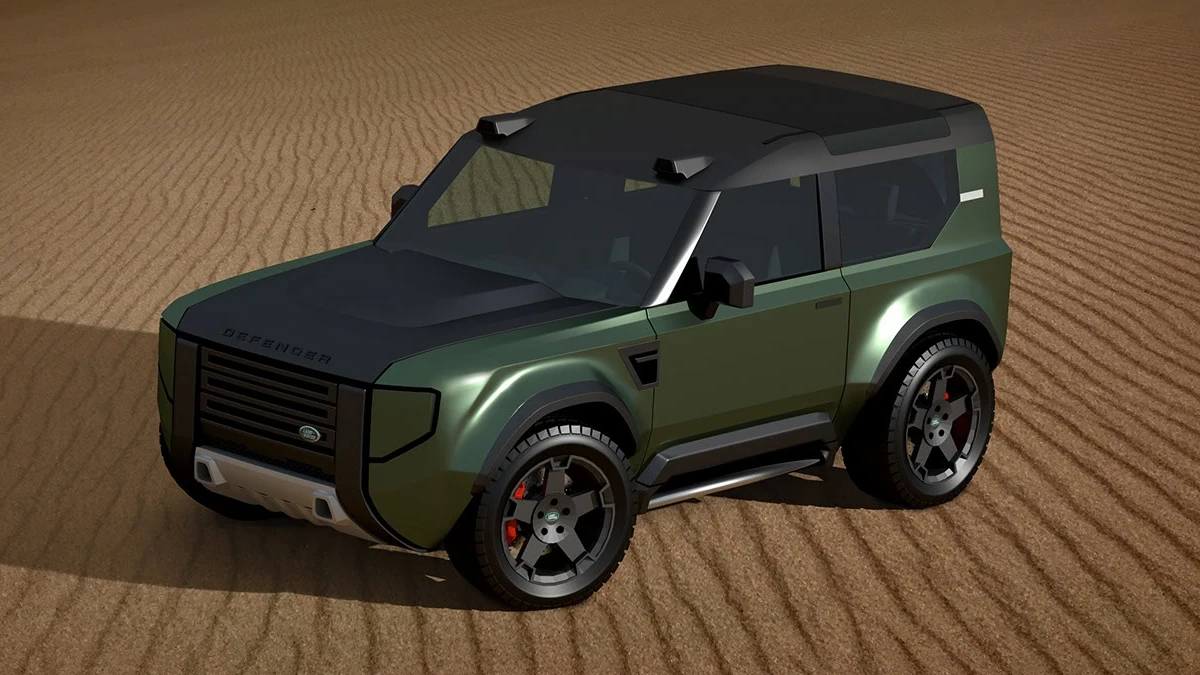
For decades, the Land Rover Defender stood as a towering, uncompromised monument to mechanical grit and hardcore off-road performance. However, as Jaguar Land Rover (JLR) aggressively pushes forward with its luxury-focused “House of Brands” organizational restructuring, the Defender is no longer just a singular model line—it is evolving into an independent lifestyle sub-brand. The most critical milestone in this brand evolution has just taken a massive step forward. Development is officially underway for an entirely new, highly compact sibling in the lineup, widely recognized in automotive circles as the “Baby Defender” (and heavily tipped to bear the production name Defender Sport).
This upcoming vehicle represents a profound shift for the British automaker. Rather than simply scaling down the existing, heavy-set aluminum platform, JLR is constructing this vehicle on a completely different mechanical foundation to target a tech-focused generation of urban adventurers.
The Powertrain Pivot: Why Full Hybrids Crashed the EV Party
When JLR engineers initially conceptualized the Baby Defender, it was intended to launch exclusively as a battery-electric vehicle (BEV) built upon the firm’s new Electric Modular Architecture (EMA). However, recent updates from the brand reveal a major strategic correction. In response to cooling global luxury EV growth—particularly across key markets like North America—JLR has officially reworked the EMA platform to accommodate a strong-hybrid (HEV) powertrain alongside the fully electric versions.
This hybrid addition is highly tactical. While plug-in hybrids (PHEVs) carry heavy battery packs that add immense weight, a dedicated full-hybrid system offers excellent real-world fuel economy and instant torque without any charging infrastructure anxieties.
Designing an electrified vehicle that honors the classic Defender DNA has presented a massive challenge for Brand Director Mark Cameron and his design team. The traditional Defender shape is defined by an upright, blocky silhouette, sharp window angles, and a flat rear end—characteristics that act as an aerodynamic nightmare for driving range.
Additionally, placing a massive battery pack flat beneath the floor typically restricts wheel articulation, which is bad news for rock crawling. To solve this, JLR is relying heavily on next-generation dual-motor torque-vectoring software to deliver the class-leading 4×4 capabilities expected of the badge.
Premium Compact Toughness: Market Context
Measuring roughly 4.5 meters in length, the Baby Defender will slide smoothly into the luxury compact segment. This positions it perfectly to attract younger buyers who love the boxy, adventurous lifestyle aesthetic but find the full-sized Defender 110 far too cumbersome for tight city parking spaces and daily commuting.
Inside, the cabin is expected to ditch rugged, exposed rivets for a highly sustainable, luxury tech layout. It will feature recycled lifestyle fabrics, a minimalist floating dashboard, and the company’s latest Pivi Pro infotainment software running on a central 13.1-inch curved display.
Global Compact Off-Roader Competitive Matrix
When the Baby Defender arrives in showrooms, it will enter a newly formed, highly competitive playground of premium, downsized off-roaders.
| Competitor Vehicle | Core Architecture Platform | Primary Powertrain Configurations | Target Drivetrain Systems | Expected Design Philosophy | Global Launch Window |
| JLR Baby Defender | JLR EMA (Electric Modular Architecture) | Full-Hybrid (HEV) & Battery Electric (BEV) | Dual-Motor e-AWD with Terrain Response | Boxy, luxury lifestyle aesthetic with premium switchgear | Early 2027 |
| Mercedes “Little G” | MMA (Mercedes Modular Architecture) | 800V Battery Electric (BEV) Only | Quad-Motor or Dual-Motor Intelligent 4MATIC | Military-derived retro boxiness downsized for urban use | Late 2026 |
| Jeep Recon EV | Stellantis STLA Large | Battery Electric (BEV) with Trail Rating | Mechanical-mimicking Electronic 4×4 | Open-air removable doors, pure utilitarian off-roading | Mid 2026 |
| Rivian R3X | Rivian Midsize Component Platform | Tri-Motor / Dual-Motor Battery Electric | Torque-Vectoring Performance AWD | Retro-rally inspired rugged hatchback styling | 2027 |
Strategic Market Takeaway
The decision to introduce a dual-powertrain strategy for the Baby Defender is a brilliant business move by JLR. By pairing a fully electric flagship with a highly practical, range-anxiety-free strong hybrid option, they ensure the vehicle remains highly viable in markets where EV adoption has slowed down.
If the engineering team successfully blends the vehicle’s high-drag, iconic boxy styling with efficient electric ranges, this downsized off-roader could easily become Land Rover’s most profitable and culturally significant launch of the entire decade.
Image Source – Link
