


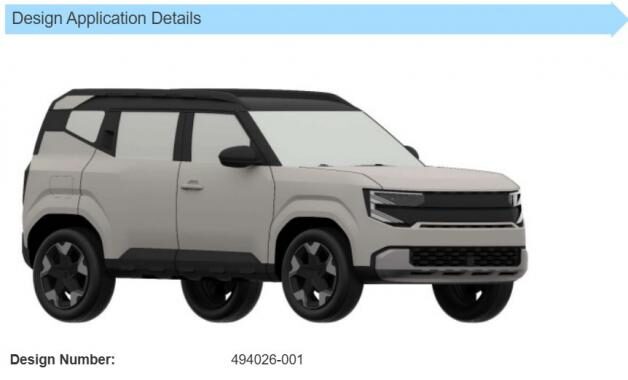
The Indian automotive landscape is undergoing a massive shift as consumer preferences lean heavily toward rugged, adventure-ready lifestyle vehicles. Recognizing this booming demand, Renault India is preparing a high-stakes product offensive to recapture its market share. Fresh off the recent momentum generated by the relaunch of the next-generation Duster, the French automaker has officially patented the design of its highly anticipated, sub-four-metre lifestyle SUV, the Renault Bridger, in India.
The submission of these production-ready patent filings marks a massive milestone. It transforms what was merely a flashy global concept into an imminent real-world contender slated to shake up the Indian market by 2027.
True to Its Roots: Translating Concept to Production
When Renault initially pulled the wraps off the Bridger Concept, it turned heads with its unapologetically boxy, upright silhouette. Historically, production vehicles rarely preserve the aggressive styling of their concept forms, but the patented design images reveal that Renault is bucking that trend. The production-spec Bridger remains strikingly faithful to the original show car.
The patented images showcase a traditional, utilitarian off-roader aesthetic defined by a near-vertical windscreen, a flat roofline, and aggressively squared-off wheel arches surrounded by chunky, protective body cladding. The front fascia utilizes rectangular headlight housing integrated seamlessly into a wide, twin-slatted front grille.
Moving toward the rear, the off-road identity becomes even more pronounced. The Bridger sports a strictly flat, upright tailgate featuring a rugged, exterior-mounted spare wheel and a side-hinged rear door mechanism—a deliberate nod to classic lifestyle 4x4s. Interestingly, eagle-eyed observers have noted the presence of two separate fuel filler caps located on opposite rear quarter panels of the patented body. This design detail strongly suggests that Renault has engineered the vehicle to support multiple energy architectures on the same production line.
Under the Skin: The RGMP Architecture and Powertrain Strategy
The upcoming Bridger will not just be a cosmetic exercise; it is built on a mechanically robust foundation. The compact SUV utilizes the flexible Renault Group Modular Platform (RGMP), which is the exact same high-tensile architecture underpinning the larger Duster. This modular framework is specifically engineered to handle rough terrain, offering high structural rigidity and a healthy ground clearance of approximately 200 mm.
Crucially, the RGMP platform is fully compatible with both traditional mechanical four-wheel-drive (4WD) layouts and advanced electronic all-wheel-drive (E-4WD) setups. To make a true dent in the lifestyle segment, Renault is expected to leverage this capability to offer genuine off-road hardware like terrain modes and hill-descent control.
Under the hood, Renault is developing a specialized powertrain strategy tailored to Indian tax regulations. The star of the lineup will be an all-new 1.2-litre, four-cylinder turbocharged petrol engine, delivering an estimated 120 horsepower. This engine is a clever derivative of the Duster’s 1.3-litre TGDi motor, modified with a shorter stroke to fall precisely under the 1,200cc threshold. This technical adjustment allows the vehicle to benefit from lower taxation brackets under local GST structures, enabling a highly competitive retail price. Additionally, this engine will utilize a multi-point fuel injection system (MPFi) to keep maintenance economical and allow for future factory-fitted CNG options. For long-term sustainability, an all-electric version (the Bridger EV) is also being co-developed as Renault’s debut electric vehicle for the Indian domestic market.
Disrupting the Lifestyle Hierarchy
Upon its official market launch, the Renault Bridger will slot cleanly between the sub-compact Kiger and the mid-sized Duster. Rather than competing directly with soft-roader urban crossovers like the Tata Nexon or Hyundai Venue, the Bridger is taking direct aim at established, adventure-oriented nameplates.
Primary Rivals in Sight:
- Maruti Suzuki Jimny: The reigning lightweight, purist off-roader.
- Mahindra Thar (RWD/3-Door): The heavy-hitting segment leader in lifestyle appeal.
- Mahindra Vision S: The upcoming sub-compact lifestyle vehicle expected to debut in the same timeline.
By combining a spacious 400-litre boot capacity and a refined five-door layout with legitimate, rough-road capability, Renault aims to bridge the gap between daily urban usability and weekend trail exploration. If the production model hits the rumored Rs 9 lakh to Rs 14 lakh price bracket, Renault may very well have a certified blockbuster on its hands.
