



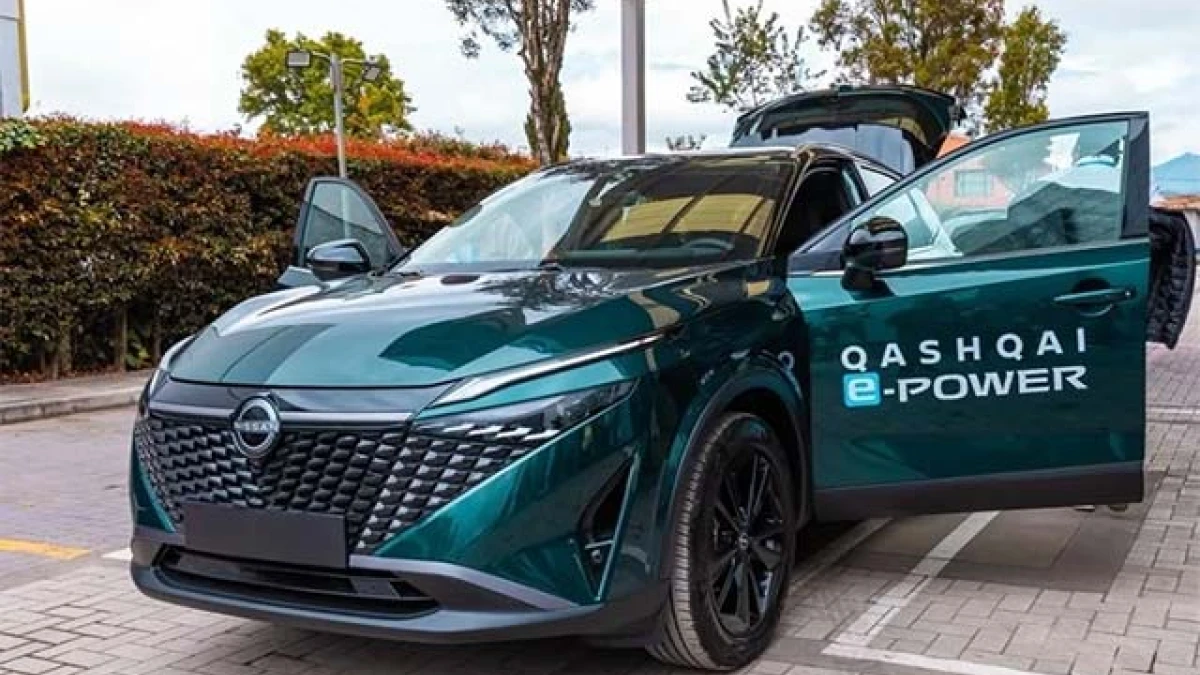
Nissan has earned an official Guinness World Records title with its latest-generation Qashqai e-POWER hybrid SUV.During an independently monitored multi-day endurance run conducted across Colombia from July 14 to July 17, 2026, the C-segment crossover traveled 1,980 kilometers (1,230 miles) on a single 55-litre tank of fuel without stopping to refuel or plugging into an external electric charger.
The certified record—officially categorized as the “longest journey completed by a non-plug-in extended-range electric SUV without external charging or refuelling”—translates to an average fuel consumption rate of 2.78 L/100 km (~36.0 km/l).This real-world test highlights the efficiency potential of Nissan’s 100% electric motor-driven e-POWER architecture under demanding topographies.
1. Guinness World Record Performance Breakdown
The record-setting run was certified by independent Guinness World Records adjudicators who monitored fuel tank seals, telemetry logs, and vehicle sensors throughout the 4-day drive.The route was designed to mirror real-world driving conditions rather than a closed-track hypermiling laboratory test.
The table below outlines the core parameters, verified metrics, and environmental conditions of the record-setting Colombia run:
| Record Category / Parameter | Official Verified Record Data | Operational Context & Driving Impact |
| Official World Record Title | Longest journey by a non-PHEV extended-range SUV | Certified without external charging or refuelling |
| Total Distance Covered | 1,980 km (1,230.3 miles) | Surpassed official factory range rating (1,279 km) by 54% |
| Fuel Tank Capacity Utilized | 55 Litres (95 RON Premium Unleaded) | Standard production factory fuel tank |
| Calculated Average Efficiency | 2.78 L/100 km (~35.97 km/l) | Outstanding improvement over claimed 4.1 L/100 km cycle |
| Testing Dates & Duration | July 14–17, 2026 (4 Days) | Multi-day real-world driving across variable weather |
| Testing Location & Route | Bogotá to Caribbean Coast (Colombia) | Varied mountain passes, highway grids & urban traffic |
2. Engineering Deep-Dive: How Nissan’s e-POWER Architecture Works
Unlike conventional parallel hybrid systems (such as Toyota’s Hybrid Synergy Drive), where both the internal combustion engine (ICE) and electric motor are mechanically linked to the driveshaft, Nissan e-POWER operates as a series hybrid system.The wheels are driven 100% exclusively by an electric motor.
Under the hood, a 1.5-litre 3-cylinder turbocharged petrol engine with variable compression ratio technology (e-VCR) acts purely as an on-board electrical generator.The engine runs at optimal thermal efficiency bands to feed electricity to a 2.1 kWh lithium-ion battery buffer or directly to the high-output traction motor via a 5-in-1 modular inverter unit.
The table below compares Nissan’s e-POWER series setup against traditional Parallel Hybrids, Plug-in Hybrids (PHEVs), and Battery Electric Vehicles (BEVs):
| Drivetrain Parameter | Nissan e-POWER (Series Hybrid) | Parallel Hybrid (e.g., Toyota) | Plug-in Hybrid (PHEV) | Battery Electric (BEV) |
| Wheel Drive Mechanism | 100% Electric Motor Only | Engine + Motor Combined | Engine + Motor Combined | 100% Electric Motor Only |
| Internal Combustion Role | Pure Generator (No Driveshaft Link) | Mechanical Drive + Generator | Mechanical Drive + Generator | None (Zero ICE Components) |
| Transmission Gearbox | Single-Speed Reducer (No Gears) | e-CVT Planetary Gearset | 6-to-8 Speed Automatic / e-CVT | Single-Speed Reducer |
| External Plug Charging | Not Required (Refuel with Petrol) | Not Required | Mandatory for EV Mode | Mandatory at EV Chargers |
| Driving Experience Feel | Linear EV Instant Torque (311 Nm) | Variable Engine Revs (e-CVT lag) | EV feel until engine kicks in | Pure EV Torque Response |
3. Topography & Energy Recovery: The Colombia Elevation Advantage
A critical factor enabling the 1,980 km record was the unique topography of the Colombian route. The drive originated in Bogotá, located in the Andes mountain range at an elevation of approximately 2,600 meters above sea level.Over the course of the journey toward the Caribbean coast, the vehicle underwent a net elevation loss of over 2,500 vertical meters.
This sustained downhill elevation profile allowed the Qashqai e-POWER’s Smart Regenerative Braking System to continuously convert kinetic energy back into electrical energy during long mountain descents. Rather than wasting kinetic energy as brake heat, the system replenished the 2.1 kWh battery buffer with zero fuel burn, allowing the petrol engine generator to remain completely shut down for extended downhill stretches.
The table below analyzes the route stages, elevation shifts, and energy regeneration mechanics observed during the drive:
| Journey Route Stage | Elevation Profile | Primary Drivetrain & Regeneration State | Fuel Consumption Impact |
| Stage 1: Bogotá Urban Grid | High Altitude (~2,600m), Stop-and-Go | Frequent low-speed EV mode; high engine thermal efficiency | Moderate consumption during urban warm-up |
| Stage 2: Andean Mountain Descent | Steep Negative Gradient (-2,200m) | Max Regenerative Braking; engine generator OFF | Near-Zero fuel burn over ~180 km |
| Stage 3: Central Valley Highways | Flat Terrain (~400m elevation) | Steady-state generator operation powering electric motor | Consistent high-efficiency cruise (~3.2 L/100km) |
| Stage 4: Caribbean Coastal Road | Sea Level Flat, High Ambient Temp | Battery buffer manages AC load; smooth electric cruise | Optimized steady thermal management |
4. Nissan e-POWER Global Endurance Benchmarks
The record-breaking Colombia drive builds upon a series of long-distance efficiency challenges conducted by Nissan engineers across different continents.Previous trials in temperate and cold climates demonstrated similar efficiency gains over manufacturer claims.
The table below compares the results of Nissan’s global Qashqai e-POWER long-distance challenges:
| Endurance Challenge Location | Total Distance Covered | Primary Road / Climate Conditions | Average Calculated Efficiency |
| United Kingdom Endurance Run | 1,300 km (807 miles) | Rolling countryside highways, temperate rain | ~3.8 L/100 km (~26.3 km/l) |
| Tasmania Tour (Australia) | 1,300 km (807 miles) | Mountainous winding roads, cool coastal air | ~3.6 L/100 km (~27.7 km/l) |
| Colombia Guinness Record Run | 1,980 km (1,230 miles) | High elevation drop, tropical heat, urban traffic | 2.78 L/100 km (~36.0 km/l) |
5. Total Cost of Ownership (TCO) & Efficiency Projection
While everyday consumer range will vary based on driving style, cargo weight, and terrain, the efficiency of series-hybrid technology translates into lower operational costs compared to traditional combustion-engine crossovers.
The table below calculates a 3-year / 45,000 km ownership fuel expenditure comparison between the Qashqai e-POWER (using real-world combined averages of ~4.2 L/100 km vs. record 2.78 L/100 km) and a conventional 1.5L Turbo Petrol SUV (assuming fuel price at $1.30 per Litre):
| Ownership Cost Parameter (3 Yrs / 45,000 km) | Conventional 1.5L Turbo Petrol SUV | Qashqai e-POWER (Standard Real-World) | Qashqai e-POWER (Optimal Record Rate) |
| Average Fuel Economy | 7.5 L/100 km (~13.3 km/l) | 4.2 L/100 km (~23.8 km/l) | 2.78 L/100 km (~36.0 km/l) |
| Total Fuel Consumed (45,000 km) | 3,375 Litres | 1,890 Litres | 1,251 Litres |
| Total Fuel Outflow ($1.30/Litre) | $4,387 USD | $2,457 USD | $1,626 USD |
| Net Operational Savings vs ICE | Baseline Reference | Save $1,930 USD (44% Reduction) | Save $2,761 USD (63% Reduction) |
| Refueling Stops Required (45k km) | ~84 Stops (based on 40L fills) | ~35 Stops | ~23 Stops |
Strategic Verdict: A Practical Bridge to Electric Mobility
The Nissan Qashqai e-POWER’s 1,980 km Guinness World Record in Colombia serves as a practical demonstration of series-hybrid engineering. By pairing an efficient petrol generator with a 100% electric motor drive unit, e-POWER delivers the smooth torque response and cabin refinement of an EV without requiring drivers to rely on public charging infrastructure or manage range anxiety.
For regions where EV charging networks remain under development, series-hybrid technologies provide a viable bridge toward long-term automotive electrification.

