



Kawasaki has launched the 2027 Ninja 300 in India with updated graphics and compliance updates while retaining its proven 296cc parallel-twin engine. Even after more than a decade in the market, the Ninja 300 continues to attract enthusiasts looking for a refined twin-cylinder sports bike. But with newer rivals offering more technology and fresh designs, does the Ninja 300 still make sense in 2027? Here’s everything you need to know.
2027 Kawasaki Ninja 300: What’s New?
The latest iteration of the beloved entry-level supersport keeps things incredibly familiar, focusing strictly on minor cosmetic and pricing adjustments.
- Price Update: The motorcycle is now priced at ₹3.34 lakh (ex-showroom), which represents a premium of ₹17,000 over the outgoing model.
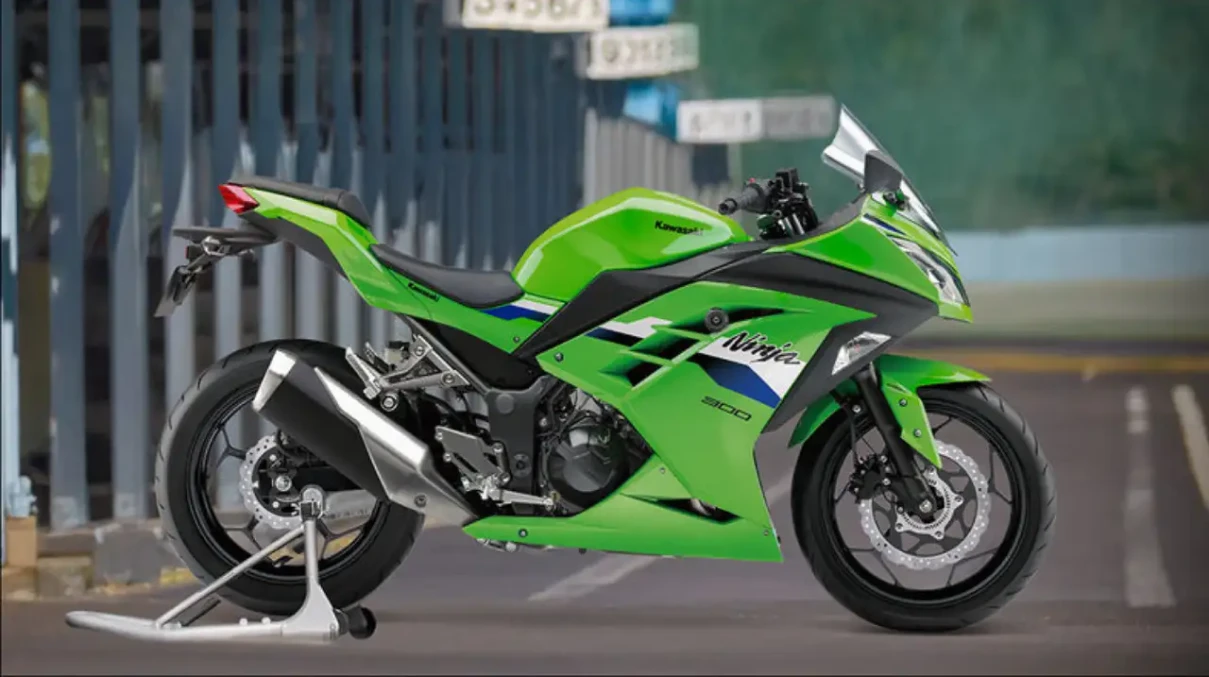
- New Colour Schemes and Graphics: For 2027, the Ninja 300 is offered exclusively in the iconic Lime Green shade, closely mirroring the aggressive aesthetic of the larger ZX-6R.
- Refreshed Styling Details: The update brings minor decal revisions and a slightly larger floating windscreen to improve wind deflection.Importantly, there are no mechanical overhauls—the chassis, engine tuning, and suspension hardware remain entirely untouched.
Engine & Performance
The beating heart of the Ninja 300 is its legendary 296cc, liquid-cooled, parallel-twin engine. Producing 39 PS (38.4 bhp) at 11,000 rpm and 26.1 Nm of peak torque at 10,000 rpm, this motor thrives when revved hard. It is paired with a slick 6-speed gearbox supported by an assist and slipper clutch.
The twin-cylinder layout continues to be the motorcycle’s biggest trump card. It offers unparalleled riding refinement and highly linear power delivery, making it an outstanding companion for high-speed highway touring without the fatiguing vibrations commonly found in single-cylinder alternatives.
Design & Styling
Despite its age, the Ninja 300 commands serious road presence. It features a full-fairing design, an aggressive fuel tank, and sharp split seats that scream supersport pedigree. The twin projector headlamps give the front end an intimidating, track-ready look. The sporty riding stance hits the absolute sweet spot—aggressive enough for spirited corner carving, yet relaxed enough to avoid wrist and back pain during long weekend rides.
Features
While it rides brilliantly, the equipment list is where the Ninja 300 undeniably shows its age.
- Instrumentation: A traditional semi-digital instrument cluster featuring a large analogue tachometer alongside an LCD for speed and fuel.
- Safety: Standard dual-channel ABS paired with front and rear disc brakes.
- Hardware: It utilizes a tubular diamond frame, telescopic front forks, and a rear monoshock, rolling on 17-inch alloy wheels with tubeless tyres.
Unlike newer competitors, it entirely misses out on modern electronics like TFT displays, Bluetooth connectivity, or dedicated riding modes.
Kawasaki Ninja 300 vs Rivals
| Feature | Kawasaki Ninja 300 | Yamaha R3 | Aprilia RS 457 | KTM RC 390 |
| Engine | 296cc Parallel-Twin | 321cc Parallel-Twin | 457cc Parallel-Twin | 373cc Single-Cylinder |
| Power | 39 PS | 42 PS | 47.6 PS | 43.5 PS |
| Standout Strength | Bulletproof reliability & refinement | Pure performance & handling | Supreme value & modern electronics | Unmatched track focus & tech |
| Tech Level | Basic (Analogue/LCD) | Basic (LCD) | High (TFT, Ride Modes) | High (TFT, Quickshifter) |
The Ninja 300 still stands out purely through its butter-smooth parallel-twin engine and proven, long-term reliability that the newer, more highly strung motorcycles simply haven’t had the time to establish.
Pros & Cons
Pros:
- Incredibly smooth twin-cylinder engine.
- Excellent highway cruising performance.
- Comfortable ergonomics for long-distance touring.
- Bulletproof, proven reliability.
- Premium Kawasaki brand appeal.
Cons:
- Ageing, decade-old design language.
- Basic semi-analogue instrument cluster.
- Lacks modern electronic riding aids entirely.
- Higher price tag than more powerful single-cylinder rivals.
Mileage & Ownership
The Ninja 300 delivers a highly respectable claimed fuel efficiency of around 30 km/l. When paired with its generous 17-litre fuel tank, long-distance touring is a breeze, requiring far fewer fuel stops. However, potential owners must account for Kawasaki’s premium maintenance costs and spare parts availability, which tend to be higher than domestic competitors.
Who Should Buy the Ninja 300?
This motorcycle is custom-built for riders who:
- Prefer the highly refined, vibration-free nature of a twin-cylinder engine.
- Frequently embark on long, sustained highway tours.
- Value linear smoothness over aggressive, snappy power delivery.
- Want a premium, forgiving, and beginner-friendly sports bike.
Should You Buy the 2027 Kawasaki Ninja 300?
Buy it if: You want a refined twin-cylinder engine that simply won’t quit, you prioritize touring comfort over lap times, and you love the timeless sporty styling of the Ninja family.
Consider rivals if: You demand a full-color TFT display, require traction control and riding modes, or simply seek higher performance and modern features for the exact same budget.
MotorFuturist Verdict
The 2027 Kawasaki Ninja 300 proves that sheer mechanical refinement never goes out of style. While the latest update focuses exclusively on minor cosmetic enhancements and a slight price bump, its smooth parallel-twin engine, highly comfortable ergonomics, and rock-solid dependability continue to make it a compelling choice. However, with newer rivals offering drastically more technology and stronger value on paper, buyers must carefully weigh whether they prioritize timeless, proven refinement or cutting-edge modern features before writing the cheque.

