





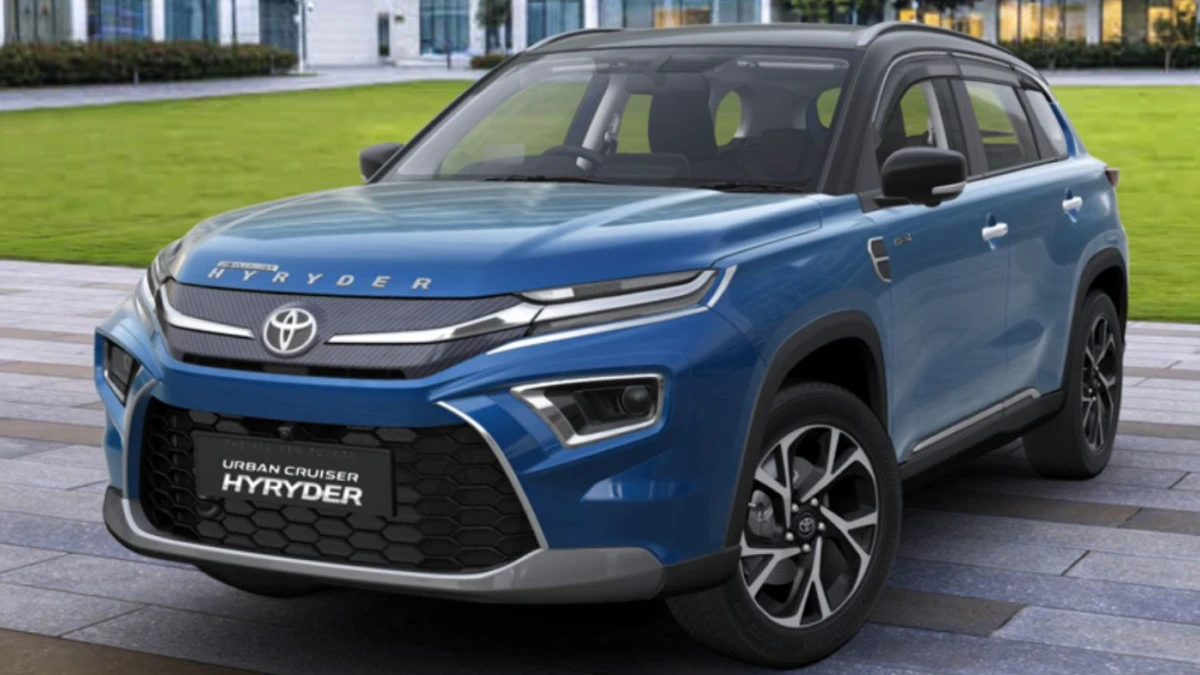
The mid-size hybrid SUV segment has completely shifted how Indian car buyers view fuel efficiency. Leading this revolution from the front line is the Toyota Urban Cruiser Hyryder, a vehicle that made strong hybrid technology accessible to mass-market buyers. However, eagle-eyed owners recently discovered a stealthy mechanical change hidden beneath the cargo floor during routine maintenance.
Toyota has updated the Hyryder’s powertrain by replacing the original 0.76 kWh lithium-ion battery pack with a more compact 0.60 kWh unit. While a downsized battery might sound like a step backward on paper, the engineering reality behind how a self-charging hybrid operates tells a vastly different story.
Decoding the Specs: Old vs. New Battery Framework
To give you a completely transparent view of what has shifted under the hood, we can lay out the updated technical metrics side-by-side with the launch version of the vehicle. This data clarifies exactly what has changed and, more importantly, what has stayed completely identical.
| Technical Powertrain Metrics | Updated Toyota Hyryder Hybrid | Original Launch-Spec Hyryder |
| Hybrid Battery Capacity | 0.60 kWh | 0.76 kWh |
| Battery Chemistry Type | Lithium-ion | Lithium-ion |
| Combustion Engine Layout | 1.5L 3-Cylinder Atkinson Cycle | 1.5L 3-Cylinder Atkinson Cycle |
| Engine Peak Output | 92 hp @ 5,500 rpm | 92 hp @ 5,500 rpm |
| Electric Motor Output | 80 hp / 141 Nm | 80 hp / 141 Nm |
| Combined Maximum System Power | 115.56 PS (113 bhp) | 115.56 PS (113 bhp) |
| Gearbox Configuration | Electronic CVT (e-CVT) | Electronic CVT (e-CVT) |
| Certified Fuel Efficiency | 27.97 km/l (ARAI Rated) | 27.97 km/l (ARAI Rated) |
Does a Smaller Battery Hurt Performance or Mileage?
The immediate concern for any buyer is whether this 21% reduction in storage capacity will result in a drop in fuel economy or sluggish highway overtaking maneuvers. Toyota has officially confirmed the change, clarifying that the optimization has zero impact on the vehicle’s certified performance or efficiency figures.
To understand why, you have to look at how a strong hybrid system behaves compared to a standard electric vehicle (EV):
- Continuous Charge-Discharge Cycles: Unlike an EV that you plug in to store large amounts of power, the Hyryder behaves like a self-sustaining energy loop. The small battery pack is constantly discharging to assist the engine and immediately recharging whenever you coast or step on the brakes.
- The Charging Trade-off: While the new 0.60 kWh setup means you might stay in pure EV-only mode for a slightly shorter physical distance before the petrol engine wakes up, the exact reverse is also true. Because the battery storage is smaller, it takes significantly less time and kinetic energy to replenish back to full capacity.
The net result over a standard city commute is an identical balance. The engine may kick in a fraction of a second sooner under heavy acceleration, but the system gets back into its efficient charging zone faster than before.
The Hidden Advantage: Practical Cabin Packaging
There is an excellent structural silver lining to this downsized component. One of the very few complaints owners had about the initial version of the Hyryder was the design of the luggage space. The original 0.76 kWh battery assembly occupied a large footprint beneath the boot floor, resulting in an awkward, raised “hump” that made loading flat suitcases a bit of a puzzle.
By upgrading to the more compact 0.60 kWh packaging, Toyota has successfully managed to reduce the height of this trunk floor obstruction. This design adjustment gives owners a noticeably flatter, cleaner, and far more practical cargo area to stack bags for family road trips.
The Manufacturing Angle: Automakers routinely optimize component sizing over a vehicle’s lifecycle. Shifting to a more compact, resource-efficient battery structure lets Toyota streamline production lines and manage manufacturing costs effectively without sacrificing the 27.97 km/l mileage target that attracts buyers to showrooms in the first place.
The Verdict: Business as Usual
At the end of the day, the change from a 0.76 kWh battery to a 0.60 kWh pack is a smart piece of engineering packaging rather than a feature downgrade. The driving dynamics remain completely smooth, the system power outputs stay exactly where they were, and your monthly fuel budget will not change by a single rupee. If you are tracking a new delivery or considering booking a strong hybrid variant, the Hyryder continues to deliver the exact same elite efficiency that made it a segment benchmark.

