


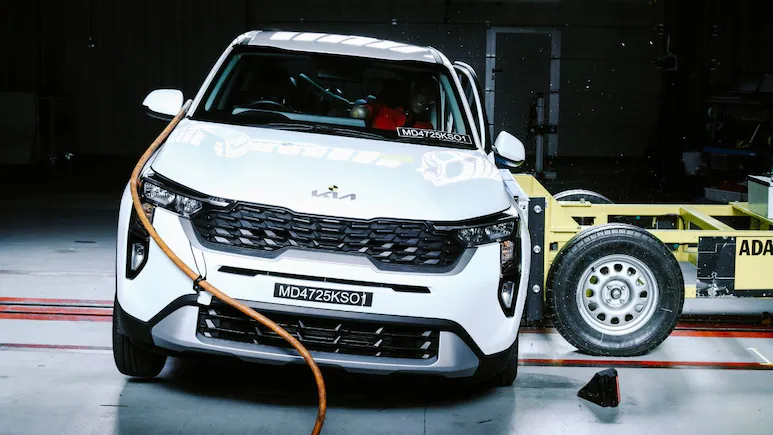
The Indian automotive sector has made historic strides in vehicle safety over the last few years. With the establishment of Bharat NCAP and a growing consumer demand for safer cars, sub-4-meter SUVs are routinely expected to score high marks. However, a recent wave of headlines has caused a stir across the industry: the India-built Kia Sonet scored a low 1-star safety rating in Global NCAP crash tests.
For prospective buyers and current owners in India, a headline like this naturally raises immediate alarm bells. But before drawing conclusions about the car parked in your driveway, it is vital to look into the technical details. The vehicle evaluated by Global NCAP under its #SaferCarsForAfrica protocol is fundamentally different from the version sold on Indian showroom floors.
The Core Split: Export-Spec vs. Indian-Spec Safety Packages
Global NCAP’s testing framework is notoriously uncompromising. The agency actively penalizes vehicles that lack comprehensive, standard electronic and structural safety nets across their absolute base models.
The vehicle shipped from India to the South African market was evaluated in its entry-level form. The massive divergence in standard equipment explains why this specific version collapsed to a 1-star rating, while the version driving on Indian roads tells a completely different safety story:
| Critical Safety Feature & Score | Global NCAP Tested Model (Export-Spec) | Indian-Market Retail Model (India-Spec) |
| Market Destined For | South Africa / African Export Corridors | Domestic Indian Market Only |
| Airbag Count (Standard) | Dual Front Airbags Only (2 Airbags) | 6 Airbags Standard Across All Variants |
| Electronic Stability Control (ESC) | Available but Not Fitted as Standard | ESC Standard Across All Variants |
| Adult Occupant Protection (AOP) | 21.29 out of 34 Points (1-Star Rating) | Not Yet Rated (Significantly higher base kit) |
| Child Occupant Protection (COP) | 28.57 out of 49 Points (3-Star Rating) | Not Yet Rated (Benefits from uniform 3-point belts) |
| Rear Center Seat Belt Configuration | Traditional Lap Belt Only | 3-Point Seat Belt Standard for All Passenger Seats |
| Side Pole Impact Testing | Not Conducted (Failed by default due to no side airbags) | Fully eligible due to standard side/curtain airbags |
| Advanced Driver Assistance (ADAS) | Entirely Absent on Base Trims | Level 1 ADAS Available on Top-Tier Variants |
Breaking Down the Crash Test Data: Where the Points Were Lost
In the frontal offset impact test, which simulates a head-on collision at 64 km/h, the Sonet actually showed strong fundamental performance in specific areas. The dummy readouts indicated good protection for both the driver’s and front passenger’s head and neck. The passenger’s chest also registered a good safety rating, while the driver’s chest protection was deemed adequate.
The severe point deductions occurred because of structural limits and missing safety equipment:
Structural Integrity Warning: Global NCAP’s engineering report explicitly categorized both the bodyshell and the footwell area as unstable, stating that the structure was not capable of withstanding further load configurations. Furthermore, the driver’s feet suffered worst-case placement, marking a poor protection rating for the ankles.
During the side movable barrier impact test, protection for the head and pelvis remained good, but chest protection was rated poor. Because the export base variant lacks curtain and side torso airbags entirely, Global NCAP skipped the side pole impact test altogether, automatically lowering the maximum adult safety score the car could achieve.
The Child Safety Silver Lining
In stark contrast to the adult occupant results, the child occupant safety segment delivered highly reassuring dynamic data. Both the 18-month-old and 3-year-old child dummies were secured using rearward-facing Child Restraint Systems (CRS) paired with ISOFIX anchorage points and a stabilizing support leg.
In both the frontal and side-impact crash scenarios, the dummies recorded a perfect dynamic score (24 out of 24 points), showing complete protection against severe neck and chest deceleration. The reduction to a 3-star child safety rating was driven purely by secondary factors: the lack of a physical deactivation switch for the front passenger airbag and the presence of a basic lap belt in the rear center seat of the export model.
The Verdict: Should Indian Buyers Worry?
The short answer is no. The 1-star Global NCAP rating belongs exclusively to a stripped-back export model tailored to match South African regulatory minimums.
In India, current automotive mandates and intense market rivalry have pushed Kia to equip the domestic Sonet with a far more robust baseline defense line. With six airbags, full Electronic Stability Control (ESC), Vehicle Stability Management (VSM), and 3-point seatbelts protecting every single passenger from the base trim up, the vehicle sold in India is built to a vastly superior safety standard than the one tested in Germany. This results highlights a crucial lesson for modern car buyers: a vehicle’s safety rating is defined by its specific safety features, not just the badge on its tailgate.

