


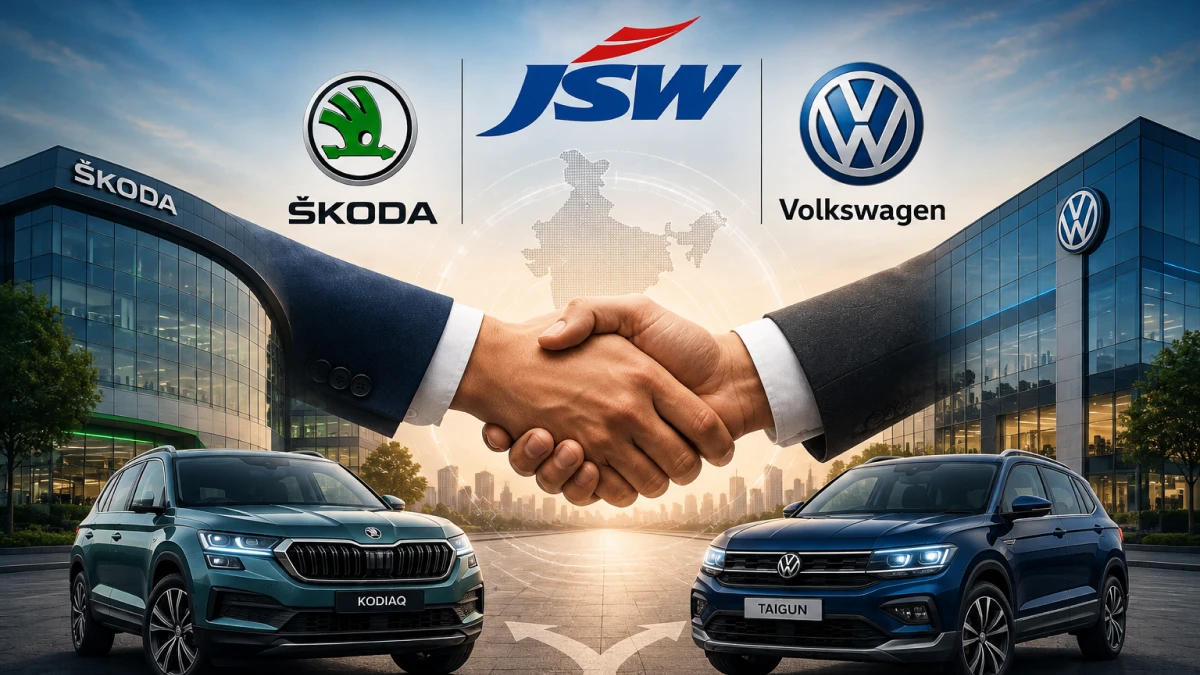
The Indian automotive landscape is witnessing a massive strategic consolidation. Sajjan Jindal-led JSW Green Mobility Limited and Czech automaker Skoda Auto a.s.(spearheading Volkswagen Group’s operations in India) have officially signed a non-binding Memorandum of Understanding (MoU).The partnership aims to establish a high-impact automotive joint venture to manufacture, market, and export passenger vehicles.
| Partnership Attribute | Overview & Key Strategic Metrics |
| Primary Entities | Skoda Auto a.s. (Volkswagen Group) & JSW Green Mobility Limited |
| Agreement Type | Non-Binding Memorandum of Understanding (MoU) |
| Proposed Equity Split | Exploring a 51:49 structure with JSW holding majority share |
| Powertrain Focus | ICE (Petrol/Diesel), Hybrid, Plug-in Hybrid (PHEV), & BEV |
| Core Target Markets | Indian Domestic Market & Global Export Hubs |
| Target Binding Date | Negotiations targeting a definitive agreement by late 2026 |
Expanding Horizons Across Multiple Powertrains
Unlike pure-play electric vehicle agreements, this alliance encompasses a comprehensive multi-powertrain model lineup. The proposed joint venture addresses immediate demand for traditional Internal Combustion Engine (ICE) vehicles while building out long-term infrastructure for sustainable energy mobility.
| Powertrain Variant | Strategic Role in the Joint Venture |
| ICE (Petrol & Diesel) | Maintains market share in mass-market SUVs and sedans across urban and rural tiers. |
| Hybrid Systems | Offers fuel-efficient transitional mobility options without relying strictly on charging infrastructure. |
| Plug-in Hybrids (PHEV) | Serves premium segments seeking long-range flexibility paired with zero-emission city commuting. |
| Battery Electric (BEV) | Drives long-term electrification efforts backed by localized battery and component supply chains. |
Elevating Localisation and R&D Capabilities
To remain competitive in India’s price-sensitive automotive ecosystem, Volkswagen Group and Skoda are targeting localized supply chains.Partnering with JSW allows Skoda Auto Volkswagen India Pvt Ltd (SAVWIPL) to reduce unit manufacturing expenses, hedge foreign exchange exposure, and build resilient domestic supply lines.
| Localisation Focus Area | Expected Strategic Impact |
| Manufacturing Scale | Leverages JSW’s raw material sourcing, steel manufacturing, and industrial facilities in Maharashtra. |
| Research & Development | Accelerates local R&D iterations tailored to Indian road conditions, climate factors, and consumer preferences. |
| Component Ecosystem | Minimizes reliance on imported kits (CKD/CBU), driving down retail pricing for high-volume segments. |
| Plant Capacity Utilisation | Maximizes capacity across existing SAVWIPL plants in Chakan (Pune) and Chhatrapati Sambhajinagar. |
Harnessing the India Main Platform (IMP) Architecture
A major technological cornerstone under evaluation is Volkswagen Group’s India Main Platform (IMP). Derived from the China Main Platform (CMP), the architecture is engineered specifically to suit emerging market costs, high local-content requirements, and structural road variances.
| Architecture Metric | Platform Strategy Highlights |
| Base Origin | Derived from Volkswagen Group’s China Main Platform (CMP). |
| Target Segments | Compact SUVs, mid-size crossovers, and localized electric sedans. |
| Cost Optimization | Designed for deep local component integration and high volume scale. |
| Future Adaptability | Engineered to support multi-energy variants alongside modular EV battery packs. |
Establishing India as a Global Automotive Export Base
The scope of this strategic alliance extends beyond domestic sales.Volkswagen Group plans to leverage India’s competitive manufacturing costs, skilled engineering talent, and favorable trade agreements to establish a regional production and export hub.
| Export Strategy Pillar | Strategic Objective |
| Cost Competitiveness | Capitalizes on competitive labor and tooling expenditures relative to European manufacturing plants. |
| Regional Supply Hub | Serves right-hand drive and emerging markets across Southeast Asia, Africa, and Latin America. |
| Trade Leverage | Capitalizes on evolving bilateral trade pacts between India and international economic blocs. |
| Logistical Efficiency | Utilizes coastal shipping access from Western Indian ports to streamline vehicle dispatches. |
Roadmap: Key Milestones Ahead
While the signing of this non-binding MoU marks a fundamental shift, both corporate entities are navigating valuation checks, regulatory clearances, and structural alignment.
| Milestone Stage | Target Objective |
| Valuation & Due Diligence | Auditing commercial assets, liabilities, and debt exposure. |
| Definitive Terms Agreement | Finalizing the exact equity distribution, governance clauses, and board structures. |
| Regulatory Approvals | Securing antitrust, anti-monopoly, and foreign investment clearances from Indian authorities. |
| Product Roadmap Rollout | Unveiling finalized vehicle models, production schedules, and capital allocations. |

