




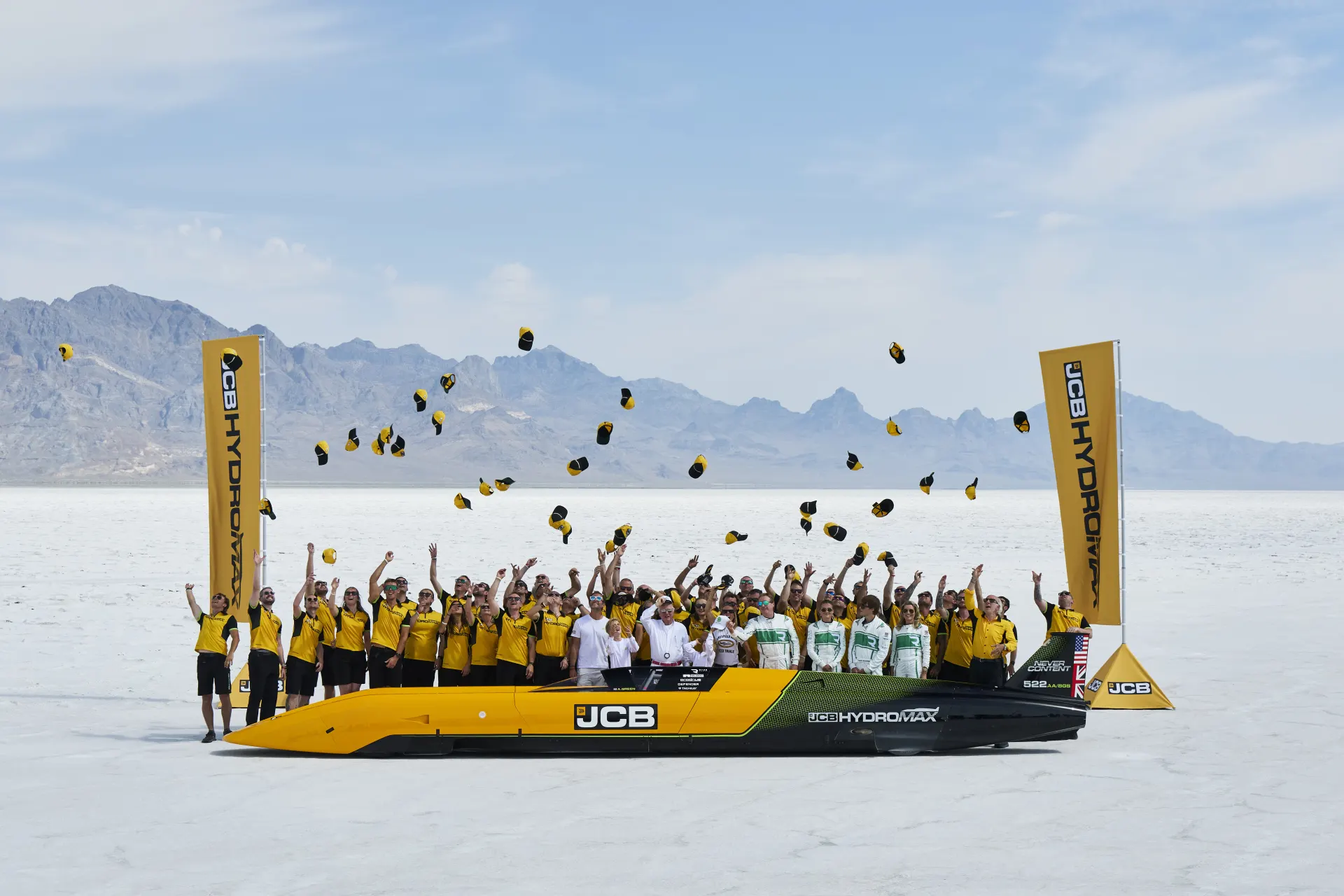
British industrial machinery manufacturer JCB has written a new chapter in automotive motorsport and zero-emission powertrain engineering. Operating on the salt crust of Utah’s legendary Bonneville Salt Flats in the USA, the custom-built JCB Hydromax speedster set an official world land speed record for a hydrogen-powered vehicle.Piloted by former Royal Air Force fighter pilot Wing Commander Andy Green, the twin-engine machine achieved a two-way average speed of 653.909 km/h (406.320 mph) over the flying mile.
Overseen and verified on-site by representatives from the Fédération Internationale de l’Automobile (FIA), the record-breaking run eclipses the previous hydrogen internal-combustion speed record of 298.53 km/h (185.5 mph) set by the BMW H2R in 2004. The achievement highlights the performance potential of hydrogen internal combustion engines (H2-ICE)—a technology JCB is developing to decarbonize heavy off-highway construction equipment.
1. Record Run Breakdown: The Physics of 406 mph on Salt
Achieving a recognized world land speed record under FIA regulations requires two consecutive runs in opposite directions over a measured 10-mile course within a strict one-hour window. This eliminates any speed advantage gained from tailwinds or surface gradients.
Assisted by a push-start from a Land Rover Defender OCTA to engage first gear at roughly 96 km/h (60 mph), Andy Green accelerated the 9.75-metre Hydromax across the Bonneville salt.On its outbound run, the car recorded 644.74 km/h (400.62 mph) through the timing traps between markers five and six.On the return pass in the opposite direction, the vehicle reached 663.26 km/h (412.14 mph).
The resulting two-way average of 653.909 km/h (406.320 mph) establishes the JCB Hydromax as the fastest hydrogen-powered vehicle of any kind in land speed history.During the full record pass, the Hydromax consumed just over 2.0 kg of compressed hydrogen gas while emitting approximately 18 litres of pure water vapor from its exhaust tailpipes.
The table below breaks down the run data and performance metrics recorded during the FIA record attempt at Bonneville:
| Record Run Parameter | Outbound Run 1 (Southbound) | Return Run 2 (Northbound) | FIA Verified Official Average | Comparative Historical Benchmark |
| Recorded Flying-Mile Speed | 644.74 km/h (400.62 mph) | 663.26 km/h (412.14 mph) | 653.909 km/h (406.320 mph) | 298.53 km/h (2004 BMW H2R Record) |
| Hydrogen Fuel Consumption | ~1.05 kg Hydrogen Gas | ~1.05 kg Hydrogen Gas | ~2.10 kg Total H2 Consumed | Zero fossil diesel / petrol fuel used |
| Water Vapor Tailpipe Output | ~9.0 Litres H2O | ~9.0 Litres H2O | ~18.0 Litres Pure Water Output | Zero CO2 / hydrocarbon emissions |
| Cooling Ice Requirement | 250 kg Fresh Crushed Ice | 250 kg Fresh Crushed Ice | 500 kg Ice Total (No Drag Intakes) | Replaces drag-inducing front radiators |
| Run Distance & Braking | 10 Miles Total Length | 10 Miles Total Length | Parachute Deployed at Mile 7 | Self-packed deceleration parachute |
2. Powertrain Architecture: From Diggers to 1,622 Horsepower
Unlike typical land speed vehicles that rely on custom racing engines or military surplus jet turbines, the JCB Hydromax is powered by two production-derived 4.8-litre 4-cylinder engine blocks.These engines share fundamental bottom-end architecture, crankshafts, and oil sumps with the standard JCB 448 engines used in commercial backhoe loaders, excavators, and telescopic handlers.
Developed in partnership with British motorsport and engineering group Prodrive, each 4.8-litre engine was converted from diesel to direct-injection hydrogen combustion.Modifications include redesigned cylinder heads, specialized spark plugs derived from Le Mans endurance racing cars, custom single-stage motorsport turbochargers designed to compensate for Bonneville’s high altitude and thin air, and recalibrated electronic control units (ECUs).
The two engines are mounted in-line along the chassis, with one dedicated to driving the front axle and the other driving the rear axle to form a four-wheel drive (4WD) system.Operating at over 4,000 rpm—double the maximum rotational speed of the standard industrial digger engine—each unit generates over 811 hp, providing a total system output of 1,622 hp.
The table below contrasts the technical specifications of the JCB Hydromax against JCB’s famous 2006 diesel record holder, the JCB Dieselmax:
| Engine & Vehicle Specification | JCB Hydromax (2026 Hydrogen Record) | JCB Dieselmax (2006 Diesel Record) | Engineering Evolution |
| Fuel Source / Combustion Type | Compressed Hydrogen Gas (H2-ICE) | Ultra-Low Sulfur Diesel (ICE) | Zero-carbon combustion transition |
| Engine Architecture & Count | Twin 4.8L 4-Cylinder JCB 448 Blocks | Twin 5.0L 4-Cylinder JCB 444 Blocks | Shares commercial digger crank/sump |
| Total Engine Displacement | 9.6 Litres Combined Capacity | 10.0 Litres Combined Capacity | High-efficiency displacement scaling |
| Combined System Horsepower | 1,622 hp @ 4,200 rpm | 1,500 hp @ 3,800 rpm | +122 hp power output gain |
| Transmission Architecture | Twin 6-Speed Xtrac Sequential Boxes | Twin 6-Speed Xtrac Sequential Gearboxes | Synchronized dual-axle drive delivery |
| Drivetrain Configuration | Mechanical Four-Wheel Drive (4WD) | Mechanical Four-Wheel Drive (4WD) | Balanced traction across salt crust |
| FIA Certified Record Speed | 653.909 km/h (406.320 mph) | 563.418 km/h (350.092 mph) | +90.49 km/h (+56.22 mph) faster |
3. Aerodynamics, Chassis Engineering, and Heat Management
Transmitting 1,622 horsepower to an unpaved, slippery salt surface at over 600 km/h presents significant engineering challenges. The Hydromax utilizes a hybrid chassis design: a steel-tube main frame chassis houses the long engine layout, while the driver sits within a high-rigidity carbon-fibre monocoque safety cell.
Key Aerodynamic and Mechanical Solutions:
- Underbody Salt Channels:The front nose section features sculpted underbody air channels engineered to direct loose surface salt away from the vehicle’s floorpan, reducing aerodynamic drag and underbody lift.
- Ice-Bucket Heat Exchanger System: Conventional radiator grilles create significant aerodynamic drag at speeds above 400 km/h. To eliminate drag-inducing cooling ducts, the Hydromax uses an internal thermal management system containing two tanks packed with 250 kg of crushed ice per run (500 kg total). Engine coolant circulates directly through these ice reservoirs during the two-minute run.
- Expanding High-Speed Tires:Commissioned specifically for the Hydromax project, the high-speed pneumatic tires expand in diameter due to centrifugal forces at speeds exceeding 600 km/h.To accommodate this tire growth without rubbing, JCB engineers reshaped and enlarged the front wheel arches prior to the Bonneville runs.
4. Legend Behind the Wheel: Andy Green’s Land Speed Trilogy
The record adds another milestone to the motorsport career of Wing Commander Andy Green. The 64-year-old former RAF fighter pilot remains the only person in history to officially break the sound barrier on land, having driven the twin-turbofan Thrust SSC to 1,227.985 km/h (763.035 mph / Mach 1.02) in October 1997.
Green’s partnership with JCB began 20 years ago when he piloted the JCB Dieselmax to 563.418 km/h (350.092 mph) at Bonneville in August 2006—a diesel land speed record that remains unbroken.By piloting the Hydromax to 653.909 km/h (406.320 mph), Green now holds world land speed records across three distinct powertrain eras: jet-thrust, diesel internal combustion, and hydrogen internal combustion.
The table below summarizes Andy Green’s historic land speed record achievements:
| Year of Record | Record Vehicle | Powertrain / Energy Technology | Official Certified Speed | Historical Significance / World First |
| 1997 | Thrust SSC | Twin Rolls-Royce Spey Turbofan Jets | 1,227.985 km/h (763.035 mph) | First and only supersonic land record (Mach 1.02) |
| 2006 | JCB Dieselmax | Twin 5.0L JCB Diesel ICE (1,500 hp) | 563.418 km/h (350.092 mph) | World’s fastest diesel-powered vehicle |
| 2026 | JCB Hydromax | Twin 4.8L JCB Hydrogen ICE (1,622 hp) | 653.909 km/h (406.320 mph) | World’s fastest hydrogen-powered vehicle |
5. Industrial Context: Why Hydrogen Combustion Matters for Heavy Machinery
While the 406 mph Hydromax speedster is a purpose-built land speed machine, the project serves a direct commercial purpose for JCB’s core construction and agricultural equipment business. Under the leadership of Chairman Lord Anthony Bamford, JCB has invested over £100 million in developing hydrogen internal combustion technology.
For heavy 20-tonne excavators, backhoe loaders, and agricultural telehandlers operating 12 hours a day on remote off-grid construction sites, heavy lithium-ion battery packs present operational limitations due to high weight, long charging times, and high initial costs.
Why Hydrogen ICE Benefits Heavy Equipment:
- Familiar Manufacturing & Service Infrastructure: Hydrogen ICE engines utilize existing manufacturing supply chains, casting facilities, block machining tools, and technician service networks.
- Rapid Jobsite Refueling: A hydrogen-powered excavator or backhoe loader can be refueled with compressed hydrogen gas in under 10 minutes from a mobile tanker, matching the operational uptime of traditional diesel plant machinery.
- Zero CO2 Tailpipe Emissions: Burning pure hydrogen gas in an internal combustion engine produces water vapor as its primary exhaust byproduct, completely eliminating carbon dioxide (CO2) emissions.
- No Rare-Earth Metal Reliance: Unlike hydrogen fuel cell stacks that require expensive platinum catalysts, hydrogen ICE engines rely on steel, aluminum, and standard engine alloys.
Industry Verdict: A Zero-Carbon Milestone
The JCB Hydromax setting an FIA-verified world hydrogen land speed record of 653.909 km/h (406.320 mph) demonstrates the performance capabilities of hydrogen combustion technology.By adapting its production digger engines to achieve over 1,600 horsepower on the Utah salt flats, JCB has established a high-profile showcase for hydrogen as a zero-carbon alternative to diesel power in heavy industry.
As commercial equipment manufacturers explore alternatives to fossil fuels, the Hydromax project highlights the potential of hydrogen internal combustion for demanding applications on land and on the jobsite.

