



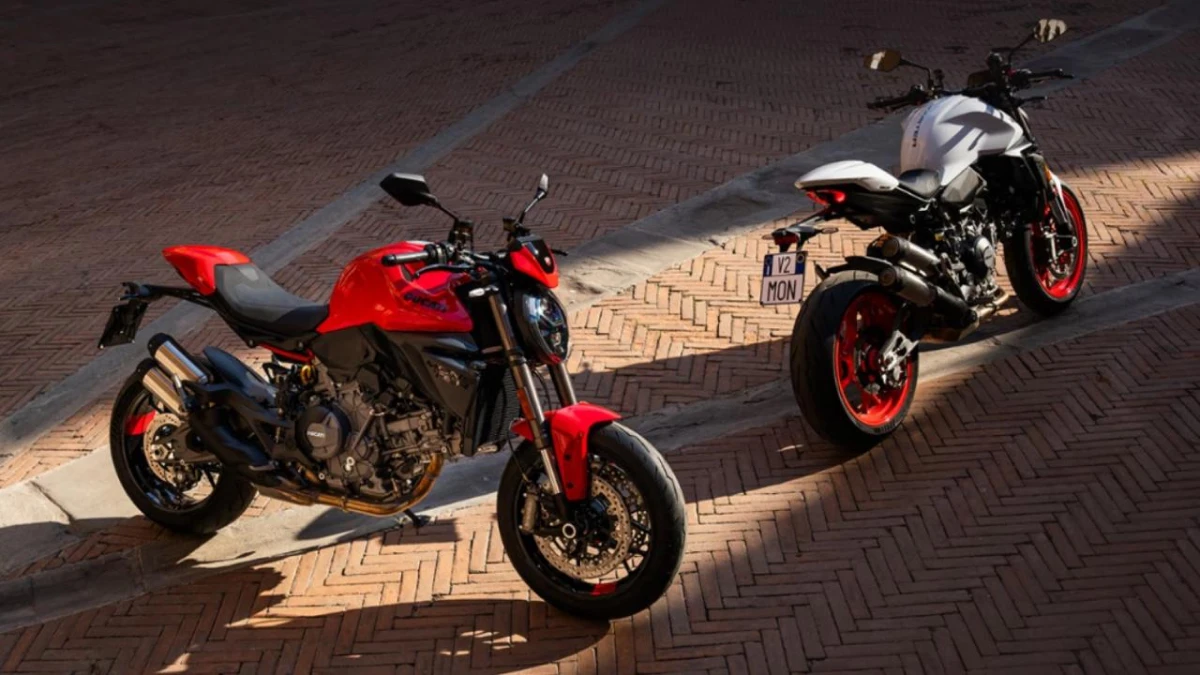
Ducati India has officially launched the fifth-generation 2026 Ducati Monster V2 and Monster+ V2 in the Indian market, with prices starting at ₹13.99 Lakh (ex-showroom). Representing a major evolutionary leap for the iconic middleweight naked roadster, the updated motorcycle debuts an all-new 890cc V-twin engine equipped with Intake Variable Timing (IVT), a lighter monocoque chassis, refined ergonomics, and an upgraded electronics package.
Carrying a modest ₹15,000 price increment over the outgoing 937cc model, the new Monster V2 delivers 111 HP while reducing total vehicle weight by 4 kg, bringing the wet weight without fuel down to 175 kg.
1. Variant Hierarchy, Color Options, and Ex-Showroom Pricing
The 2026 Ducati Monster V2 is available in two distinct trim levels: the Standard Monster V2 and the Monster+ V2. The Monster+ variant adds a color-matched headlight cowl and a quick-release passenger seat cover for a more aggressive, single-seat aesthetic.
Both variants are offered in three livery options: Ducati Red, Iceberg White, and Sport Livery.
The table below provides the full variant-wise and color-wise ex-showroom pricing structure across India:
| Variant Trim Level | Color / Livery Option | Ex-Showroom Price (Pan-India) | Added Equipment / Aesthetic Features |
| Monster V2 (Standard) | Ducati Red | ₹13,99,000 | Standard naked configuration, LED lighting, 5-inch TFT |
| Monster V2 (Standard) | Iceberg White | ₹14,23,000 | Iceberg White finish with red wheel accents |
| Monster V2 (Standard) | Sport Livery | ₹14,23,000 | Multi-tone graphics with sporty contrast striping |
| Monster+ V2 | Ducati Red | ₹14,34,000 | Adds aerodynamic headlight cowl & rear seat cowl |
| Monster+ V2 | Iceberg White | ₹14,45,000 | Premium White finish + cowl package |
| Monster+ V2 | Sport Livery | ₹14,45,000 | Top-spec graphics + headlamp cowl & rear seat cover |
2. Engine Architecture: 890cc V2 with Intake Variable Timing (IVT)
The headline engineering upgrade for the 2026 Monster V2 is its 890cc V2 engine—a platform shared with the latest Multistrada V2, Panigale V2, and Streetfighter V2 models. Despite a reduction in engine displacement compared to the outgoing 937cc Testastretta 11° unit, the new engine produces the same 111 HP while shaving 5.9 kg off the engine assembly alone.
Crucially, the introduction of Intake Variable Timing (IVT) continuously alters valve timing based on engine speed. This technology optimizes low-end torque delivery for urban city riding while extending the desmodromic valve clearance inspection interval to 45,000 km.
The table below contrasts the mechanical specifications of the new 890cc V2 engine against the outgoing 937cc Testastretta unit:
| Engine Metric / Parameter | Outgoing 937cc Testastretta Engine | New 890cc V2 Engine (2026 Model) | Operational & Technical Advantage |
| Displacement | 937 cc | 890 cc | 47 cc smaller, more compact crankcase design |
| Peak Horsepower | 111 HP @ 9,250 rpm | 111 HP (110 bhp) @ 9,000 rpm | Peak power achieved 250 rpm earlier |
| Peak Torque Output | 93.0 Nm @ 6,500 rpm | 91.1 Nm @ 7,250 rpm | Over 80% torque spread from 4,000–10,000 rpm |
| Engine Weight | Baseline Reference | 5.9 kg Lighter | Drastically reduces front axle mass loading |
| Valve Timing Mechanism | Fixed Desmodromic Timing | Intake Variable Timing (IVT) | Smoother low-RPM throttle response & reduced emissions |
| Valve Clearance Interval | 30,000 km | 45,000 km Inspection | 50% longer maintenance gap lowers cost of ownership |
| Transmission & Quickshifter | 6-Speed + DQS v1 | 6-Speed + Ducati Quick Shift (DQS) 2.0 | Bi-directional seamless gear shifts with revised sensors |
3. Chassis, Ergonomics, and Suspension Setup
The 2026 Monster V2 uses an aluminum monocoque frame attached directly to the cylinder heads, treating the 890cc V2 engine as a fully stressed structural member. At the rear, Ducati has fitted a new double-sided swingarm inspired by the hollow symmetrical aluminum swingarm used on the flagship Panigale V4.
Ergonomically, the seat height has been lowered by 5 mm to 815 mm, while the inner leg arch has been narrowed to make ground reach easier for shorter riders.The handlebar position has been moved higher and slightly forward to reduce wrist fatigue during long commutes.
The table below outlines the structural chassis dimensions, suspension components, and braking hardware of the 2026 Monster V2:
| Hardware / Geometry Head | Standard Specification | Optional / Accessory Adaptation |
| Frame Architecture | Aluminum Monocoque Chassis (Engine as stressed member) | Technopolymer & steel trellis rear subframe |
| Front Suspension | 43mm Showa Upside-Down (USD) Forks (130mm travel) | Non-adjustable factory setup tuned for street compliance |
| Rear Suspension | Showa Rear Monoshock (Preload adjustable, 160mm travel) | Paired with Panigale V4-derived double-sided swingarm |
| Front Braking System | Twin 320mm Discs with Brembo 4-Piston Radial Calipers | Radial master cylinder with cornering ABS support |
| Rear Braking System | Single 245mm Disc with Brembo 2-Piston Caliper | Integrated engine brake control intervention |
| Standard Seat Height | 815 mm | 795 mm (Low Seat) or 775 mm (Low Seat + Suspension Kit) |
| Tires & Wheel Package | 17-inch Cast Alloy Wheels (120/70 ZR17 Front, 180/55 ZR17 Rear) | Wrapped in Pirelli Diablo Rosso IV sport tires |
| Vehicle Wet Weight | 175 kg (Without Fuel) | 4 kg total reduction compared to outgoing model |
4. Electronics, Riding Modes, and Driver Assistance Suite
The 2026 Ducati Monster V2 is equipped with a six-axis Inertial Measurement Unit (6-axis IMU) that processes pitch, roll, and yaw angles in real-time to adjust rider assistance parameters.
Instrumentation is managed via a 5-inch full-color TFT display (16:9 aspect ratio, 800×400 resolution) with revised menu graphics.
Key Electronic Features & Rider Aids:
- Four Selectable Riding Modes:Sport, Road, Urban, and Wet (adjusts throttle response, peak power output, and safety interventions).
- Ducati Traction Control (DTC) & Wheelie Control (DWC): Multi-level lean-sensitive traction control and front-wheel lift mitigation.
- Cornering ABS (Bosch Electronics): Three-level anti-lock braking system preventing wheel lockup while leaned over in turns.
- Engine Brake Control (EBC): Prevents rear-wheel lockup or hop under aggressive downshifts.
- Ducati Quick Shift (DQS) 2.0: Clutchless upshifts and downshifts operating across all engine speed bands.
- Connectivity Options: Factory-ready for the Ducati Multimedia System (DMS), turn-by-turn navigation alerts, and cruise control.
5. Maintenance Contracts: Ducati Protect+ and Protect Pro Plans
Addressing traditional ownership cost concerns associated with Italian performance motorcycles, Ducati India has introduced prepaid periodic maintenance contracts alongside the launch of the Monster V2.
The table below outlines the coverage, duration, and pricing of Ducati’s prepaid service contracts:
| Maintenance Package Name | Package Price (INR) | Validity Period / Mileage Limit | Included Service Coverages |
| Ducati Protect+ | ₹30,999 | 2 Years or 15,000 km | Scheduled engine oil services, oil filters, genuine parts & labor |
| Ducati Protect Pro | ₹54,999 | 4 Years or 30,000 km | Extended coverage including routine inspection labor & fluids |
| Standard Factory Warranty | Included Free | 2 Years / Unlimited Mileage | Full bumper-to-bumper manufacturing defect coverage |
*Note: Consumables such as brake pads, tires, drive chains, and clutch friction plates are excluded from routine prepaid maintenance plans.
6. Competitive Matrix: Ducati Monster V2 vs. Middleweight Naked Rivals
The ₹13.99 Lakh launch price positions the 2026 Ducati Monster V2 against established middleweight streetfighters in India, including the inline-four Kawasaki Z900, the triple-cylinder Triumph Street Triple R, and the twin-cylinder BMW F 900 R.
The table below contrasts the 2026 Ducati Monster V2 against its primary middleweight naked rivals:
| Parameter / Feature | Ducati Monster V2 | Triumph Street Triple R | Kawasaki Z900 | BMW F 900 R |
| Engine Type | 890cc V2 Twin (IVT) | 765cc Inline 3-Cylinder | 948cc Inline 4-Cylinder | 895cc Parallel-Twin |
| Peak Power Output | 111 HP @ 9,000 rpm | 120 HP @ 11,500 rpm | 125 HP @ 9,500 rpm | 105 HP @ 8,500 rpm |
| Peak Torque Output | 91.1 Nm @ 7,250 rpm | 80.0 Nm @ 9,500 rpm | 98.6 Nm @ 7,700 rpm | 92.0 Nm @ 6,500 rpm |
| Wet Weight (No Fuel) | 175 kg | 189 kg (Kerb) | 212 kg (Kerb) | 211 kg (Kerb) |
| 6-Axis IMU Suite | Yes (Standard) | Yes (Standard) | No (Basic Traction Control) | Optional (Riding Modes Pro) |
| Quickshifter System | Bi-Directional DQS 2.0 | Bi-Directional Triumph Shift | Accessories Extra | Optional (Shift Assist Pro) |
| Starting Price (Ex-S/R) | ₹13.99 Lakh | ₹10.43 Lakh | ₹9.38 Lakh | ₹10.80 Lakh |
Buyer Verdict: Is the 2026 Ducati Monster V2 Worth the Price?
The 2026 Ducati Monster V2 combines accessible ergonomics, reduced chassis weight, and a flexible 890cc V2 engine with Intake Variable Timing. By lowering the seat height to 815 mm, expanding valve inspection intervals to 45,000 km, and offering prepaid Ducati Protect maintenance plans, Ducati has addressed core practical ownership factors while maintaining middleweight performance.
For riders seeking an Italian naked roadster equipped with 6-axis IMU electronics, high-end Brembo braking hardware, and sharp handling, the new Monster V2 represents a refined package in the sub-₹15 Lakh motorcycle class. Bookings are officially open across all authorized Ducati India dealerships.

