





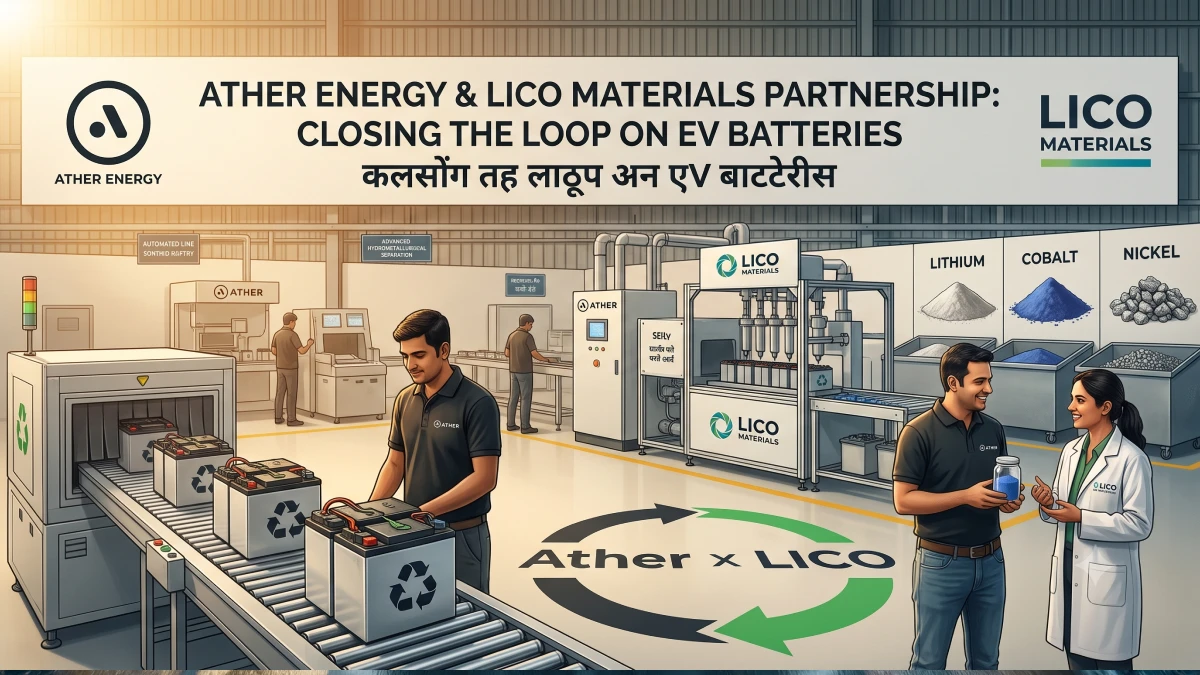
As India’s electric vehicle (EV) revolution accelerates, a critical question looms over the industry: What happens to electric vehicle batteries when they reach the end of their usable life?
With no major domestic reserves of rare-earth minerals like lithium, cobalt, and nickel, India’s green transition is heavily vulnerable to global supply chains and import reliance. To address this challenge, premium electric two-wheeler pioneer Ather Energy has announced a strategic partnership with Gurugram-based critical material recovery specialist BatX Energies.
This collaboration establishes a structured, highly advanced recycling ecosystem designed to harvest end-of-life lithium-ion battery packs from Ather’s fleet, ensuring they are safely processed, refined, and reintroduced into India’s domestic battery manufacturing pipeline.
Decoupling the Partnership: Logistics, Technology, and Targets
The partnership is built on an Extended Producer Responsibility (EPR) framework. Rather than allowing dead battery modules to end up in landfills, Ather will systematically retrieve degraded packs from its service network and channel them directly to BatX’s advanced hydro-metallurgical facilities.
The detailed structural matrix below highlights the key operational parameters, technology profiles, and recovery expectations of this clean-tech alliance:
| Recycle Parameter & Targets | Standard Battery Disposal (Conventional) | Ather & BatX recycling Alliance (Advanced) |
| Primary Process Tech | Pyrometallurgy (Smelting / High-Heat) | Hydrometallurgy (Low-Emission Leaching) |
| Material Recovery Efficiency | 70% – 80% (Lithium is lost in the slag) | Up to 95% overall material recovery |
| Carbon Footprint Impact | High greenhouse gas emissions | Net-Zero Waste & near-zero emissions process |
| Key Recovered Materials | Standard Copper, Aluminum, and Steel | Battery-grade Lithium, Cobalt, Nickel, and Manganese |
| Target Battery Chemistries | Limited to specific high-cobalt chemistries | Universal (NMC, LFP, and customized cell setups) |
| Regulatory Compliance | Basic waste disposal standards | Strict alignment with Battery Waste Management Rules 2022 |
| Supply Chain Destination | Landfill or low-grade downcycled plastics | Direct re-entry to local cell manufacturers & OEMs |
Why Hydrometallurgy Wins: The Science of Clean Extraction
Most traditional, large-scale battery recycling operations rely on pyrometallurgy, which uses extreme furnace heat exceeding 1,400°C to melt down battery components. While fast, this method is energy-intensive and vaporizes valuable lithium, leaving it trapped in the leftover slag.
To avoid this waste, BatX utilizes an in-house developed, closed-loop hydrometallurgical process.
- Discharge & Dismantling: The depleted battery packs are fully discharged and carefully stripped of their outer aluminum and plastic casings.
- Shredding to “Black Mass”: The inner cells are crushed under a controlled atmosphere to produce a fine, dark powder known as “black mass”.
- Acid Leaching: The black mass is treated with chemical solvents to dissolve and isolate individual elements.
This chemistry-first approach allows BatX to pull out high-purity, battery-grade Lithium Carbonate and Nickel/Cobalt sulfates—all while keeping processing emissions incredibly low.
The Regulatory Clock: Extended Producer Responsibility (EPR)
India’s regulatory stance on electronic waste is tightening rapidly. Under the Battery Waste Management Rules (BWM), 2022, EV manufacturers are legally responsible for the entire lifecycle of the batteries they put on the market. This means OEMs must guarantee that a fixed percentage of their sold battery weight is collected and recycled year over year. By partnering with BatX, Ather Energy is proactively cementing its compliance, ensuring it stays ahead of strict government audits while building a transparent, trackable waste management ledger.
Securing India’s Battery Sovereignity
For India, battery recycling is not just an environmental obligation; it is a critical geostrategic necessity. The country currently imports almost all of its raw lithium and finished lithium-ion cells, leaving the domestic EV industry highly vulnerable to international market shocks, mining shortages, and trade policies.
Feeding recovered, high-purity minerals back into India’s domestic manufacturing ecosystem acts as an urban mining network. Every gram of lithium saved from an old Ather 450X battery pack is a gram of lithium that does not need to be mined abroad, effectively driving down the cost of building next-generation electric vehicles right here in India.
Final Takeaway
Ather Energy’s alliance with BatX Energies shows that true sustainability goes far beyond tailpipe emissions. Real environmental stewardship requires a highly circular approach where a vehicle’s end is simply the beginning of the next one. By investing in premium, closed-loop recycling, Ather is helping pave the way toward an independent, self-reliant, and truly green Indian EV industry.
To see a step-by-step breakdown of how dead EV battery packs are safely dismantled, witness the shredding of lithium-ion cells into “black mass,” and hear the founders discuss India’s battery future, watch our Exclusive Ather & BatX Energies Battery Recycling Plant Walkthrough Video.

