


India’s luxury automotive landscape is shifting rapidly, but the name at the top of the leaderboard remains unchanged. Mercedes-Benz India has firmly defended its crown as the country’s dominant luxury carmaker, closing out the first half (H1) of calendar year 2026 with historic registration metrics.
According to official half-yearly sales reports, the German auto giant retailed a record-breaking 9,768 units between January and June 2026, capturing a steady 9% year-on-year (YoY) growth. Despite luxury vehicle price revisions and fluctuating raw material supply chains, a strong surge in the second quarter (Q2)—accounting for 4,637 retail units—propelled the brand to its strongest-ever first-half performance in Indian automotive history.
Mapping the Portfolio: Core Pillars of the H1 2026 Performance
The secret behind Mercedes-Benz’s sustained market dominance lies in a highly defensive product portfolio strategy. While rival brands rely heavily on entry-level models to inflate their numbers, Mercedes-Benz has seen intense growth at the absolute top end of its hierarchy.
To give your premium auto blog readers a transparent look at the current sales mix and segment performance, the matrix below details the three strategic pillars that anchored the brand’s H1 2026 volume:
| Portfolio Segment | Volume Contribution Share | YoY Growth Sub-Trend | Key Performance Drivers & Anchor Models | Market Dynamics & Consumer Behavior |
| 1. The Core Segment | ~58% of Total Volume | Steady / Volume Backbone | E-Class Long-Wheelbase (LWB), C-Class, GLC, GLE | The LWB E-Class continues to hold the undisputed title of India’s overall best-selling luxury model. |
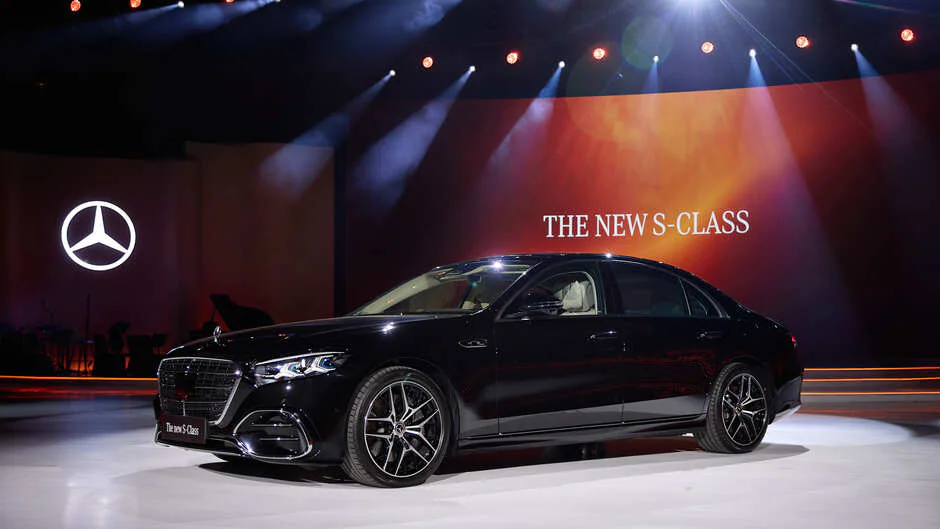
| 2. Top-End Luxury (TEV) | 28% of Total Volume (All-Time High) | +20% Segment Surge | S-Class, Mercedes-Maybach, AMG Fleet, V-Class | Chauffeur-driven buyers and performance purists are heavily scaling up to high-margin custom flagships. |
| 3. Battery Electric (BEV) | 14% of Total Sales Mix (Q2) | Double EV Penetration | New CLA BEV, Flagship EQS SUV | Clean energy adoption has gone mainstream in the metro cities; top-end EVs made up 25% of all high-end sales. |
Structural Trajectories Redefining the Luxury Experience
Three profound trends emerged from the luxury automaker’s mid-year dispatches, indicating where the high-net-worth individual (HNWI) automotive budget is heading:
- The E-Class Monarchy Remains Absolute: Even with luxury buyers actively pivoting toward versatile monocoque utility vehicles, the locally assembled E-Class Long-Wheelbase (LWB) remains the single highest-selling luxury vehicle in the country. High demand for the top-tier E 450 variant shows that rear-seat luxury and highway ride comfort still take top priority over SUV road presence.
- A Massive Surge in AMG Performance Track Dynamics: Performance-focused Mercedes-AMG vehicles recorded an astonishing 50% growth trajectory in H1 2026. This reflects an evolving, younger demographic of ultra-premium buyers who favor high-performance track dynamics alongside everyday executive usability.
- The EQS SUV Leads the Premium EV Charge: In the pure electric space, the localized assembly of the EQS SUV has paid off handsomely. Priced at ₹1.34 crore onwards, it has officially overtaken smaller platforms to become the highest-selling luxury electric vehicle in the brand’s stable, backed closely by the newly launched CLA electric sedan, which completely sold out its initial allocation within days of debut.
The Network Expansion Angle: To sustain this momentum into the high-volume festive quarters, Mercedes-Benz India is actively rolling out a ₹450 crore retail expansion plan alongside franchise partners. The strategy focuses heavily on entering tier-2 and tier-3 emerging luxury hubs—such as an upcoming flagship experience store debuting in Varanasi by Q3 2026.
Final Thoughts
Mercedes-Benz’s H1 2026 numbers reveal an industry insulated from broader entry-level market corrections. By managing an orderly transition from traditional internal combustion engines to hybrid and electric architectures without compromising brand equity, the three-pointed star has built a highly defensive moat. As order backlogs for flagship models like the S-Class PHEV and AMG variants remain packed well into the winter season, Mercedes-Benz enters the second half of the year in an optimal position to retain its market crown.

