





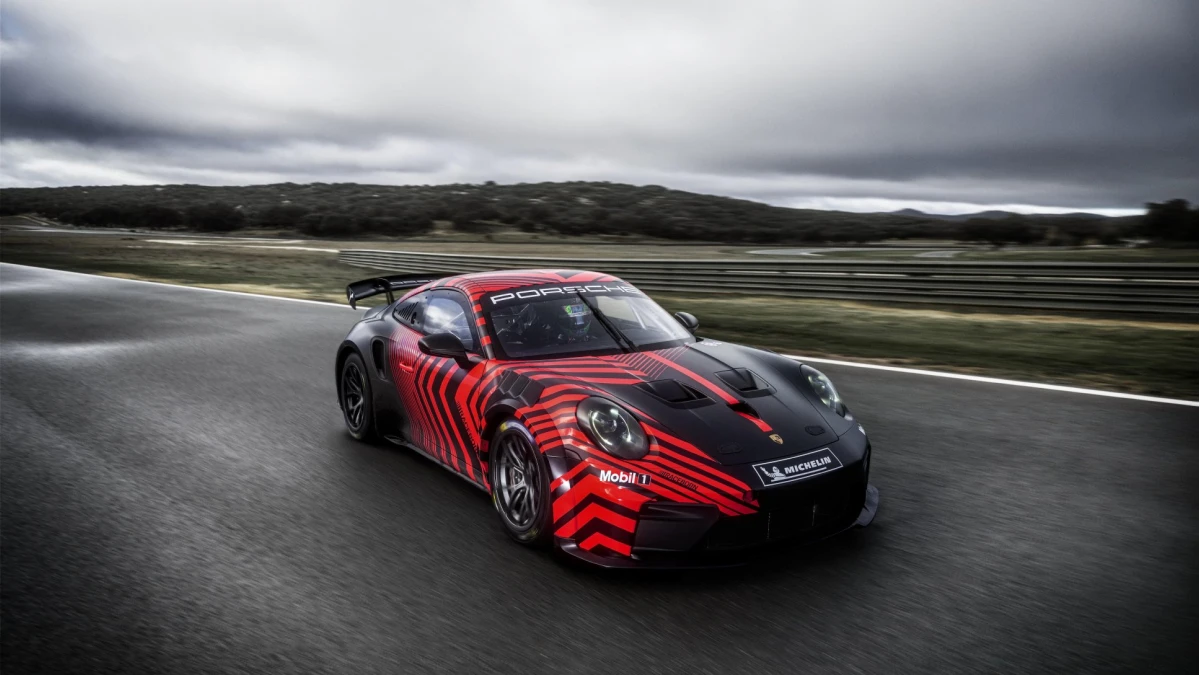
For nearly a decade, if you wanted to go GT4 racing with a Porsche crest on your hood, you drove a Cayman. The mid-engine 718 Cayman GT4 RS Clubsport was the undisputed king of the entry-level customer racing pyramid, praised for its forgiving balance and predictable handling. But with the internal combustion Cayman effectively driving off into the sunset, Porsche faced a fascinating dilemma: what comes next?
The answer is something purists have dreamed about for years. Enter the brand-new Porsche 911 GT4 R—marking the very first time Stuttgart has homologated its flagship rear-engine icon for the globally competitive GT4 category.
Hand-Me-Downs from the Big Brother
Instead of building a new GT4 car from the ground up, Porsche Motorsport took a brilliantly pragmatic approach. They based the GT4 R directly on the world’s most successful one-make race car: the current 992.2-generation 911 GT3 Cup.
Sitting behind the rear axle is the exact same naturally aspirated 4.0-liter flat-six engine. Left entirely unrestricted, this screamer pushes out an aggressive 520 horsepower and 470 Nm of torque. However, because GT4 is a heavily regulated, Balance of Performance (BoP) class, Porsche has to ensure parity against rivals like the McLaren Artura and Ford Mustang GT4. Straight from the factory, the engine is fitted with 53.7-millimeter air restrictors, safely capping output at 430 horsepower.
Power is sent to the rear wheels via a raw, lightning-fast six-speed sequential dog gearbox, operated by steering-wheel paddle shifters and a heavy-duty four-disc racing clutch.
A Radical Change in Driving Dynamics
The shift from the Cayman to the 911 isn’t just a cosmetic upgrade; it fundamentally alters the physics of how teams will race.
Privateer “gentleman” drivers loved the mid-engine Cayman because it rarely snapped unexpectedly at the limit. The 911’s rear-engine layout demands a completely different driving style. Drivers will have to master the car’s signature pendulum effect—trail-braking deep into the apex to keep weight pinned to the front tires, before exploiting the massive rear-engine traction to rocket out of corners. It requires more skill to tame, but it unlocks a significantly higher performance ceiling.
To help drivers manage this, the GT4 R utilizes dual-adjustable dampers and three selectable spring rates, creating a suspension setup that is slightly softer and far more approachable than a pure GT3 machine.
The 911 GT4 R Engineering Blueprint
Here is a quick breakdown of the hardware customer racing teams are getting for the upcoming season:
| Technical Specification | 2027 Porsche 911 GT4 R |
| Structural Foundation | Type 992.2 911 GT3 Cup |
| Engine Configuration | 4.0-Liter Naturally Aspirated Flat-Six |
| Peak Output (Unrestricted) | Up to 520 HP / 470 Nm |
| GT4 Regulated Output (BoP) | 430 HP (via 53.7mm air restrictors) |
| Transmission Setup | 6-Speed Sequential Dog-Box |
| Aerodynamics | 11-Position Manually Adjustable Rear Wing |
| Wheel Mounting | 5-Lug Pattern (Replaces Center-Lock) |
| Estimated Turnkey Price | ~$375,500 (US Market) |
Sustainable Speed: The Eco-Composite Body
One of the most fascinating engineering details on the GT4 R isn’t the engine—it’s the bodywork. To hit their strict weight targets while keeping replacement part costs down for privateer teams, engineers largely abandoned traditional carbon fiber.
Instead, they leaned into extensive use of natural-fiber-reinforced plastic bound with epoxy resin. You’ll find this lightweight, sustainable composite making up the doors, the engine cover, the massive rear wing, and several key interior cockpit panels.
Inside, the cabin is strictly business. Drivers are locked into a full FIA-spec roll cage and face a crisp 10.3-inch color digital display. A built-in data logger and high-precision GPS system come standard, allowing pit walls to instantly download telemetry and analyze driver performance sector-by-sector.
The Bottom Line for Privateers
Priced at roughly $375,500, the 911 GT4 R is a serious financial commitment, but in the realm of turnkey factory race cars, it offers incredible value. The shift to the 911 platform ensures teams get a wider track, vastly improved structural rigidity, and more advanced motorsport electronics than the Cayman ever offered.
Set to make its competition debut in the 2027 IMSA Michelin Pilot Challenge and global SRO series, this car isn’t just a replacement model. It is a massive upgrade that brings the legendary dynamics of the 911 down to a highly accessible, fiercely competitive tier of global motorsport.

