




For the past few years, Nissan India’s domestic portfolio has relied almost entirely on a single volume driver: the Magnite compact crossover. While the upcoming Gravite MPV has started expanding the brand’s footprint, the Japanese automaker has desperately needed a heavy hitter in the country’s most cutthroat segment. That silence is officially breaking. Nissan has released a highly revealing teaser for its upcoming midsize contender, officially christened the Nissan Tekton.
Scheduled for its highly anticipated global debut on July 9, 2026, the Tekton is being aggressively marketed under a bold internal moniker: the “Baby Patrol.” By tying its newest family vehicle directly to the legendary legacy of its full-sized luxury off-roader, Nissan is attempting to capture the imagination of buyers who favor rugged lifestyle dynamics over soft, city-slicker styling.
Visual Stance: Inheriting the Flagship DNA
While the Tekton shares its high-tensile CMF-B platform and basic proportions with the upcoming next-generation Renault Duster, Nissan’s design team under Alfonso Albaisa has gone to extreme lengths to establish an independent, highly commanding identity.
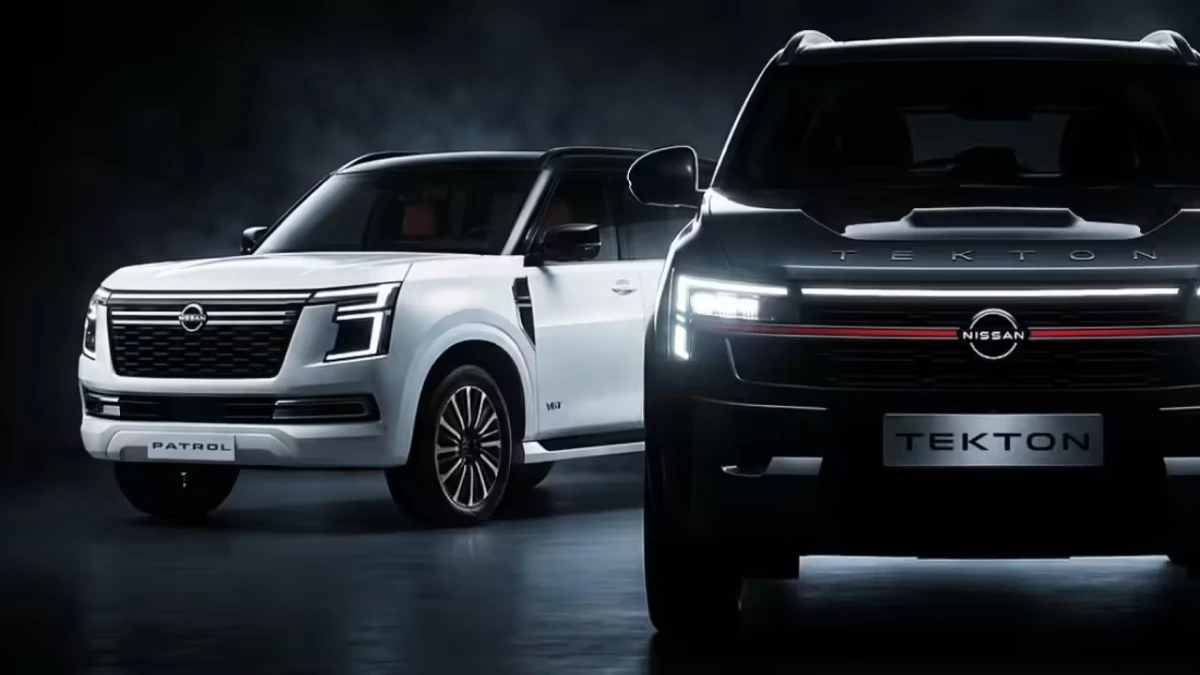
The latest official preview shows the Tekton parked right alongside the flagship Patrol, making its styling inspirations crystal clear. The front end drops the rounded curves of previous Nissan crossovers for an upright, squared-off fascia. It features an imposing multi-slat front grille sliced by an illuminated red horizontal accent strip, with prominent “TEKTON” lettering stamped across the sculpted bonnet lines.
The lighting signature is modern, showcasing full-width connected LED daytime running lights linked to L-shaped main projector units.
The side profile leans heavily into a rugged, muscular stance. It utilizes bold shoulder lines, high 212mm ground clearance, and 18-inch dual-tone alloy wheels.
Interestingly, the rear doors feature C-pillar-integrated handles, giving the side profile a seamless, aerodynamic look.
At the back, the vehicle utilizes a unique twin-ridge roof spoiler and distinctive C-shaped connected tail-lamps that mirror the heavy-set rear design of the premium global Patrol.
Inside, the cabin shifts toward a premium tech environment. The multi-layered dashboard features high-end gloss black panels highlighted by warm copper accents. Drivers are greeted by a fully digital 10.25-inch instrument cluster and a floating 10.1-inch infotainment screen running Google built-in software.
Premium cabin comforts are extensive, including a panoramic sunroof, ventilated front seats, dual-zone automatic climate control, a 360-degree camera array, and a full Level 2 Advanced Driver Assistance Systems (ADAS) safety suite.
Powertrain Architecture: Turbocharged Choices and Hybrid Efficiency
Mechanically, the Tekton leverages its global alliance underpinnings to offer a highly diverse, all-turbocharged engine lineup. This strategy allows it to target budget-conscious urban commuters and performance enthusiasts simultaneously.
The entry-level configuration utilizes a highly efficient 1.0-litre three-cylinder turbocharged petrol engine, delivering a practical 100 PS of power and 160 Nm of torque via a traditional 6-speed manual gearbox.
For buyers demanding stronger highway performance and effortless overtaking capability, Nissan offers a high-performance 1.3-litre four-cylinder turbo-petrol unit. Co-developed with Mercedes-Benz, this engine pumps out a healthy 163 PS of power and 280 Nm of peak torque, available with either a 6-speed manual or a lightning-fast 7-speed dual-clutch transmission (DCT).
Furthermore, to take the fight directly to segment leaders, Nissan is evaluating a highly advanced 1.8-litre strong-hybrid petrol powertrain. This system pairs a smooth naturally aspirated engine with an electric motor and a 1.4kWh lithium-ion battery, yielding a combined system output of 160 HP and delivering exceptional, city-friendly fuel efficiency figures.
Competitive Midsize Segment Analysis
When it launches in July, the Nissan Tekton will enter a highly crowded segment, facing rivals ranging from refined city crossovers to fuel-efficient hybrids.
| SUV Competitor | Engine Alternatives | Peak Power Output Range | Transmission Options | Notable Tech & Cabin Features | Estimated Base Price Range |
| Nissan Tekton | 1.0L Turbo / 1.3L Turbo / 1.8L Hybrid | 100 PS to 163 PS | 6-speed MT / 7-speed DCT / e-CVT | Google Built-in, Panoramic Sunroof, Level 2 ADAS | ₹10.50L – ₹18.00L |
| Hyundai Creta | 1.5L NA / 1.5L Diesel / 1.5L Turbo | 115 PS to 160 PS | 6-speed MT / IVT / 6-speed AT / 7-speed DCT | Dual 10.25-inch screens, Ventilated seats, ADAS | ₹11.00L – ₹20.15L |
| Maruti Grand Vitara | 1.5L Mild Hybrid / 1.5L Strong Hybrid | 103 PS to 116 PS | 5-speed MT / 6-speed AT / e-CVT | AllGrip AWD, Heads-Up Display, 360 Camera | ₹10.99L – ₹20.09L |
| Tata Sierra (Upcoming) | Turbo Petrol / Pure Electric (EV) | TBD | Manual / Automatic / Single-speed EV | Minimalist lounge seating, Digital cockpit | ₹12.00L – ₹22.00L |
Strategic Market Takeaway
The “Baby Patrol” positioning is an exceptionally smart marketing play by Nissan India. Instead of attempting to out-feature the Hyundai Creta or beat Maruti Suzuki purely on fuel economy, the Tekton carves out a highly unique niche based on rugged pedigree, mechanical strength, and authentic SUV styling.
If Nissan can price the production model competitively within the estimated ₹10.50 lakh to ₹18 lakh bracket while delivering on its promised hybrid efficiency, the Tekton could very well become the definitive comeback vehicle the brand needs to reclaim its share of the Indian automotive market.

