




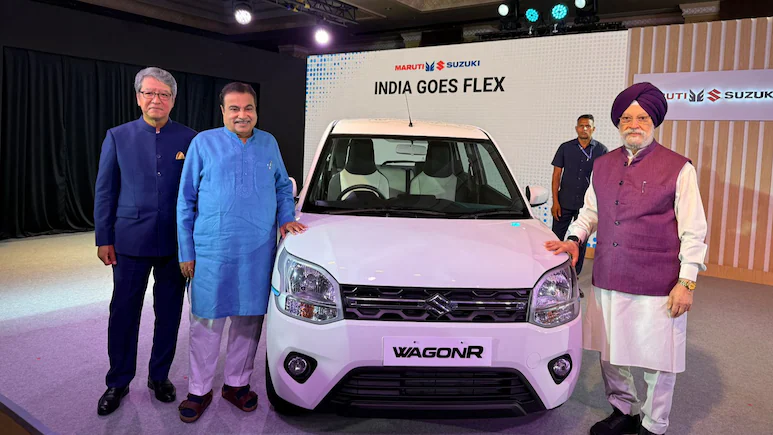
The Indian automotive sector has officially crossed a major technological milestone on its path toward sustainable mobility. Maruti Suzuki has made history by introducing the WagonR Flex-Fuel, cementing its position as the first automobile manufacturer in India to put a mass-market, flex-fuel passenger car into production.
Built on India’s favorite tall-boy hatchback platform, this specialized WagonR is engineered from the factory floor to run seamlessly on ethanol-gasoline blends ranging anywhere from E20 (20% ethanol) all the way up to E85 (85% ethanol). By moving this technology from an experimental motor show concept straight onto the assembly line, Maruti Suzuki is providing the industrial muscle needed to kickstart the government’s alternative fuel roadmap.
Maruti WagonR Flex-Fuel vs. Standard WagonR Petrol: The Key Differences
To understand exactly how Maruti Suzuki has adapted its highest-selling hatchback for high-blend bio-ethanol fuels, we have mapped the core technical and operational shifts below:
| Technical & Performance Metric | Standard Maruti WagonR 1.2L | New Maruti WagonR Flex-Fuel (Production Spec) |
| Compatible Fuel Blends | Up to E20 (Standard Indian Petrol) | Highly Flexible: E20 all the way to E85 |
| Engine Architecture Type | 1.2L K12N Four-Cylinder DualJet | Modified 1.2L K12N DualJet Flex-Fuel Engine |
| Material Protection | Standard anti-corrosion lines | Nickel-plated components & stainless steel lines |
| Fuel Delivery Infrastructure | Baseline multi-point injection | High-flow injectors with heated fuel rail options |
| Fuel Chemistry Detection | Standard oxygen sensors in exhaust | Advanced inline electronic Ethanol Content Sensor |
| Engine Management (ECU) | Fixed mapping for standard fuel | Dynamic, self-adjusting real-time ECU calibration |
| Primary Target Audience | Budget-focused urban commuters | Eco-conscious buyers & high-mileage fleet owners |
Under the Skin: Critical Engineering Upgrades for Ethanol Compliance
You cannot run a standard internal combustion engine on high-blend ethanol without causing catastrophic mechanical failure within a few thousand kilometers. Because ethanol is highly hygroscopic—meaning it actively absorbs moisture from the air—and naturally corrosive to raw aluminum and standard rubber, Maruti Suzuki had to completely overhaul the WagonR’s fuel delivery system.
1. Robust Material Reinforcement
To counter the corrosive nature of alcohol, engineers swapped out standard rubber hoses and plastic fuel rails for high-grade, nickel-plated components and specialized stainless steel fuel lines. The fuel tank itself has been reinforced with unique polymers to prevent moisture contamination over long periods of parking.
2. High-Flow Fuel Injectors & Pumps
Ethanol has a lower energy density than pure fossil fuel, requiring more volume to be sprayed into the cylinders to achieve a perfect combustion stroke. Maruti integrated an upgraded, high-volume fuel pump alongside high-flow injectors. These components handle the increased fuel demand effortlessly while keeping engine performance snappy.
3. Smart Sensors & Real-Time ECU Remapping
The absolute brain of the car is its new inline Ethanol Content Sensor. This sensor instantly reads the chemical ratio of the fuel coming from the tank and flashes the data to a re-calibrated Engine Control Unit (ECU). Whether you fill up with standard E20 petrol or pure E85 flex-fuel, the ECU automatically adjusts spark timing and injection duration on the fly to maximize thermal efficiency.
Driving Dynamics and Economic Viability
Under the hood, the vehicle utilizes a heavily modified version of the trusted 1.2-litre K12N DualJet four-cylinder petrol engine. In its standard state, this engine pushes out a refined 89 hp and 113 Nm of torque.
When running on high-blend E85 fuel, drivers can expect the exact same smooth power delivery and crisp low-end torque that the K-Series engine is famous for. While running on E85 naturally results in a minor drop in overall fuel efficiency due to ethanol’s lower energy density, this drop will be heavily offset at the pump. With the government planning a deeply subsidized, low-cost pricing model for E85 fuel, your cost-per-kilometer is expected to fall significantly below traditional petrol hatchbacks.
Why This Matters: A Historic Shift for Indian Motoring
The commercial rollout of a production flex-fuel WagonR carries massive strategic value for India’s macroeconomy. Currently, India spends enormous amounts of foreign exchange reserves importing global crude oil. Switching high-volume passenger cars to bio-ethanol—which is produced natively from sugarcane molasses and agricultural waste—keeps energy spending directly inside the country.
A Win for Farmers: This technology acts as a direct financial bridge to India’s rural economy. By creating an immense, highly stable automotive demand for ethanol, Maruti Suzuki is helping secure a predictable livelihood for millions of local sugarcane and grain farmers.
Market Launch and Future Outlook
With production-ready validation trials completed successfully, Maruti Suzuki is preparing to scale up manufacturing as the nationwide E85 refueling infrastructure rolls out across major urban centers.
By utilizing the highly affordable and trusted WagonR brand as its launch pad, Maruti is ensuring that green technology isn’t restricted to expensive premium imports. Instead, it places sustainable, low-cost motoring directly into the hands of mass-market car buyers, clearing a wide path for widespread ethanol vehicle adoption across India.

